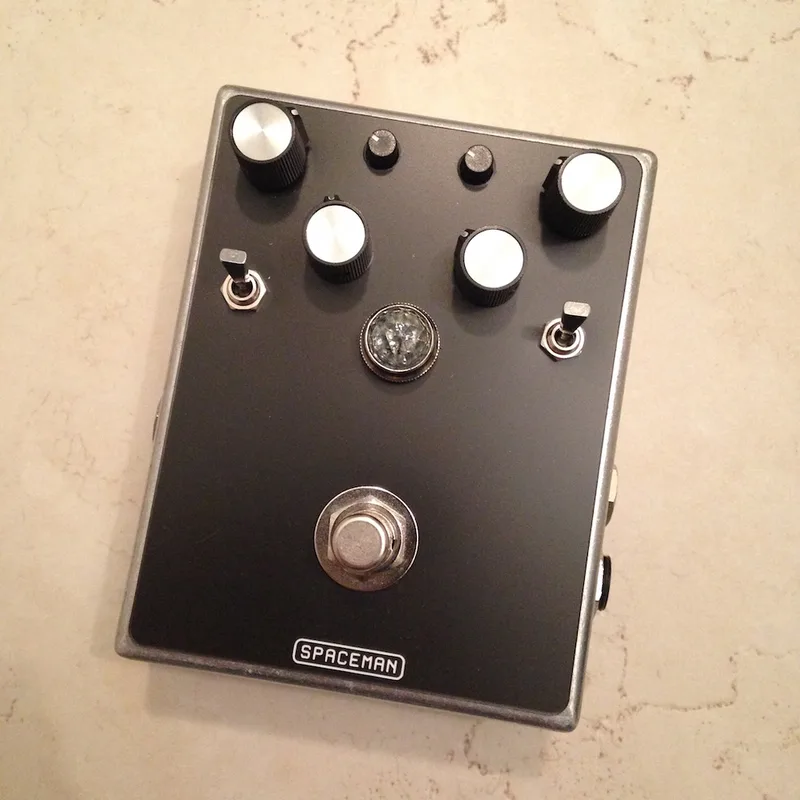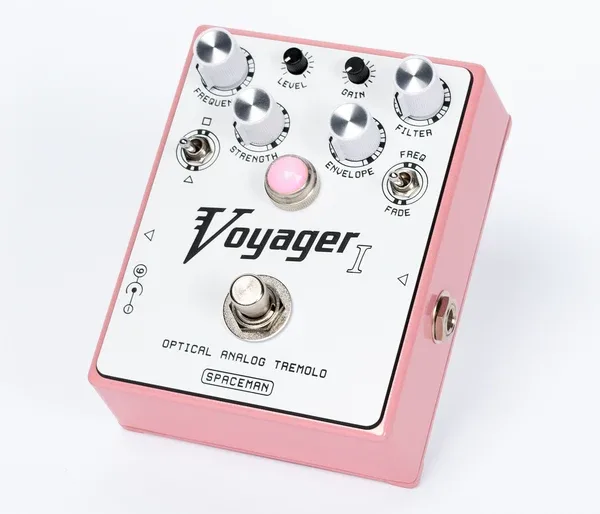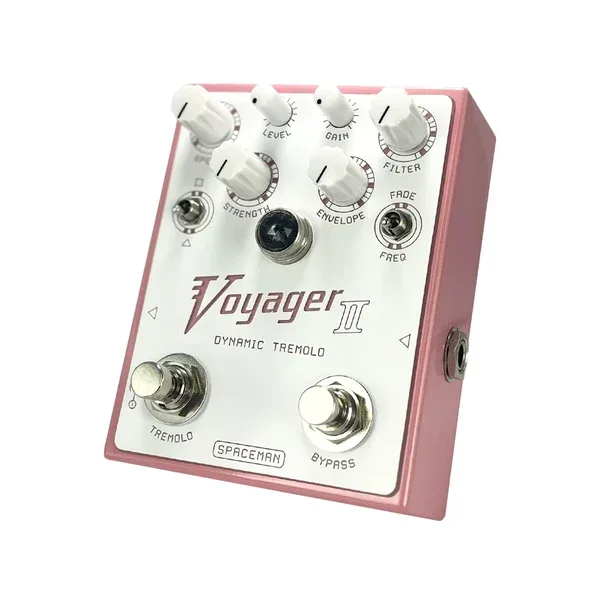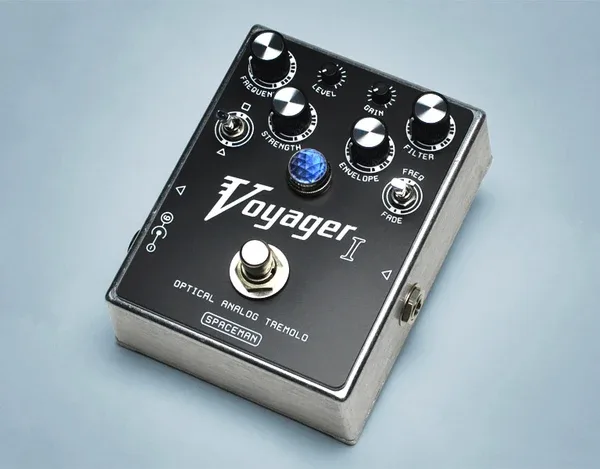


The Spaceman Voyager I is an optical analog tremolo pedal made by Spaceman Effects, released in 2014. What set it apart when it arrived was its envelope control section: an optional part of the circuit that changes tremolo parameters based on your playing dynamics, so the effect responds to how hard or softly you pick rather than simply cycling at a fixed rate. Spaceman describes it as the first dynamic tremolo pedal on the planet1.
The tremolo itself is all analog and light-based, using an optical design the maker says gives it vintage tone and feel. The Voyager I was completely hand-soldered and handmade in Portland, Oregon2.
An optical tremolo that responds to playing dynamics
Optical tremolo works by using a light-dependent element to vary the signal level, the same approach as the tremolo circuits in vintage amplifiers. The Voyager I uses an all analog, light-based (optical) design, and its optional envelope control section changes parameters based on your playing dynamics23.
The envelope section is optional in the sense that you choose how it behaves, or how much, through its controls. A selector switch picks between two envelope control options, Freq and Fade2:
- Freq: the LFO speed increases with louder dynamics and slows back down when you play with a lighter touch2.
- Fade: a heavy hand fades out the tremolo effect entirely, and the tremolo fades back in with light playing or sustained phrases2.
The practical result is a tremolo that breathes with your picking rather than sitting on top of it. In the Freq setting, the LFO speed increases with louder dynamics and slows back down when playing with a lighter touch, while in the Fade position a heavy hand fades out the tremolo effect, with the tremolo fading back in with light playing or sustained phrases23.
The controls
The Voyager I's control set covers the tremolo's core settings plus the envelope section and a gain stage23:
| Control | What it does |
|---|---|
| Frequency | Sets LFO speed2 |
| Strength | Sets LFO depth2 |
| Envelope | Dials the sensitivity of the envelope section2 |
| Filter | Shifts between sparkle and warmth, adding tonal flavor to the tremolo2 |
| Gain | Adjusts output volume; can dial in analog overdrive2 |
| Level | Adjusts output volume2 |
Two switches round out the panel. A wave shape switch selects between Triangle or Square wave shapes, which Spaceman describes as a smooth or choppier feel2. The envelope selector switch chooses between the Freq and Fade behaviors described above2.
The Gain and Level controls are worth a note for players who like a little grit: Spaceman says they not only let you adjust output volume to taste, but you can also dial in some analog overdrive2. It remains a tremolo pedal, but the gain stage gives it a second use as a light overdrive.
Build, versions and the Voyager II
The Voyager I is built in a USA-cast aluminum enclosure with a durable, engraved vinyl faceplate and a clear jewel indicator light, with the signal carried through quality open-frame jacks2. The circuit is the original run design, fully handmade and hand-soldered3. It was offered in multiple finishes, shown as Silver, Black, Brass, White, Navy Blue, Chrome, and Copper2.
The Voyager I is fully handmade and hand-soldered, built on the original run circuit3. Its USA-cast aluminum enclosure carries a durable, engraved vinyl faceplate and a clear jewel indicator light, and the tone passes through quality open-frame jacks2. Over its run the pedal listed between $349.00 and $499.00 USD2.
The Voyager I is sold out at Spaceman Effects3. Players looking for the same circuit new will find it in the Voyager II reissue; the original Voyager I is available only on the used market.
Videos
Knobs
Premier Guitar
Zachary Rizer
Questions
Is the Spaceman Voyager I true bypass?
Yes. Spaceman Effects states the Voyager I uses true-bypass switching through what it describes as the heaviest duty mechanical footswitch available. When the pedal is off, the input signal passes straight through without the circuit in the path.
What power supply does the Spaceman Voyager I need?
The Voyager I runs on 9V DC. It draws 17 mA in bypass and 22 mA engaged, so a standard 9V pedalboard supply handles it easily. The maker does not list battery operation among its features.
Is the Spaceman Voyager I still made?
No. The Voyager I is shown as sold out on Spaceman Effects' product pages, and the company has since reissued the design as the Voyager II. Original Voyager I units were fully handmade and hand-soldered in Portland, Oregon.
What is the difference between the Voyager I and Voyager II?
The Voyager II is a reissue of the same dynamic optical tremolo concept with upgrades: an expanded envelope sensitivity range, refined Filter and Depth controls, and an improved noise floor. Spaceman also relabeled Frequency as Speed and added a separate Overdrive Bypass footswitch on the Voyager II.
Can the Voyager I be used as an overdrive?
Partly. The Gain and Level controls adjust output volume, and Spaceman says you can also dial in some analog overdrive with them. It is a tremolo first, but the gain stage can push the signal into light overdrive territory.
Sources (3)
- Voyager II: Dynamic Analog Tremolo, Spaceman Effects
- Voyager I: Optical Analog Tremolo, Spaceman Effects
- Voyager I: Optical Analog Tremolo, Spaceman Effects