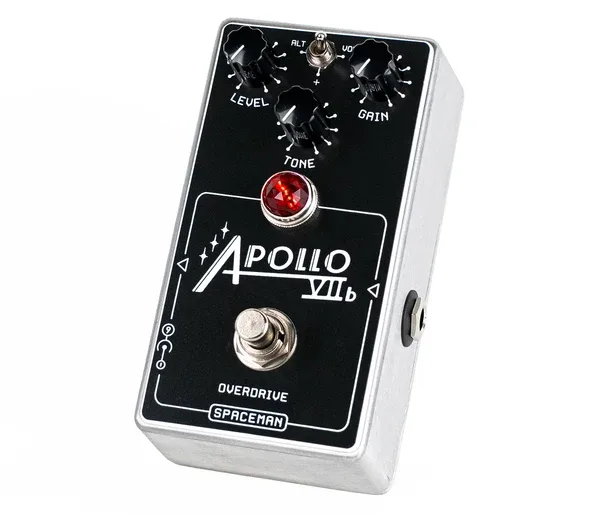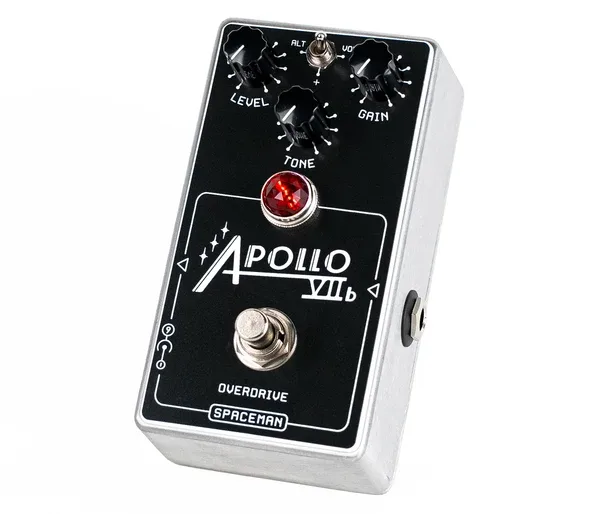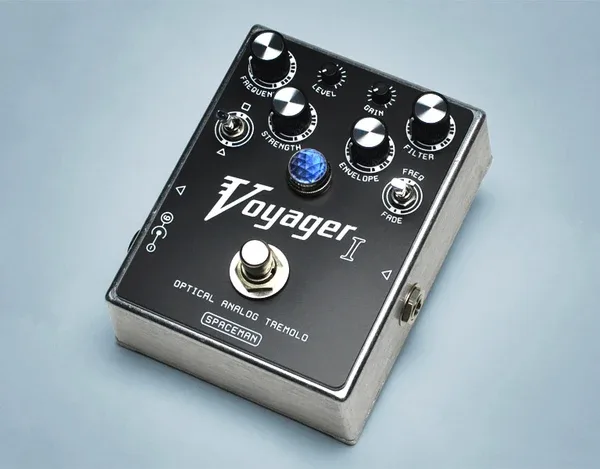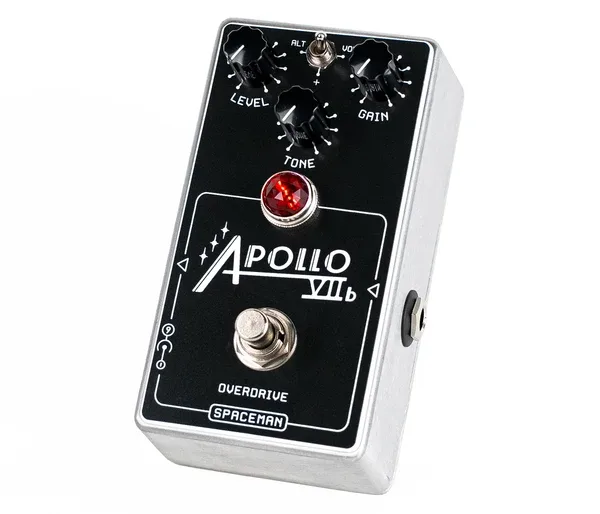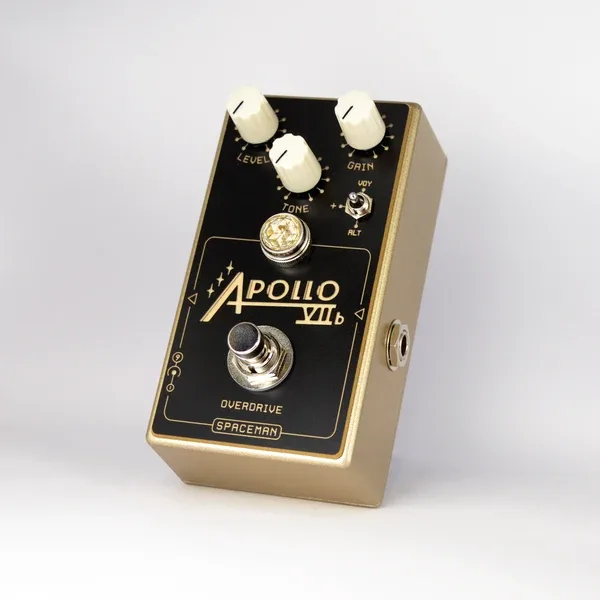
The Spaceman Apollo VIIb Cadet is a compact analog preamp and medium-gain overdrive from Spaceman Effects. Its circuit is the preamp and overdrive section from the Voyager tremolo series, isolated in its own enclosure, so it delivers the drive half of the Voyager without the tremolo1. Spaceman describes it as a medium-gain overdrive with a natural tone structure, offering a full-yet-focused frequency range with highs that sparkle without getting shrill1.
It is the Cadet Series build of the Apollo VIIb, meaning it is a machine-made, SMD-based version priced at $179.00, where the PDX Custom Series version is hand-built with through-hole components12.
What the Apollo VIIb Cadet does
The pedal takes the Voyager tremolo's preamp and overdrive circuit and puts it in a standalone box. With its Gain and Level controls, Spaceman says it can deliver a range from a powerful, well-voiced boost to layered organic overdrive1. RockBoard's PedalPedia entry for the Apollo VIIb describes it as a medium-gain overdrive and preamp derived from the preamp section of the Voyager tremolo, with the circuit fully analog and true bypass3.
A three-position toggle switch gives two additional options beyond the original Voyager tremolo preamp, selecting between three clipping voices: VOY, ALT and +1. That makes it usable as a boost, a light drive, or a thicker medium-gain overdrive depending on where the Gain knob and toggle sit.
The controls: Gain, Tone and the VOY / ALT / + toggle
| Control | What it does |
|---|---|
| Gain | Sets the drive amount, from clean boost to layered organic overdrive1 |
| Level | Sets the output volume across that range1 |
| Tone | Dials in the amount of sparkle or analog warmth1 |
| Toggle (VOY / ALT / +) | Selects the clipping character1 |
The three toggle positions each change how the signal breaks up:
- VOY is the original semi-symmetrical LED-based clipping from the Voyager pedal series, using the same specific measured LEDs as the Voyager I, 1e and II. Spaceman says it offers a blend of odd and even-order harmonics14.
- ALT is a new asymmetrical diode clipping option exclusive to the Apollo VIIb, with increased even-order harmonics for a smoother breakup1. Guitar Pedal X identifies the ALT setting as asymmetrical silicon5, and Delicious Audio calls it exclusive asymmetrical clipping with smoother breakup2.
- + is Boost mode, which removes the clipping diodes entirely. Spaceman describes it as significantly louder and less compressed, with pronounced odd-order harmonics1; Delicious Audio calls it a diode-less boost with sparkling, louder tones2.
Power and connections
The Cadet runs on 9V DC, center negative, through a 2.1mm jack, and requires an external power supply: there is no battery option on this build1. That differs from the PDX Custom Series Apollo VIIb, which can be powered by a 9V battery or an external supply4. Current draw is 15 mA in bypass and 38 mA engaged1.
The Cadet Series build has no battery compartment. If you run your board on batteries, the PDX Custom Series version is the one that supports it14.
Beyond the instrument input and output, there is an EXP / Control Voltage jack: a 0-5V DC TRS input protected against over and reverse voltage, for connecting an expression pedal or control voltage source1. Input resistance is 1Meg Ohm, so it presents a normal load to the guitar1.
History: from the Voyager tremolo preamp to the Cadet Series
The Apollo line began with the Apollo VII, launched in December 2019 as an overdrive derived from the Voyager I tremolo preamp, with Level, Gain and Tone controls and a toggle offering three clipping diode modes: LED clipping, silicon diode clipping, and no diodes67. Spaceman's Apollo VII page lists its input voltage as 9V to 18V DC, a wider range than the VIIb's 9V-only supply6.
Founder Zak Martin returned to Spaceman in 2024 and found the released Apollo VII circuit had been altered from his intended design1. The Apollo VIIb is the result: Spaceman calls it an updated and refined version of the Apollo VII, as it was intended to be1. When the related Apollo VIIb Voyager shipped in April 2025, Guitar Pedal X reported that Spaceman said it should really be called the Apollo VIII, as it is 80% different from the original, with over 60% of components and/or values changed to correct the Apollo circuit5.
The VIIb first appeared as a limited edition in 2025, offered in three signed and numbered colors, Blue, Black and White, with an extra-limited Black Edition featuring a vintage dimmable aerospace indicator light, built with hand-selected through-hole components42. The Cadet Series version followed, bringing the same circuit to Spaceman's range of repeatable, SMD-based designs with consistent availability, accessible pricing and everyday reliability18. Cadet Series pedals carry screen printed faceplates and raw metal enclosures1.
Spaceman has used a tiered approach before: the Cadet Series brings the company's signature sonic character to a wider audience through repeatable, SMD-based designs with consistent availability, accessible pricing, and everyday reliability89.
Versions at a glance
| Version | Build | Power | Bypass | Notes |
|---|---|---|---|---|
| Apollo VIIb Cadet | SMD-based Cadet Series1 | 9V DC only, external supply1 | True-bypass relay, momentary footswitch1 | $179.001 |
| Apollo VIIb (PDX Custom Series) | Hand-selected through-hole components2 | 9V DC or 9V battery4 | Mechanical true bypass, soft-click footswitch4 | Limited edition colors; sold out at time of page capture4 |
| Apollo VII (2019) | Original release5 | 9V to 18V DC6 | Digitally controlled relay bypass, no battery snap5 | Three clipping modes: LED, silicon, no diodes7 |
Questions
What is the difference between the Apollo VII and Apollo VIIb?
The Apollo VIIb is an updated and refined version of the Apollo VII, as Spaceman says it was intended to be. Founder Zak Martin returned to the company in 2024 and found the released Apollo VII circuit had been altered from his intended design, which led to the VIIb. It adds the ALT clipping mode, an asymmetrical diode clipping option exclusive to the Apollo VIIb.
What is the difference between the Cadet Series and PDX Custom Series Apollo VIIb?
The Apollo VIIb is available in either Cadet Series or PDX Custom Series builds. The Cadet Series uses repeatable, SMD-based designs with consistent availability, accessible pricing and everyday reliability, in screen printed faceplates and raw metal enclosures. The PDX Custom Series version is the hand-built counterpart, built with hand-selected, through-hole components.
What does the + position do on the Apollo VIIb?
The + setting is Boost mode, which removes the clipping diodes entirely. Spaceman describes it as significantly louder and less compressed, with pronounced odd-order harmonics. Delicious Audio characterizes it as a diode-less boost with sparkling, louder tones.
What can the expression jack on the Apollo VIIb control?
The Cadet has an EXP / Control Voltage input: a 0-5V DC TRS jack that is protected against over and reverse voltage. It accepts an expression pedal or a control voltage source for remote control of the pedal, though Spaceman's product page does not specify which individual parameters it sweeps.
Is the Spaceman Apollo VIIb true bypass?
Yes. The Apollo VIIb Cadet uses true-bypass relay switching via a momentary footswitch. The PDX Custom Series Apollo VIIb uses mechanical true-bypass switching via a soft-click footswitch, and the earlier Apollo VIIb Voyager was described as fully analog with mechanical bypass.
Sources (9)
- Apollo VIIb Cadet: Preamp / Overdrive, Spaceman Effects
- New Pedal: Spaceman Apollo VIIB Overdrive, Delicious Audio, 2025-07-17
- Apollo VIIb (Blue) by Spaceman Effects, RockBoard PedalPedia, 2026
- Apollo VIIb: Overdrive, Spaceman Effects
- Guitar Pedal X, Guitar Pedal X, 2025-04-11
- Apollo VII, Spaceman Effects
- Spaceman Effects Apollo VII Overdrive, Delicious Audio, 2022-03-30
- Explorer: Optical Phaser by Spaceman, Spaceman Effects
- Saturn VI: Harmonic Booster - Spaceman Effects, Spaceman Effects