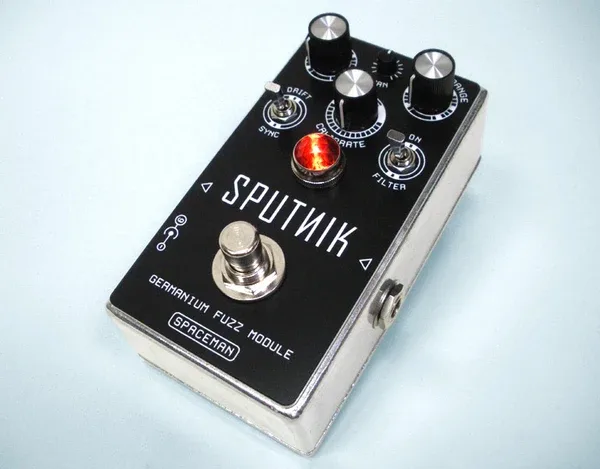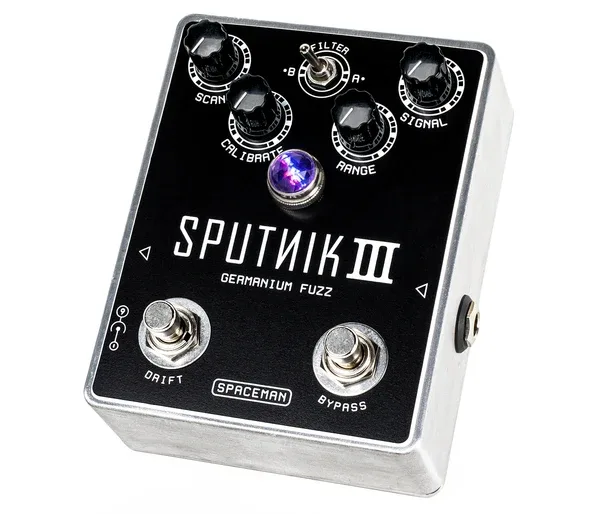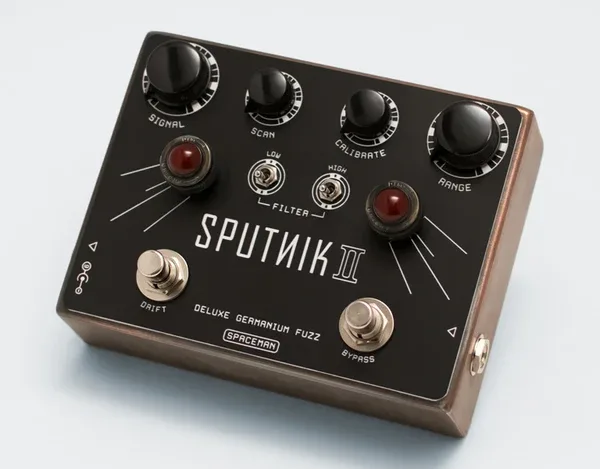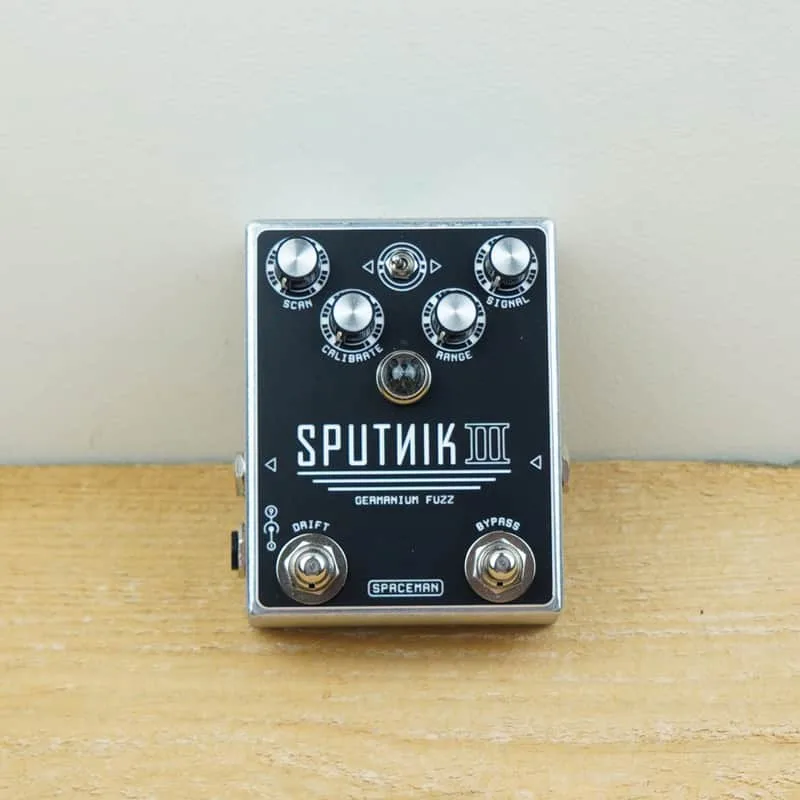


The Spaceman Sputnik III is a germanium fuzz pedal from Spaceman Effects, the third version of the company's flagship fuzz circuit. It runs on NOS Soviet-era germanium transistors and a NOS Soviet germanium diode, and Spaceman describes its output as "complex textures, gritty crunch, beautiful sustain and character"1. What sets it apart from a straightforward vintage-style fuzz is Drift mode, a second footswitchable setting that corrupts the signal, and a Scan control that sets how far that corruption goes.
The pedal arrived in 20202 and was sold in a range of editions and finishes. The hand-wired original is currently listed as sold out at Spaceman1, and in October 2025 the company released a machine-made Cadet version at a lower price3.
A germanium fuzz with a chaos mode
In its normal mode the Sputnik III is an all-germanium fuzz built on vintage Soviet transistors5. Spaceman calls it "an homage to the golden era of electronics," and the company says the circuit delivers an unconventionally wide array of fuzz tones6. Delicious Audio's rundown of the pedal's range gives a sense of how wide: "Within the Sputnik you'll find a plethora of tones, including smooth, gritty, vintage, modern, thick, thin, buzzy, bassy, splatty, sputtery, noisy, buttery, controlled and very much out-of-control tones"7.
The second side of the pedal is Drift mode. Spaceman took the footswitch-actuated Drift mode from the Sputnik II and enhanced it with optional momentary functionality, so the effect can either latch on or apply only while you hold the footswitch1. Guitar.com described the mode as one that "introduces sonic corruption to its output signal," with the momentary function upgraded from the Sputnik II version so you can corrupt the signal on demand6. Gearnews likewise noted that the momentary operation lets you push the pedal into chaos and pull back out of it at will8.
"Engage the Drift footswitch, and enter into a world so full of sonic corruption it should be illegal."
The controls and Drift footswitch
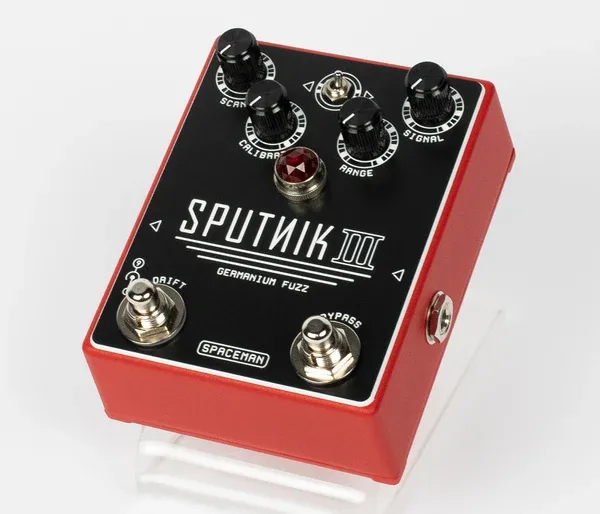
The control set mixes knobs, a toggle and two footswitches. Guitar Pedal X's 2020 fuzz roundup listed the layout as "Scan (Chaos Scrambler), Mids Switch (Mid Scoop/Flat EQ), Signal (Output), Calibrate (Tone), Range (Gain)," then the Drift footswitch and a regular bypass footswitch9.
| Control | What it does |
|---|---|
| Scan | Sets the level of corruption and chaos in Drift mode5 |
| Range | Gain9 |
| Calibrate | Wide-range tone control, a mix of both predecessors' tone controls14 |
| Filter toggle | Mid-scooped and flat settings, used with the Calibrate control1 |
| Signal | Output volume9 |
| Drift footswitch | Engages Drift mode; programmable for latching or momentary action10 |
| Bypass footswitch | True-bypass relay switching1 |
The tone section is where the Sputnik III's lineage shows. Spaceman says the tone control is a mix of both its predecessors, with the toggle offering mid-scooped and flat settings alongside the wide-range Calibrate knob14. On the Drift side, Delicious Audio reported that the footswitch "unleashes squealing and noisy tones and its response can be tweaked through the Scan knob," controllable in both latching and momentary ways7.
Power and connections
The Sputnik III runs on a 9V DC center-negative power supply, and the Cadet version has no battery option, so it requires external power104. Current draw is 8.5 mA in bypass and 58 mA engaged, with a 1 Meg Ohm input resistance4.
The Cadet also carries an expression and control voltage input: a 0 to 5V DC TRS jack, protected against over and reverse voltage10. That jack opens the pedal's parameters up to external control, something the original hand-wired versions do not list.
The 58 mA engaged draw is higher than many simple analog fuzzes, so plan a power supply with headroom rather than a low-current daisy chain output if you run other pedals off the same supply.
Signal chain placement
A feature carried over from the Sputnik II matters for anyone who has fought with vintage-style fuzzes that only sound right first in the chain. Spaceman says "the transformer based pickup simulation of the Sputnik II ensures that the Sputnik III will behave anywhere in your signal chain"1. In practice that means the pedal can sit after a wah or a buffer without the loading problems that plague many germanium circuits, and Guitar.com noted further options like fuzz stacking and voltage dropping, the dying battery effect, as additional territory6.
History and versions
The Sputnik III is the third iteration of the Sputnik fuzz line, following the original Sputnik and the Sputnik II5. Spaceman positions it as incorporating the best features of both previous pedals4, and it arrived in 2020 in a mid-sized enclosure, smaller than the Sputnik II but with more options than the first Sputnik472.
The 2020 launch offered a standard edition at $269 plus three limited-run designs: Black, Red Moon, and a Soviet-inspired Red6. Gearnews reported that limited fancy color variations carried a small price premium8. Guitar Pedal X later summarized the original pricing as $269 for the hybrid standard version, an SMT and THT mix, up to $399 for the limited all-THT editions3.
The line continued after the Sputnik III. The original 2020 editions ran from $269 for the Hybrid Standard Version (an SMT / THT mix) up to $399 for the Limited All-THT Editions3. A Cadet version followed at $219; the Cadet series uses SMT components, while the Sputnik III retains its NOS germanium transistors and diodes3. The Sputnik II before it is likewise sold out2.
| Version | Year | Price | Construction |
|---|---|---|---|
| Sputnik III hybrid standard | 2020 | $2693 | SMT / THT mix3 |
| Sputnik III Limited All-THT editions | 2020 | up to $3993 | All-THT, limited3 |
| Sputnik III (current maker listing) | $369.001 | Sold out1 | |
| Sputnik III Cadet | $2193 | SMT components, NOS germanium transistors and diodes retained3 |
The current Black & Red limited edition is a run of 3 units with a textured red powder-coat, black engraved faceplate, red jewel and solid aluminum knobs, loaded with first-run fully handmade and hand-wired circuits1. The Cadet keeps the same circuit family but moves to screen-printed faceplates on raw metal cast aluminum enclosures10.
What reviewers said
Pedal of the Day reviewed the Sputnik III in May 2020 and found a pedal with range: "Sometimes smooth and warm, sometimes harsh and unpredictable, the Sputnik III offers a wide range of fuzz goodness"5. The reviewer also liked the hardware, calling the new mid-sized enclosure "awesome" for delivering the earlier pedals' tones in a smaller box5.
Guitar Pedal X's Stefan Karlsson, writing in the site's 2020 best-of fuzz roundup, was more direct about the pedal's core sound:
"Still a magnificent searing Germanium Fuzz though - one of the very finest of its kind."
The same roundup noted the pedal's searing yet warbly output in Drift use9. For context on the family, Pedal of the Day's earlier Sputnik II review described that pedal's Drift mode as "chaotic and corrupted overload fuzz like you've never heard before," selectable via a second footswitch11, which is the mode the Sputnik III inherited and expanded.
Videos
SpacemanEffects
AndyDemos
R.J. Ronquillo
Questions
What does the Scan knob do on the Sputnik III?
Scan sets how much corruption and chaos Drift mode adds to the signal. With Drift engaged, turning Scan up pushes the pedal toward squealing, noisy, unpredictable fuzz, while lower settings keep the corruption subtle. It works in both latching and momentary Drift operation, so you can dial in a burst of scramble and trigger it only while you hold the footswitch.
Is the Spaceman Sputnik III true bypass?
Yes. Both the hand-wired Sputnik III and the Cadet version use true-bypass relay switching, actuated by soft-touch footswitches. The Cadet's bypass footswitch is momentary, and its Drift footswitch can be programmed for either latching or momentary action.
What is the difference between the Sputnik II and Sputnik III?
The Sputnik III is the third version of the circuit and combines features of the Sputnik and Sputnik II, including the Sputnik II's transformer-based pickup simulation and its Drift mode, which gains optional momentary operation. It also moves to a mid-sized enclosure, smaller than the Sputnik II but with more options than the original Sputnik.
What is the Sputnik III Cadet?
The Cadet is a machine-made, more affordable version of the Sputnik III released in October 2025 at $219, against $269 to $399 for the original editions. It keeps the NOS germanium transistors and diodes and the same control set, but uses SMT components and screen-printed faceplates on raw metal enclosures instead of hand wiring.
Can you put the Sputnik III after a wah or buffer?
Yes. Spaceman says the transformer-based pickup simulation carried over from the Sputnik II ensures the pedal behaves anywhere in your signal chain, so it is not limited to first position in front of other effects like many vintage-style germanium fuzzes.
Where is the Sputnik III made?
The original Sputnik III is handmade and hand-wired in Portland, Oregon, in a cast aluminum enclosure. The Cadet series is the machine-made, more affordable alternative, using SMT construction rather than hand wiring.
Sources (11)
- Sputnik III: Germanium Fuzz, Spaceman Effects
- Guitar Pedal X, Guitar Pedal X, 2024-11-15
- Guitar Pedal X, Guitar Pedal X, 2025-10-30
- Sputnik III, Spaceman Effects
- Spaceman Effects Sputnik III Germanium Fuzz, Pedal of the Day, 2020-05-21
- Spaceman Effects’ Sputnik III germanium fuzz has entered the orbit, Guitar.com, 2020-04-22
- Spaceman FX Sputniuk III Germanium Fuzz, Delicious Audio, 2022-08-02
- Spaceman Effects launches the new Sputnik III Germanium Fuzz, gearnews.com, 2020-04-22
- Guitar Pedal X, Guitar Pedal X, 2020-12-18
- Sputnik III: Germanium Fuzz, Spaceman Effects
- Spaceman Effects Sputnik II Deluxe Germanium Fuzz, Pedal of the Day (www.pedal-of-the-day.com), 2017-06-30