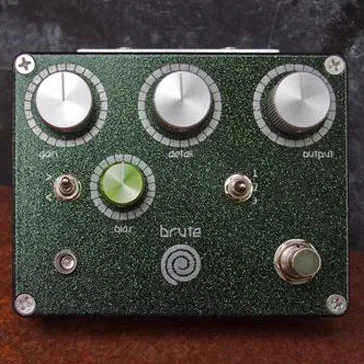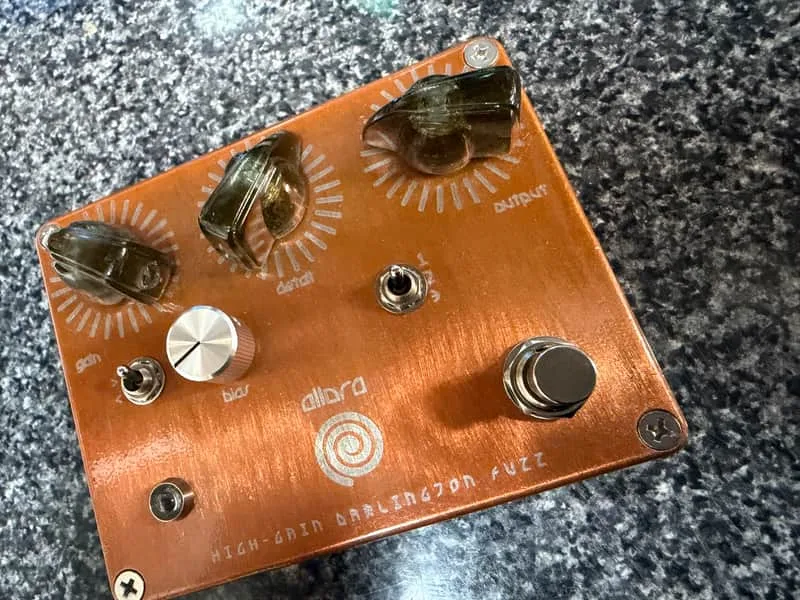

The Spiral Electric FX Allora High-Gain Darlington Fuzz is a fuzz pedal built around two Darlington transistors, a type of transistor that delivers a very large amount of gain. It was designed by Tom Cram, owner and circuit designer of Spiral Electric FX, after customer requests for a higher-gain version of the company's Brute Fuzz. That amount of gain required substantial reworking of the input, output and Detail controls compared with the circuit it grew from1.
Where it came from
The Allora came out of what Delicious Audio describes as a dialog between producer and end user: players kept asking for a hotter version of the Brute Fuzz, and that led Cram to experiment with Darlington transistors, which he describes as very hot1. The pedal's enclosure is a coppery translucent orange powder-coat shot over a hand-brushed top, with laser-cut graphics1.
The controls
| Control | What it does |
|---|---|
| Texture (3-way toggle) | Selects three diode modes: Silicon 1N914 diodes, Blower (straight transistor tone), or Special1 |
| Focus Toggle | Can shave off some low-end to make the pedal play nice with an already dirty amp channel1 |
| Output | Generous output allows it to hit the front end of an amp pretty hard; unity is right around noon1 |
| Gain | Along with Bias, brought to around 10:00 to 11:00 for the lower-gain boost setting1 |
| Bias | Opened up to increase gating so you can control noise; gating kicks in around 2:001 |
| Input, Output and Detail | Substantially reworked relative to the Brute Fuzz to handle the Darlington gain1 |
The Output control is generous enough to hit the front end of an amp pretty hard, with unity gain sitting right around noon, according to Spiral Electric FX1. The Focus Toggle can shave off some low-end to make the pedal play nice with an already dirty amp channel, and the amount of gain from the Darlingtons required substantial reworking of the input, output, and Detail controls1.
The three Texture settings
The three-way Texture toggle activates three different diode modes1:
- Silicon 1N914 diodes: smooth breakup with a little added compression. Cram says these are common silicon diodes that Christopher from SHOE turned him on to, and that they are also used on the Red Spiral1.
- Blower (straight transistor tone): a raw transistor fuzz sound. As Cram puts it, "It is just the straight raw tone of the transistors clipping," something he started doing on a few one-off builds1.
- Special: a setting that scoops the lower end, allowing a better transition from fuzz to clean tones using the guitar's volume knob, and great for feedback. Cram describes it as a part he discovered that scoops a tiny bit of the lower-mids; at higher gain it tends to resolve to the upper octave1.
How it sounds and how it compares
Cram's own description of the Allora sets it apart from the rest of the Spiral Electric fuzz line: "…more compressed, wilder, ruder, feeds-back, sputters, sags, spits, woofs, growls, and even horns(?), like no other fuzz I make. Some settings remind me of a Muff, other settings remind me of a Buzzaround"1.
Against the Brute Fuzz it is derived from, the Allora is the higher-gain pedal, with the Darlington transistors and the reworked input, output and Detail controls as the practical differences1.
A lower-gain setting worth knowing
The designer suggests a lower-gain boost setting: set the Output in the 3:00 range so it acts like a boost, then bring the Gain and Bias up to around 10:00 to 11:00. He reports this sounds phenomenal with an amp channel on the verge of break-up1.
Videos
Demos In The Dark
Joel Gilardini
Ed Pettersen
Questions
What does the Texture toggle do on the Allora?
It is a three-way toggle that selects between three diode modes. Position 1 uses Silicon 1N914 diodes for smooth breakup with a little added compression. Position 2, Blower, bypasses the diodes for the straight raw tone of the transistors clipping. Position 3, Special, scoops a small amount of the lower-mids, which allows a smoother transition from fuzz to clean tones with the guitar's volume knob and, at higher gain, tends to resolve to the upper octave, which is useful for feedback.
Who designed the Spiral Electric FX Allora?
The Allora was designed by Tom Cram, owner and circuit designer of Spiral Electric FX. It came out of a dialog between producer and end user: customer requests for a higher-gain version of the company's Brute Fuzz led Cram to experiment with Darlington transistors, which run very hot, and to rework the circuit around them.
What transistors does the Allora use?
The Allora uses two Darlington transistors at its core. To handle the amount of gain they produce, Cram reconfigured the overall transistor arrangement using BC108C, BC549, MPSA12 and 2N5089 transistors, and substantially reworked the input, output and Detail controls compared with the Brute Fuzz circuit it grew out of.
How does the Bias control work on the Allora?
The Bias control was opened up on the Allora to increase gating so that players can control noise. According to the designer, right around 2:00 on the Bias knob you can hear the gating kick in and the noise floor is drastically improved. Pushed further, in the 4:00 range, the Bias produces horn-like sounds where pick attack is completely removed.
Can the Allora be used as a lower-gain boost?
Yes. The suggested lower-gain setting is to set the Output in the 3:00 range so it acts like a boost, then bring the Gain and Bias up to around 10:00 to 11:00. The designer reports this sounds phenomenal with an amp channel on the verge of break-up.
How is the Allora different from the Brute Fuzz?
The Allora is a higher-gain version of the Brute Fuzz, developed after customers asked for one. It uses two Darlington transistors, which required substantial reworking of the input, output and Detail controls. The designer describes it as more compressed, wilder and ruder than his other fuzzes, feeding back, sputtering, sagging, spitting, woofing and growling, with some settings recalling a Muff and others a Buzzaround.
Sources (1)
- Spiral Electric FX Allora High-Gain Darlington Fuzz, Delicious Audio, 2021-04-07