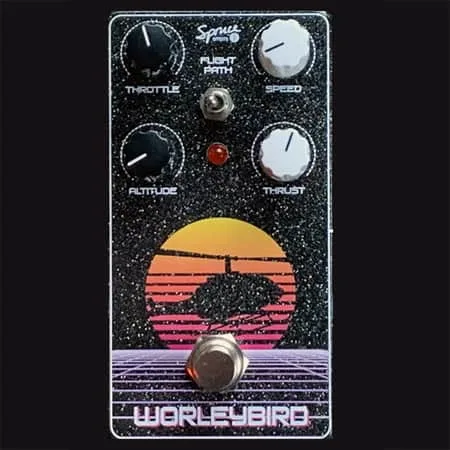

The Worleybird is a tremolo pedal with a gain stage built in, made by Spruce Effects in collaboration with Clifton Worley of The Clifton Worley Show podcast. The circuit is based on the mostly unknown Kay T1 tremolo effect, which used a volume-pedal-like design, and Spruce added a Germanium/Silicon hybrid gain stage to it, placed on an order switch.1
The controls: Throttle, Altitude, Speed and Thrust
The Worleybird's four knobs carry aviation-flavored names, and each does a distinct job:
| Control | What it does |
|---|---|
| Throttle | Controls the amount of gain |
| Altitude | Controls the input frequency, like a tone control |
| Speed | Controls the speed of the tremolo effect, medium to quite fast |
| Thrust | Controls the amount of depth; as Spruce put it, "it's a choppah!" |
All four controls are described by Delicious Audio, the publication that profiled the pedal at its release.1
On the sound, the maker's own description runs from smooth to hard hitting: "On the lower depth setting, you can get some smooth, amp like tremolo, and on the high end, it hits hard." Spruce also said of the pedal, "We think it sounds pretty great with fuzz."1
The order switch: tremolo before or after the gain
The order switch is the pedal's central feature. It places the tremolo before the gain circuit for a traditional tremolo sound, or after it for maximum chop. Because the two blocks can be reordered, the switch also lets you feed the tremolo more gain to get tremolo clipping, or boost the output volume going into your amp.1
That flexibility ties into the gain stage itself, which uses NOS Germanium and Silicon transistors. Beyond the panel, there is a hidden control: "There is a secret internal 'grit' control (trim pot) that allows you to dial in the Germanium 'dirt' on the gainstage."1
Power and connections
The Worleybird runs on 9V, center negative power, which Spruce describes as the industry standard power supply, with standard negative ground. The jacks are side-mounted, with the input on the right and the output on the left. The true-bypass stomp switch handles on and off, and the speed of the tremolo is indicated by an LED pulse.1
From the Kay T1 to the Clifton Worley collaboration
The pedal came about when Worley approached Spruce Effects: "Clifton approached us about doing a 'Worleybird' pedal and he was open to a lot of ideas." The circuit they settled on draws from the Kay T1, a little-known tremolo effect with a volume-pedal-like design.1
The enclosure is printed and drilled in the USA, and the pedal is hand wired and assembled in California.1
Videos
Demos In The Dark
Questions
Is the Spruce Effects Worleybird true bypass?
Yes. The Worleybird uses a high quality true-bypass stomp switch for on and off. The speed of the tremolo is indicated by an LED pulse, so you can see the rate even when the effect is engaged. Power is 9V center negative, the industry standard supply.
What does the internal grit trim pot on the Worleybird do?
The Worleybird has a secret internal grit control, a trim pot that lets you dial in the amount of Germanium dirt on the gain stage. It works alongside the external Throttle knob, which controls the amount of gain, so you can set the character of the dirt inside and the overall gain from the top panel.
Can the Worleybird be used as a clean boost?
The order switch makes this possible. With the tremolo placed before the gain circuit, you can boost the output volume going into your amp, and the Throttle control sets the amount of gain. The pedal is built around a Germanium/Silicon hybrid gain stage, so it covers boost and dirt territory as well as tremolo.
Where is the Spruce Effects Worleybird made?
The enclosure is printed and drilled in the USA, and the pedal is hand wired and assembled in California. It uses new old stock Germanium and Silicon transistors in the gain stage.
How fast does the Worleybird tremolo go?
The Speed control covers a medium to quite fast range, according to Delicious Audio's write-up of the pedal. The Thrust control sets the depth, from smooth, amp-like tremolo on the lower setting to a hard-hitting chop at the top.
Sources (1)
- Spruce Effects Worleybird Tremolo, Delicious Audio, 2019-04-29