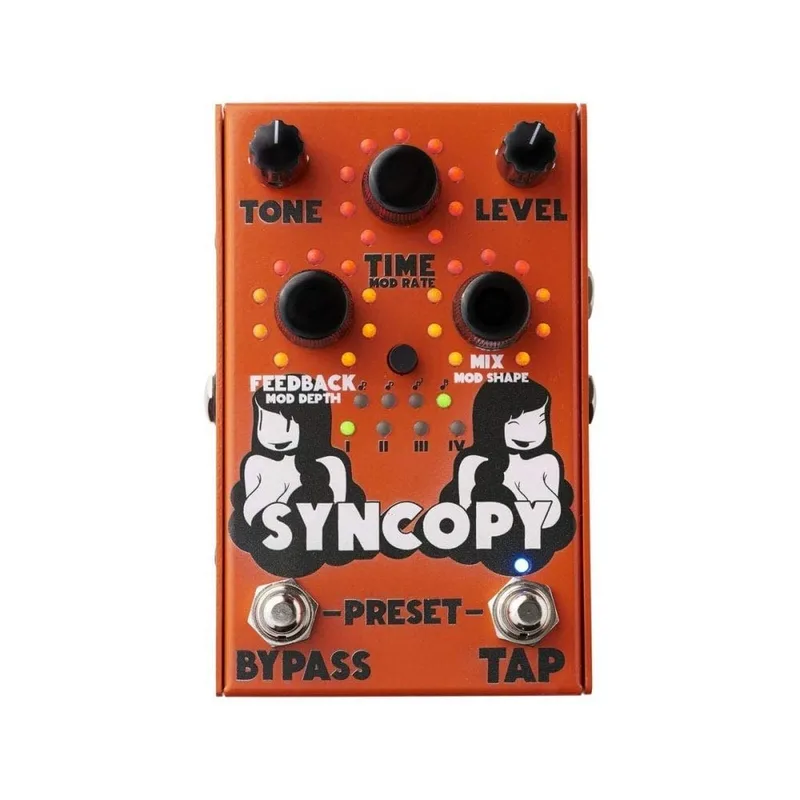


The Stone Deaf Syncopy is a delay pedal from UK maker Stone Deaf that pairs an all-analog signal path with digital control. The repeats come from bucket-brigade (BBD) chips, the classic analog delay technology, but a digital brain handles presets, tap tempo and MIDI123. Where analog delays of the past usually topped out around 450 to 500ms, the Syncopy reaches about 1000ms, a full second of delay42.
The concept is straightforward: you get the warmth and quirk of a bucket-brigade delay, but with the convenience features, tap tempo, presets, expression control and MIDI, that analog pedals traditionally lacked4. Guitar.com described it as a "digitally controlled analogue delay pedal" that "combines all-analogue signal processing with digital tweakability"2.
What it does to your sound
With no modulation engaged and the tone control at noon, Guitar.com's reviewer found the Syncopy "about as pure as analogue delay gets"2. On That Pedal Show, the presenters highlighted the clarity of the repeats, with Mick noting that "one of the hardest things to do with analog delay is to get clarity in the in peds and there's tons of that it's really really lovely"1.
On top of the basic delay, the pedal carries switchable analog modulation2. You get control over modulation depth, rate and shape, and turning the depth all the way down switches the modulation off completely, returning you to a plain analog delay41. Delicious Audio credited the "high-quality BBD chips and ingenious filtering" for what they called lush, crystal-clear delay tones3.
Controls and footswitches
The main delay parameters are Time, Tone and Level4. The tone and output level controls at the top are standard analog dials that operate independently of the presets, so you can make quick adjustments without overwriting a saved sound2.
| Control | What it does |
|---|---|
| Time | Sets the delay time4 |
| Tone | Shapes the repeats, standard analog dial42 |
| Level | Sets output level, standard analog dial42 |
| Time + Feedback + Mix (held together) | Enters Secondary Mode for Modulation Depth, Rate and Shape4 |
| Tap footswitch (held down) | Slams feedback to full2 |
There are three footswitches: Bypass, Tap and Preset, with the preset function reached by pressing Bypass and Tap together3. Pressing both at once scrolls through the presets, and the pedal selects the next one instantly rather than making you confirm it21. A green LED indicates the mix setting and a red LED indicates the modulation shape1.
Presets, MIDI and expression control
The Syncopy holds four onboard presets. You set up the sound you want, save it to one of the four slots, and recall it from the footswitches1. A five-pin MIDI input expands the count to 128 presets accessible from any MIDI controller42.
There is also an input for a standard TRS expression pedal, assignable to the Feedback, Time and Mix Mod controls32. Guitar.com noted the expression pedal is programmable to move any or all of the three main knobs in delay mode, modulation mode, or both, with the assignment storable in presets2. Players building a MIDI pedalboard or using an expression pedal have plenty to hook into.
Power and connections
The Syncopy needs a minimum of 250mA at 9V, and the supply is not included2. That current draw is well beyond what a battery or a low-current daisy chain output can deliver, so plan on a dedicated 9V output from a pedal power supply. The jack is a standard 2.1mm center-negative (Boss-style) connector3.
For switching, the pedal offers a choice of true bypass or buffered bypass with trails, so repeats can continue to ring out after you disengage the effect2. Stone Deaf uses true-bypass relay switching to reduce switching noise, and the circuit uses Burr Brown op-amps3.
Where it came from
The Syncopy is an analog delay pedal from Stone Deaf, a UK builder, and Richard Purvis reviewed it for The Guitar Magazine in August 2018 on a pre-production unit2. He noted that, on that pre-production unit at least, self-oscillation did not always come on as eagerly as expected and could take some coaxing depending on input level and other settings2. He also found it to be a complex pedal offering a microscopic level of control over every variable of "wobbliness," though not all players will appreciate that, and observed that it is UK-built and, compared to most of its obvious rivals, quite affordable5.
What reviewers said
Reviews were positive but noted the pedal's complexity. Guitar.com's verdict captured both sides:
"The Syncopy is a complex pedal, and not all players will appreciate its microscopic level of control over every variable of wobbliness you could want, but it's great to have such tools available in an analogue delay, especially one that's UK-built and, compared to most of its obvious rivals, quite affordable, too."
Purvis's review found one quirk on the pre-production unit: "self-oscillation doesn't always come on as eagerly as expected, at times, depending on input level and other settings, it can take some coaxing"2. Pedal of the Day was more effusive, calling it a "work of art" with "long echoes, more modulation than you could ever need and enough presets to last a lifetime"4.
On That Pedal Show, the demo highlighted the preset switching and the self-oscillation behavior, with the presenters pleased that the pedal "does the self off oscillation thing" and that the feedback control makes it easy to reach sounds that are not necessarily pleasant but show what the pedal can do1.
How it differs from other analog delays
The Syncopy's distinguishing combination is a full second of BBD delay time, roughly double what older analog delays offered4, together with tap tempo and four tap divisions4, preset storage and MIDI expansion4, and deep modulation shaping4. Most classic bucket-brigade delays offer none of those digital conveniences, while most delay pedals with full preset and MIDI control are digital throughout. The Syncopy sits between the two: analog repeats, digital brain4. A fuller page on the Stone Deaf FX Syncopy Analog Delay covers the shipping version of the same pedal.
Videos
AndyDemos
JayLeonardJ
EytschPi42
Questions
Does the Stone Deaf Syncopy have tap tempo?
Yes. The Syncopy has a dedicated Tap Tempo footswitch for setting delay times in real time, and four tap division settings for further rhythmic options. Holding down the tap footswitch also slams the feedback to full for self-oscillation effects.
Is the Syncopy true bypass or buffered?
It is switchable between true bypass and buffered bypass with trails. Stone Deaf also uses true-bypass relay switching to reduce switching noise, so preset and bypass changes happen without clicks.
How much current does the Stone Deaf Syncopy need?
It runs on a 9V supply with a minimum of 250mA, which is not included with the pedal. The power connector is a standard 2.1mm center-negative (Boss-style) 9-volt DC jack, so most common pedal power supplies will fit.
What is the maximum delay time on the Syncopy?
Around 1000ms, roughly a full second. That is about double the 450 to 500ms that analog delays of the past usually topped out at, which is one of the pedal's main draws for players who want long analog echoes.
Where is the Stone Deaf Syncopy made?
It is built in the UK by Stone Deaf FX, the Manchester pedal maker. Guitar.com noted it is UK-built and, compared to most of its obvious rivals, quite affordable.
How many presets does the Syncopy hold?
Four onboard presets, which you scroll through by pressing the bypass and tap-tempo footswitches at the same time. Connecting a MIDI controller to the five-pin MIDI input expands that to 128 presets.
Sources (5)
- Mad Professor Twimble, Stone Deaf FX Syncopy Delay & EarthQuaker Devices Pyramids, That Pedal Show (YouTube), 2018-05-28
- Stone Deaf Syncopy Delay Review, Guitar.com (The Guitar Magazine), 2018-08-24
- Stone Deaf FX Syncopy Analog Delay, Delicious Audio, 2019-01-07
- Stone Deaf FX Syncopy Analog Delay, Pedal of the Day, 2020-02-18
- Gear of the Year 2018: Best premium pedals, Guitar.com, 2018-12-12