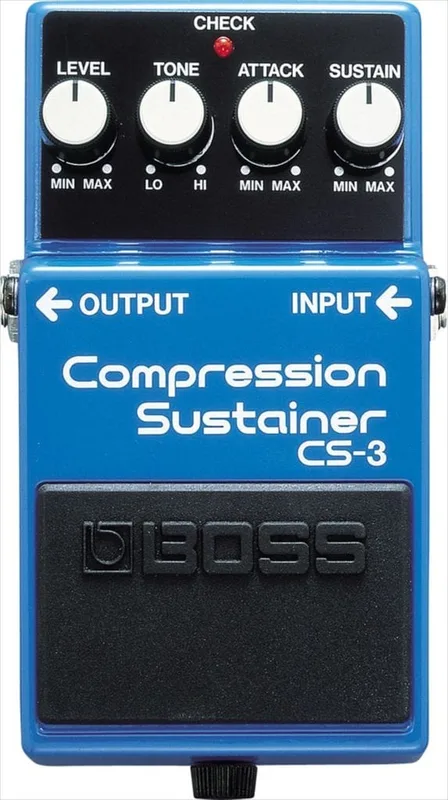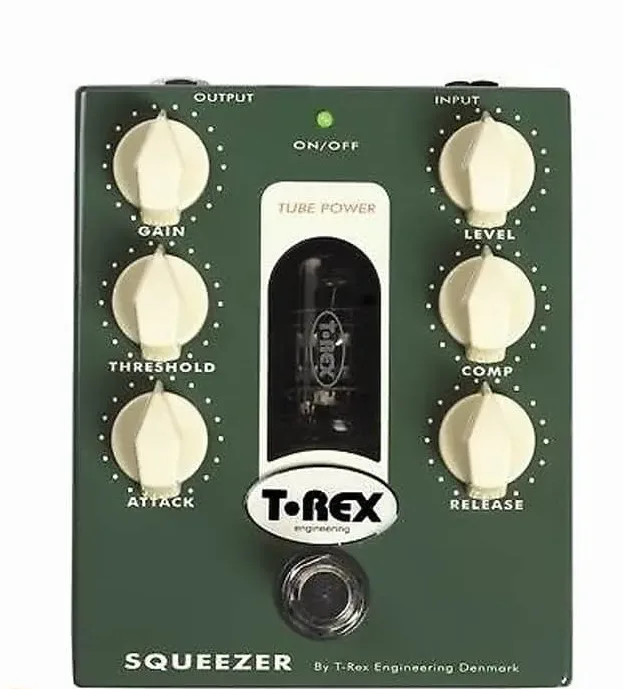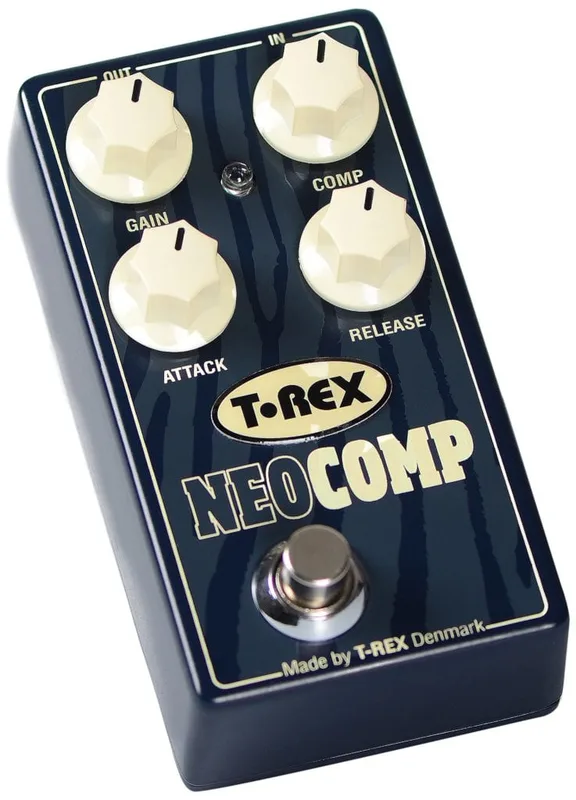


The T-Rex NeoComp is an analog compressor pedal from T-Rex Effects, aimed at players who want studio-style compression on a pedalboard. T-Rex describes it as delivering "Studio-quality compression for guitar, bass or even vocals, right from the convenience of your pedal board"1. What sets it apart from most pedals in its class is its circuit: instead of the OTA circuitry found in the majority of guitar compressors, it is modeled on the studio-grade Blackmer VCA, the same voltage-controlled amplifier approach used in the Boss CS-312.
The controls
The NeoComp keeps its control set simple: an on/off switch plus gain, comp, attack and release knobs1. Having attack and release on a compact pedal is notable, since many small compressors fix those parameters internally.
| Control | What it does |
|---|---|
| On/off switch | Bypasses or engages the compression1 |
| Gain | Sets the output level1 |
| Comp | Sets the amount of compression, up to 9:11 |
| Attack | Sets how quickly the compressor responds to a signal1 |
| Release | Sets how quickly the compression eases off after the note1 |
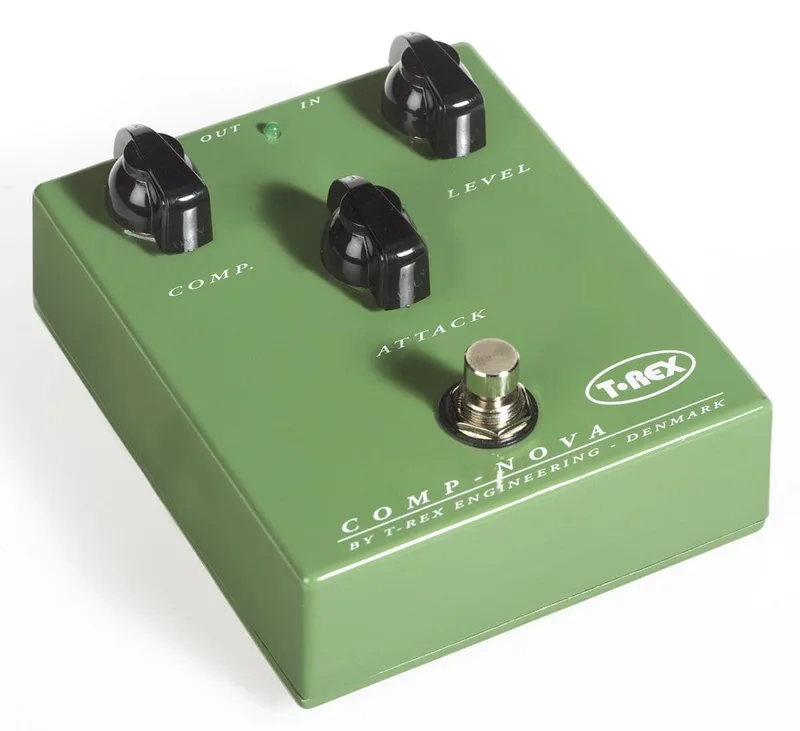
Ovnilab's reviewer, Cyrus Joaquin Heiduska, found that "the attack and release knobs have a good useful range", which matters for players who want to shape whether the compressor clamps down fast on a picked note or lets the initial transient through3. He also noted the compression circuit seems to have a higher ratio than the older T-Rex Comp Nova, so the NeoComp can squeeze harder than its predecessor when pushed3.
Power and connections
The NeoComp presents a high input impedance, higher than 1M Ohm at 1KHz, and a low output impedance, lower than 1K Ohm at 1KHz1. For a player, that means it loads the guitar lightly on the way in, preserving high end from passive pickups, and drives long cable runs and the next pedal in the chain without losing signal, so it can sit early on a pedalboard without coloring what feeds it1.
The 24 mA draw at 9V DC is modest, but the 5-hour maximum battery life means most players will want the 9V DC jack rather than a battery for anything beyond occasional use1.
Connections are straightforward: an input jack, an output jack and the 9V DC jack1. Input impedance is higher than 1M Ohm at 1KHz and output impedance is lower than 1K Ohm at 1KHz, so it plays nicely with guitars in front and typical amp or pedal inputs behind it1. Maximum input signal is 5V p-p1.
VCA versus OTA compression
Most guitar compressors are based on OTA (operational transconductance amplifier) circuitry, an approach favored for its low cost and small footprint in stompboxes. The NeoComp takes a different route. As MusicRadar's reviewer Trevor Curwen put it:
"Most guitar compressors are based on OTA circuitry, but T-Rex's NeoComp uses a VCA (as does the Boss CS-3)"2
A VCA is a voltage-controlled amplifier, and the Blackmer VCA the NeoComp is modeled on is a studio-grade design of the kind found in rack compressors1. For a player, the practical question is whether that circuit difference is audible, and that is where the reviews diverge.
What reviewers said
The two published reviews of the NeoComp reach very different conclusions.
MusicRadar's Trevor Curwen was positive, listing "Accurate controls. Practical range of compression. Good build quality." among the pedal's strengths2.
Ovnilab's Cyrus Joaquin Heiduska was far less impressed. On the sound itself he found things to like: "There is no loss of low frequencies" and "only a little bit of high end rolloff", and he considered the attack and release range good3. But his review centered on a noise problem:
"I could hear a weird whine as some component charged and discharged"3
His verdict was blunt:
"I cannot recommend this pedal at any price, due to this unacceptable noise."3
He was also lukewarm on construction, saying "The construction quality is OK I guess"3. So a player weighing the NeoComp against other compressor pedals is looking at a pedal with a well-specified VCA circuit and useful controls, but with one published reviewer reporting a noise issue serious enough to rule the pedal out, and another finding it accurate and well built. The disagreement is worth knowing about before seeking one out secondhand, since T-Rex no longer lists it as a current product.
Videos
Musicoff - Where Music Matters
Custom Boards Finland
American Musical Supply
Questions
Does the T-Rex NeoComp run on a battery?
Yes. It takes a 9V battery of the 6F22 type, with a maximum battery life of about 5 hours. It also has a 9V DC jack for a power supply, drawing 24 mA at 9V DC, so most players will prefer running it from a pedalboard power supply.
Can the T-Rex NeoComp run at 12V?
No. T-Rex specifies a maximum power supply voltage of 12.5V DC and a minimum of 8V DC, so a 12V supply is within range, but anything above 12.5V DC is not. The pedal is designed around a 9V DC supply such as the T-Rex FuelTank.
What is the maximum compression ratio on the NeoComp?
T-Rex rates the NeoComp at a compression ratio of up to 9:1. Ovnilab's reviewer found the compression circuit seems to have a higher ratio than the older T-Rex Comp Nova, giving it more squish when pushed.
How is a VCA compressor different from an OTA compressor?
Most guitar compressor pedals use OTA (operational transconductance amplifier) circuitry, which is cheap and common in stompboxes. The NeoComp instead uses a VCA, a voltage-controlled amplifier of the studio-grade Blackmer type, the same approach as the Boss CS-3. VCA designs are closer to what studio rack compressors use.
Sources (3)
- → T-REX EFFECTS ← Pedals for guitar and bass players!, T-Rex Effects
- T-Rex NeoComp review, MusicRadar, 2014-09-30
- T Rex NeoComp, ovnilab.com