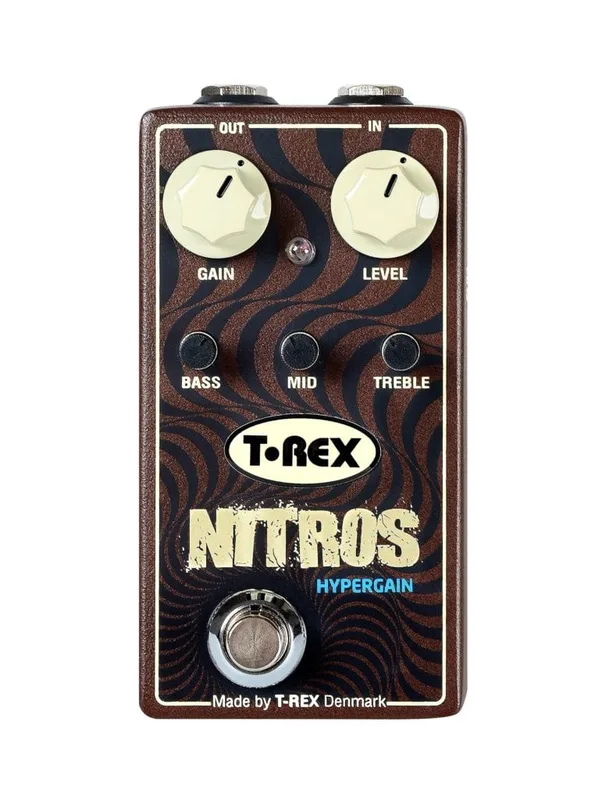



The T-Rex Nitros Hypergain is a compact distortion pedal from T-Rex Effects. T-Rex describes it as "a very punchy and scooped high gain distortion," built around what the maker calls "bold and aggressive clipping circuitry"1. It was introduced to the press in late 2014, with Premier Guitar's announcement describing it as delivering "mid to high gain with tightness and articulation"2.
What sets the Nitros apart from many high-gain boxes is its EQ section: an active 3-band EQ that Premier Guitar described as allowing "extreme shaping of the voicing"2. Between the scooped core sound and the active EQ, a player can push the mids back in for cut, or carve the voicing further for rhythm work.
Controls and how it shapes the sound
The control set is straightforward: an on/off switch, gain, level, and separate bass, mid, and treble knobs1. Because the EQ is active rather than passive, those three knobs can boost as well as cut, which is what lets the pedal move from its scooped default toward a more mid-forward voice2.
| Control | What it does |
|---|---|
| Gain | Sets the amount of distortion, mid to high gain range2 |
| Level | Sets the output volume |
| Bass | Active low-band cut or boost2 |
| Mid | Active mid-band cut or boost, for reshaping the scooped voicing2 |
| Treble | Active high-band cut or boost2 |
Bypass and buffering
The Nitros does not use true bypass. T-Rex specifies a FET bypass, chosen for "low switching noise and buffering capabilities"1, a detail Guitar.com also noted in its coverage of the launch3. For a player, this means the pedal acts as a buffer in the signal chain even when it is off, which can help preserve high end over long cable runs. If you want to read more about how buffers work in a chain, see the buffer pedals page.
Powering it
The pedal runs on a 9V DC supply and draws 30 mA at 9V DC1. External connectors are an input jack, an output jack, and a 9V DC jack1. The input impedance is higher than 1M Ohm at 1KHz and the output impedance is lower than 1K Ohm at 1KHz1.
The maker specifies the pedal's power figures at 9V DC, including the 30 mA current draw, so a steady 9V DC supply is the reference condition for the ratings on this page.
Signal specifications
T-Rex lists an input impedance higher than 1M Ohm at 1KHz and an output impedance lower than 1K Ohm at 1KHz1. The high input impedance means the pedal presents a light load to the guitar, and the low output impedance means it drives long cable runs and later pedals without losing treble.
Where it came from
The Nitros Hypergain was announced in late December 2014 alongside T-Rex's ToneTrunk pedalboards, covered by Premier Guitar2, Vintage Guitar4, and Guitar.com3. Vintage Guitar identified it simply as the T-Rex Nitros Hypergain Distortion4, and the press materials framed it as a high-gain entry in the T-Rex line rather than a reissue or update of an older circuit.
Videos
T-Rex Effects
EytschPi42
chatreeo
Questions
How long does a battery last in the T-Rex Nitros?
T-Rex rates the 9V 6F22 battery at a maximum of 5 hours of life. At a 30 mA draw at 9V DC, the pedal uses power steadily, so most players on a pedalboard will prefer a power supply.
Is the T-Rex Nitros true bypass?
No. T-Rex specifies a FET bypass, chosen for low switching noise and buffering capabilities. That means the pedal buffers your signal even when switched off, rather than passing it through untouched.
Can the T-Rex Nitros run at 12V?
No. T-Rex lists a maximum power supply voltage of 12.5V DC and a minimum of 8V DC, with 9V DC as the intended supply. Anything above 12.5V DC exceeds the maker's stated limit.
Sources (4)
- → T-REX EFFECTS ← Pedals for guitar and bass players!, T-Rex Effects
- New T-Rex Nitros Hypergain & ToneTrunk Pedalboards, Premier Guitar, 2014-12-26
- T-Rex Effects Launch New Pedal and Boards, Guitar.com, 2015-01-05
- T-Rex Debuts ToneTrunk Pedalboards, Nitros Hypergain Distortion, Vintage Guitar magazine, 2014-12-24