The Tech 21 Bass Boost Fuzz is a bass fuzz pedal from Tech 21's Boost Series, a line the maker describes as all-analog. What sets it apart from a plain fuzz box is a built-in clean boost delivering up to 21 dB, operated by its own footswitch so you can use it with the fuzz on, with the fuzz off, or as a straight volume lift on its own12. The pedal debuted at the NAMM show in January 2012 as one of four new Boost Series effects, alongside the Boost Distortion, Boost Overdrive, and the guitar-voiced Boost Fuzz34.
A fuzz with a separate 21 dB clean boost
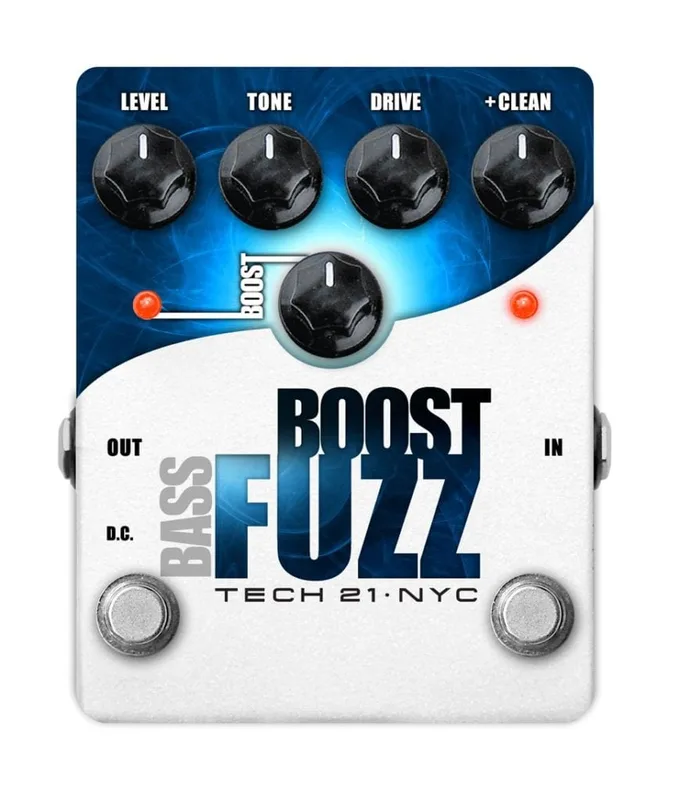
The core idea of the pedal is that the fuzz and the boost are two independent things. The boost section offers up to 21 dB of clean boost, and because it works post-effect, it raises the level of the signal after the fuzz stage rather than driving the fuzz harder1. Tech 21 says the boost can be used independently from the effect, and it has its own footswitch and a red LED so you can see at a glance whether it is engaged26.
For a bass player, that combination covers a lot of ground: a fuzz tone for sections that need it, a clean volume leap for solos or louder passages, or the boost alone as a simple volume pedal in one box. Vintage Guitar's reviewer described the two switches together as engaging "a clean volume leap capable of 21 db"7.
Tech 21 says its all-analog circuitry produces what the maker calls "righteous, vintage tones" with studio-quiet operation, and that each unit is designed and built from the ground up using individually selected, hand-biased discrete components2. The pedal is hand-built in the U.S.6.
"Responsive, flexible fuzz with a high-quality clean boost."
The controls and footswitches
The control set is built around blending fuzz against your untouched bass signal, then shaping the fuzz itself1:
| Control | What it does |
|---|---|
| Level | Adds fuzz; sets the fuzz level against the clean signal1 |
| Clean | Blends in the instrument's initial, unprocessed signal1 |
| Drive | Tempers the amount of fuzz; also responds to volume adjustments from the instrument1 |
| Tone | A sweepable low-pass filter, shifting the high cut from 10 kHz down to 1 kHz12 |
| Boost | Sets the amount of clean boost, up to 21 dB16 |
The clean knob is the feature that matters most for bass: rather than a fuzz that swallows your low end, you dial in as much of your original signal as you want alongside the fuzz1. The drive control responding to your instrument's volume knob means you can clean the fuzz up by turning the bass down, the way guitarists do with vintage fuzzes1.
The tone control is a specialized low-pass filter, sweeping the high cut between 10 kHz and 1 kHz, which lets you take the harsh edge off the fuzz or darken it right down12. Tech 21 also points to the pedal's high-impedance input as part of keeping the tone "open and controllable"2.
There are two footswitches: one for the fuzz bypass and one for the boost, each working independently16. The boost switch has its own red LED indicator6.
The Bass Boost Fuzz uses a buffered bypass rather than true bypass. Premier Guitar's reviewer found this prevents signal loss and high-end loss when the pedal is linked with other pedals in a chain1.
Power
The pedal runs on a 9-volt battery or a 9-volt power adapter; the DC supply was listed as optional when the pedal was introduced, so battery power is a fully supported option rather than a backup53.
Where it came from and how it differs from the guitar version
Tech 21 created the Bass Boost Fuzz with inspiration from its counterpart for guitarists, the Boost Fuzz, which was announced at the same time as part of the four-pedal Boost Series expansion14. The two share the concept of a fuzz with a 21 dB clean boost, but the Bass version is voiced for bass, with the clean blend and the sweepable low-pass tone filter doing the work of keeping the fundamental intact.
Bass Musician Magazine's reviewer Ty Campbell drew the practical distinction: Tech 21's Boost Fuzz is designed for guitar, and he would recommend that one for guitar, while the Bass Boost Fuzz is the one for bass players5. For 2014, Tech 21 gave the pedal a new look as part of its metallic series, with the same functions as before5.
What reviewers said
Premier Guitar's reviewer tested the pedal with a Phil Jones D-600 head and a pair of Glockenklang 112 cabinets, using basses including a Ritter R8 Singlecut, a '64 Fender Jazz, and a Nash P-style, and concluded it was a responsive, flexible fuzz with a high-quality clean boost, listing a street price of $1491. No Treble's review noted the 21 dB of clean boost and the line's analog circuitry6, and Vintage Guitar covered the pedal alongside the rest of the Boost Series, highlighting the clean volume leap from its two switches7.
Questions
Can you use the boost on the Tech 21 Bass Boost Fuzz without the fuzz?
Yes. The boost is operated by its own separate footswitch, so it can be used with or without the fuzz effect engaged. It delivers up to 21 dB of clean boost and works post-effect, meaning it raises the level of whatever signal is passing through the pedal at the time.
Is the Tech 21 Bass Boost Fuzz true bypass?
No. Premier Guitar's review describes it as having a buffered bypass rather than true bypass. The reviewer noted that the buffered bypass prevents signal loss and high-end loss when the Bass Boost Fuzz is linked to other pedals in a chain.
Does the Tech 21 Bass Boost Fuzz run on a battery?
Yes. It runs on a 9-volt battery or a 9-volt power adapter. The DC power supply was described as optional when the pedal was introduced, so the battery is a fully workable power source on its own.
What is the difference between the Tech 21 Boost Fuzz and Bass Boost Fuzz?
The Boost Fuzz is Tech 21's version designed for guitar, while the Bass Boost Fuzz was created with inspiration from that guitar counterpart but voiced for bass. A Bass Musician Magazine reviewer recommended the guitar version for guitarists and the Bass Boost Fuzz for bass players.
Is the Tech 21 Bass Boost Fuzz analog?
Yes. Tech 21 describes the Boost Series pedals, including the Bass Boost Fuzz, as using all-analog circuitry. The maker also says the pedal is designed and built from the ground up with individually selected, hand-biased discrete components.
Sources (7)
- Tech 21 Bass Boost Fuzz Pedal Review, Premier Guitar, 2012-09-05
- Bass Boost Fuzz, Tech 21 NYC, 2019-06-12
- Tech 21 Unveils Bass Boost Fuzz Pedal, No Treble (www.notreble.com), 2012-01-27
- Tech 21 Adds 4 New Effects to their Boost Series Line, Premier Guitar, 2012-02-08
- Tech 21 Bass Boost Fuzz Review by Ty Campbell, Bass Musician Magazine, 2014-05-01
- Gear Review: Tech 21 Bass Boost Fuzz Pedal, No Treble, 2012-10-23
- Tech 21’s Boost Series Pedals, Vintage Guitar magazine, 2013-12-06