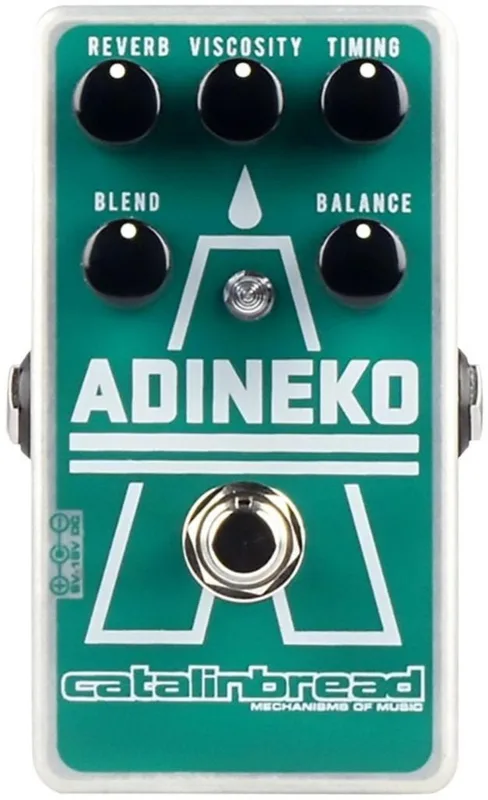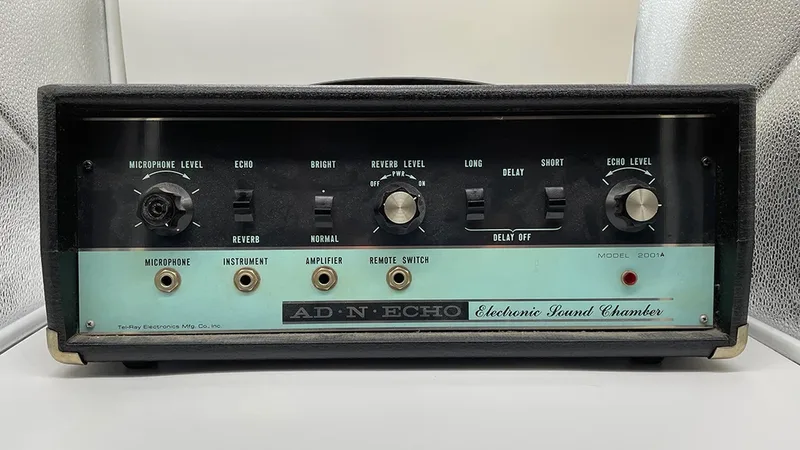


The Tel-Ray Ad-N-Echo is a stand-alone electromechanical delay unit from the 1960s, remembered today as the original "oil-can delay". In the '60s, two brothers, Ray and Marvin Lubow, created what Catalinbread's history of the design calls "an entirely new way to delay a signal": instead of magnetic tape, the unit stores the signal as an electrostatic charge inside a drum of oil1. It belongs to the same family of effects as modern delay pedals, but its method is unlike anything digital.
How it works
Opening the back of the unit reveals a can-like device filled with electrolytic oil and equipped with a motor, a flywheel and a pickup. The input signal is applied to a rubber belt by a charged wire brush, and the oil preserves the stored charge on the belt as the mechanism rotates, generating the echoes1. Vintage Guitar magazine describes the design as "an electromechanical echo unit employing a rotating disc inside a metal drum filled with electrostatic 'mystery' oil"2.
The lineage goes back further than the '60s: the design evolved from modified reel-to-reel tape decks, and the first mechanical delay devices debuted in the '50s1.
The oil-can name and the Adineko brand
The unit came to be known as the oil-can delay for its guts, which literally consisted of a can of oil with some other electronic parts1. Under the Adineko name, units were sold under several different brand names back then1.
What it replaced, and how it sounds
Before units like this, re-creating an echo meant an echo chamber or the famed Sun Studios dual-tape-machine setup. Vintage Guitar notes that Tel-Ray's Ad-n-Echo stand-alone unit allowed musicians to re-create echo effects without either2.
As for the sound, Catalinbread's account puts it plainly: "it sounded unique and awesome, thick, moody repeats that seamlessly melted into one another"1. That character, repeats that blur into each other rather than snap apart, is what the oil-can design is remembered for, and it is the sound later pedals such as Catalinbread's own Adineko set out to revisit1.
Videos
Cool Old Stuff
Tony Mullins
Sklizorch
Questions
Why is it called an oil can delay?
The nickname comes from the unit's internal construction. Inside the cabinet is a can-like device filled with electrolytic oil, equipped with a motor, a flywheel and a pickup. The input signal is applied to a rubber belt by a charged wire brush, and the oil preserves the stored charge on the belt as it rotates, which generates the echoes. Players knew the design by its guts: literally a can of oil with some other electronic bits.
What did the Ad-N-Echo replace?
Before stand-alone echo units, players needed an echo chamber or a dual tape machine setup, the approach famously used at Sun Studio. Vintage Guitar magazine notes that Tel-Ray's Ad-n-Echo stand-alone unit allowed musicians to re-create echo effects without either of those, which put a repeat effect within reach of ordinary players.
Sources (2)
- Tel-Ray Ad-N-Echo, Catalinbread Effects, 2021-08-06
- The Morley Rotating Wah, Vintage Guitar magazine, 2014-02-03