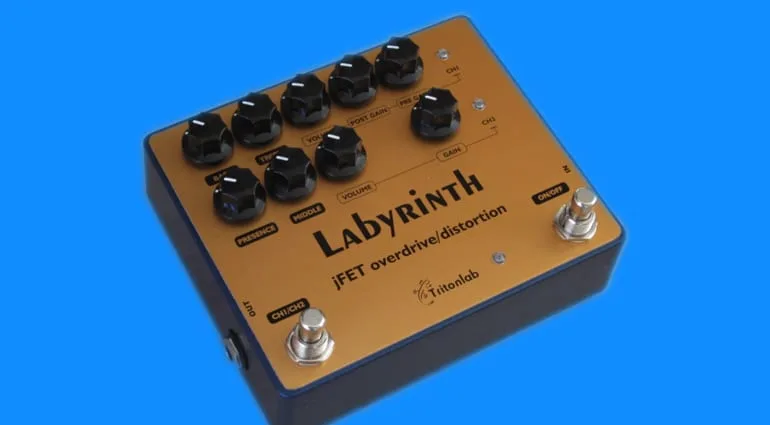
The TritonLab Labyrinth is a dual-channel overdrive and distortion pedal from TritonLab, a maker based in Estonia, launched in May 2018. It uses JFET technology, which the maker says simulates the behavior of a vacuum tube in a tube amplifier, and it runs its circuit internally at 33 volts, well above the 9 VDC supply that feeds it, to give the circuit much higher headroom than most pedals on the market1. For a player, that means two switchable drive voices in one box, sitting between the overdrive and distortion families.
How it works and what it does to your sound
The core of the Labyrinth's approach is JFET technology. TritonLab claims that the Labyrinth "simulates the behavior of a vacuum tube in tube amplifiers", and gearnews.com's report describes the result as a warm, tube-like sound with soft clipping and a lower noise level1.
The other half of the design is voltage. A step-up converter inside the pedal raises the internal supply to 33 volts, and the maker says this enables much higher headroom than most pedals on the market1. Headroom is the amount of clean signal a circuit can pass before it clips, so a higher internal voltage gives the drive stage more room before it breaks up.
"With an EQ built around the Marshall tone stack that many players know and love, and twin channels available via CH1/CH2"
The tone controls are built around the Marshall tone stack, the EQ arrangement used in Marshall amplifiers, which shapes how the mids and top end respond as you push the drive1.
Controls and channels
The Labyrinth's two channels are selected with a CH1/CH2 footswitch, and the two sides are laid out differently1.
Channel 1 carries the fuller control set, with separate Pre and Post Gain knobs alongside Volume, while channel 2 keeps things simple with Volume and Gain1.
Power and bypass
The Labyrinth needs an external power supply rated at 9 VDC / 200 mA, and no supply was included in the price. A 200 mA draw is higher than many single pedals, so plan your supply accordingly.
The pedal is true-bypass, so according to gearnews.com it "won't mess with your tone when not engaged"1.
Price and availability
The Labyrinth was hand built and launched as a new release in May 2018, with an RRP of EUR 120 plus EUR 12 shipping1. The price did not include a power supply1.
Questions
Is the TritonLab Labyrinth true bypass?
Yes. According to gearnews.com's 2018 report on the pedal's launch, the Labyrinth is true-bypass, so it will not affect your tone when it is switched out of the signal path. The pedal uses relay switching alongside its CH1/CH2 footswitch arrangement for its twin channels.
How much current does the TritonLab Labyrinth draw?
The Labyrinth needs an external 9 VDC power supply rated at 200 mA, which was not included with the pedal. Because of that current requirement, a standard low-current daisy-chain output may not be enough, so a supply with adequate headroom is worth planning for.
What is the tone stack in the Labyrinth based on?
The Labyrinth's EQ is built around the Marshall tone stack. gearnews.com described this as the tone control arrangement that many players know and love, paired with the pedal's twin channels selected via the CH1/CH2 footswitch.
How much did the TritonLab Labyrinth cost at launch?
At its launch in May 2018, the Labyrinth carried an RRP of EUR 120 plus EUR 12 shipping, according to gearnews.com. The price did not include a power supply, which had to be sourced separately.
Sources (1)
- TritonLab's new Labyrinth pedal: 33V of dual-channel overdrive and distortion, gearnews.com, 2018-05-31