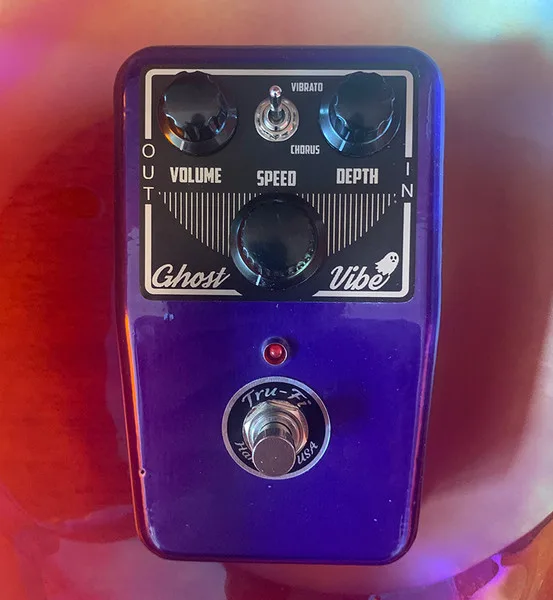


The Tru-Fi Ghost Vibe is a guitar pedal that recreates the Uni-Vibe, the optical chorus and vibrato effect first built in the late 1960s. Tru-Fi describes it as "A True Uni-Vibe in a small footprint, that runs on 9V and sounds like Woodstock plus"1. Like the original, it offers both chorus and vibrato modes, and it uses a light bulb and photocells to create its phase shifting pattern rather than the transistor stages of a conventional phaser1.
Tru-Fi says the pedal was voiced against the real thing: the company ABed it with six modern vibe pedals and a 1968 and 1969 original Uni-Vibe, and got it as close as possible to the 1968 vintage sound1. Delicious Audio calls it "A high-end US-built Uni-Vibe replica voiced after an original unit from 1968 and A/B'd against several modern variants"2. Over 500 units had sold as of Tru-Fi's product page in October 20261.
What a Uni-Vibe style pedal does
The original Uni-Vibe was designed as a chorus/vibrato for use with keyboards, aiming for a Leslie speaker type sound, and it produced an unusual phase sound that its makers actually labeled Chorus4. In chorus mode the pedal blends the dry signal from the preamp with the wet signal to create its distinctive phased sound; in vibrato mode it outputs only the wet signal, which is thinner and quieter, with a more pronounced pitch warble5. The Ghost Vibe carries over both modes, selectable on the pedal1.
The circuit topology is what separates a Uni-Vibe style pedal from an ordinary phaser. Aion FX describes the design as a four-stage optical vibrato based on the Uni-Vibe, using a photocell-based phase-shift topology6. In the Ghost Vibe, Tru-Fi says this is done with a light bulb and photocells creating the phase shifting pattern, the same approach as the 1968 original1.
Controls and the Buffer/Non switch
The Ghost Vibe sticks to the three controls of the original: Volume, Speed and Depth (called "Intensity" on the original Uni-Vibe), plus a Vibrato/Chorus switch7.
| Control | What it does |
|---|---|
| Volume | Sets the output level |
| Speed | Sets the rate of the sweep |
| Depth | Sets the intensity of the effect |
| Vibrato/Chorus switch | Selects between the two modes |
Inside the pedal there is also a Buffer/Non switch, and it ships set to non-buffered. Tru-Fi explains the difference17:
"The Buffer/Non switch is INSIDE, RED is buffered, they are set to NON BUFFERED."7
In practice that means the default position gives the darker, vintage character, while flipping the internal switch to buffered gives a brighter tone that Tru-Fi recommends when running the pedal with wah or fuzz. Changing it requires opening the enclosure, so it is a set-and-forget choice rather than a performance control17.
Power and bypass
The Ghost Vibe runs on 9V power with a negative tip, which is converted inside via the power chip to 18V; Delicious Audio notes this internal 18V operation gives extra headroom12. A 9V battery sits inside, but Tru-Fi is clear about its limits: "You CAN run the Ghost Vibe on a 9V battery but NOT long it is really just to test the signal"1. The pedal is true bypass1.
The internal 9V battery is intended only for testing the signal, not for long use. Power the Ghost Vibe from a 9V negative-tip supply for normal playing1.
Versions and finish
Alongside the standard finish, Tru-Fi offers a Zoso light gray custom finish, which one customer described as spectacular1. The pedal sits in what Tru-Fi calls the small enclosure the company uses, at roughly 5.25 inches deep by 3.5 wide by 3 high1.
What reviewers said
Guitar Pedal X named the Ghost Vibe among its best new modulation and utility pedals of 2023. Reviewer Stefan Karlsson's verdict:
"The thickest and fattest Uni-Vibes of all - sounds beautifully richly textured all of the time - but can get a touch flubby with higher gain and fuzz"3
The same review noted the pedal "looks gorgeous in standard purple" and listed it at $2993. The caveat about high gain and fuzz is worth weighing against Tru-Fi's own advice that the buffered internal switch position works best with wahs and fuzzes7.
Where the name came from
Tru-Fi says the name The Ghost Vibe was created by George Blekas, who was instrumental in getting the pedal finished1. Delicious Audio's write-up gives the same account7.
Videos
gilmourish
Alberto Barrero
Pete Clarke
Questions
Is the Tru-Fi Ghost Vibe true bypass?
Yes. Tru-Fi states the Ghost Vibe is true bypass, and Delicious Audio's write-up confirms it. There is a 9V battery inside, but Tru-Fi says the battery is really just for testing the signal rather than long-term use, so an external supply is the practical option.
Does the Ghost Vibe use a bulb and photocells?
Yes. Tru-Fi describes the circuit as using a light bulb and photocells to create a phase shifting pattern, the same optical approach as the original Uni-Vibe. That four-stage optical topology is what gives Uni-Vibe style pedals their characteristic sweep compared with transistor phasers.
What power supply does the Ghost Vibe need?
It runs on 9V DC with a negative tip, which is converted inside via the power chip to 18V for extra headroom. A 9V battery fits inside but Tru-Fi says it is only suitable for testing the signal, not for long use, so a standard 9V center-negative supply is the way to power it.
What does the Buffer/Non switch do?
It is an internal switch, shipped set to non-buffered. In the buffered position (red) the tone is brighter and Tru-Fi says it works best with wahs and fuzzes; in the non-buffered position you get the vintage, darker Uni-Vibe tone. Changing it means opening the pedal up.
Who named the Ghost Vibe?
Tru-Fi says the name The Ghost Vibe was created by George Blekas, who was also instrumental in getting the pedal finished. Delicious Audio's write-up repeats the same account of the name's origin.
Sources (7)
- The Ghost Vibe, tru-fi.com
- The 9 Best Uni-Vibe Pedals In 2024: A Guide To UniVibe Clones, Delicious Audio (delicious-audio.com), 2024-02-16
- Guitar Pedal X, Guitar Pedal X, 2023-12-19
- Sweet Sound Ultra Vibe, analogman.com, 2017
- The FX files: Uni-Vibe, MusicRadar, 2019-04-10
- Deluge Optical Vibe / EQD The Depths, Aion FX, 2026-07-03
- Tru-Fi Ghost Vibe, Delicious Audio, 2023-05-08