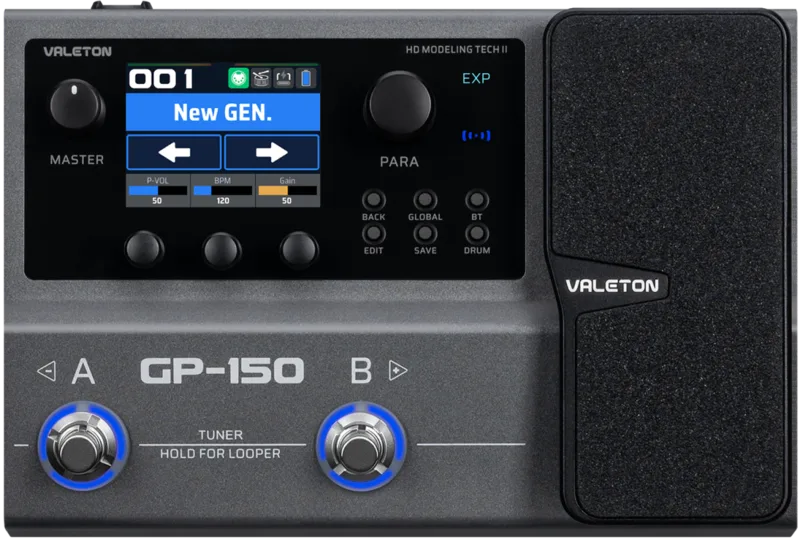


The Valeton GP-150 is a compact digital multi-effects processor: a self-contained floor unit that puts amp and effect modeling, presets, an IR loader, a drum machine lineage and a built-in expression pedal in one metal box. Valeton announced it in May 2026 alongside the larger GP-180, at a suggested retail price of $169.991. Valeton describes it as "compact, fully loaded, and designed to deliver complete functionality in a streamlined form"2.
The pitch is the all-in-one floorboard: instead of a pedalboard of separate boxes, one unit covers your whole chain, and it can run on an internal battery. For players who prefer separate stomps, Valeton frames the choice as "smooth, all-in-one operation or the open possibilities of a modular setup"2.
What it is and what it does
The GP-150 is a multi-effects pedal in floorboard form: a rugged metal chassis measuring 200 × 139 × 55mm and weighing 958g, holding the whole signal chain digitally3. It runs at 24-bit / 48kHz with a signal-to-noise ratio of 110dB3.
The controls: two footswitches and an expression pedal
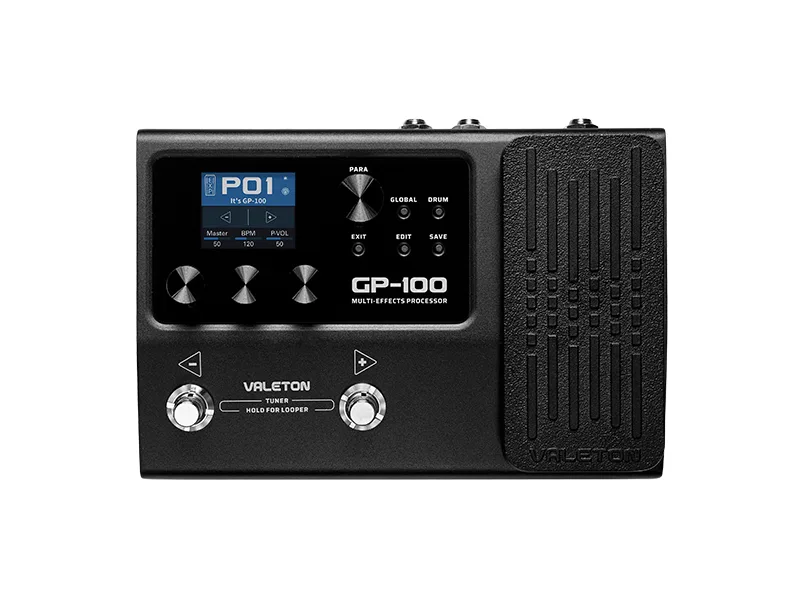
The control surface is where the GP-150 defines itself. Valeton says the "GP-150 carries the iconic GP-100 layout with dual footswitches and an expression pedal"2, and Premier Guitar's announcement confirms the set: two footswitches with an expression pedal1. Pedal of the Day adds that you "use dedicated switches for tap tempo and CTRL assignments"4.
What the built-in expression pedal means in practice was the point Cláudio Ribeiro drew out in his Bass Musician Magazine review5:
"Instead of just switching presets or toggling effects, you can actively shape your sound in real time… volume swells, wah, parameter control… it’s all immediately available."
In other words, the pedal is not just for preset scrolling: it can drive volume, wah and parameter control while you play5.
| Control | What it does |
|---|---|
| Two footswitches | Preset and effect switching, in the GP-100 layout21 |
| Expression pedal | Real-time volume swells, wah and parameter control5 |
| Dedicated tap tempo switch | Sets tempo for time-based effects4 |
| CTRL assignment switch | Custom control assignments4 |
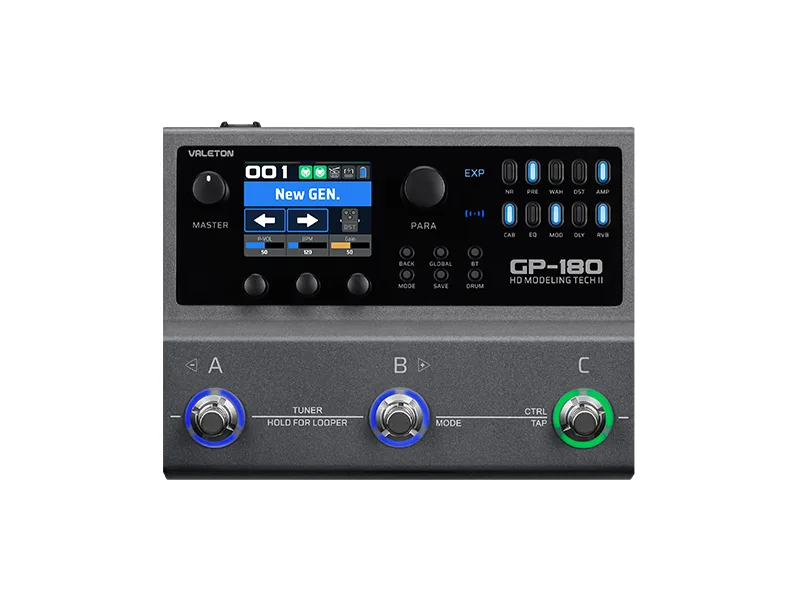
The contrast with the sibling GP-180 is control density: Valeton says the "GP-180 steps up the control experience with three footswitches and ten dedicated module shortcut keys"2. The GP-150 trades that for the smaller footprint.
Power, battery and charging
The GP-150 runs two ways. On the desk or pedalboard it takes DC 9V, center negative, on a 5.5×2.1mm plug3. On the move it runs from an internal 3000mAh / 3.7V battery3, and Valeton says charging is supported through the Type C port or the DC port1.
Valeton does not publish a battery runtime figure, only the 3000mAh capacity3.
MIDI and connections
MIDI control is supported through USB, Bluetooth, and a 6.35 mm TRS jack3, which covers the three common cases: a computer or controller over USB, wireless control over Bluetooth, and a hardware MIDI controller over a TRS cable. The audio path is a 1/4" TS input at 1M Ohm impedance, with the right output wired as a TRS balanced connection for running long lines to a desk or interface3.
Where it comes from: the GP-100 layout and GP-180 engine
The GP-150 sits between two Valeton lines. Its body and control layout come from the GP-100, the earlier floorboard unit with a built-in expression pedal and a 99-pattern drum machine62. Its processing comes from the GP-180: Valeton states that "both processors are built on the same core technology, the same new modeling engine, and the same next-generation algorithms"2.
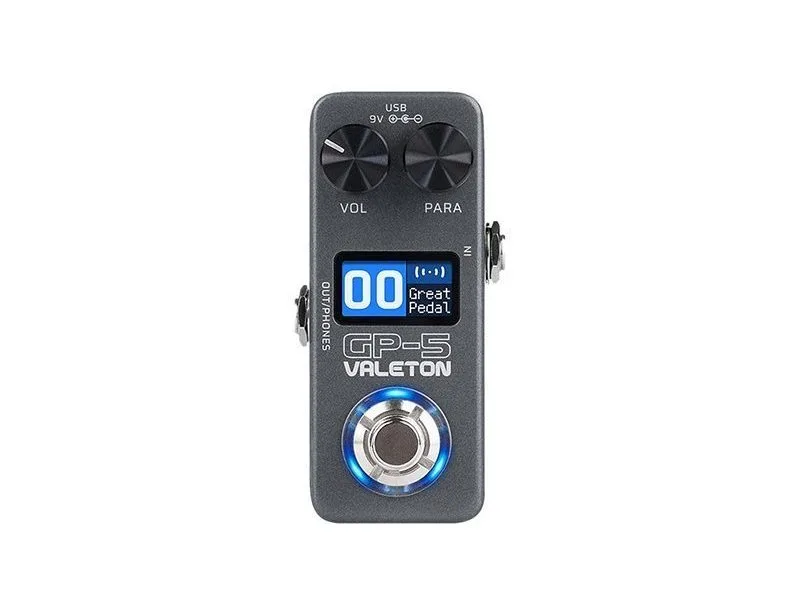
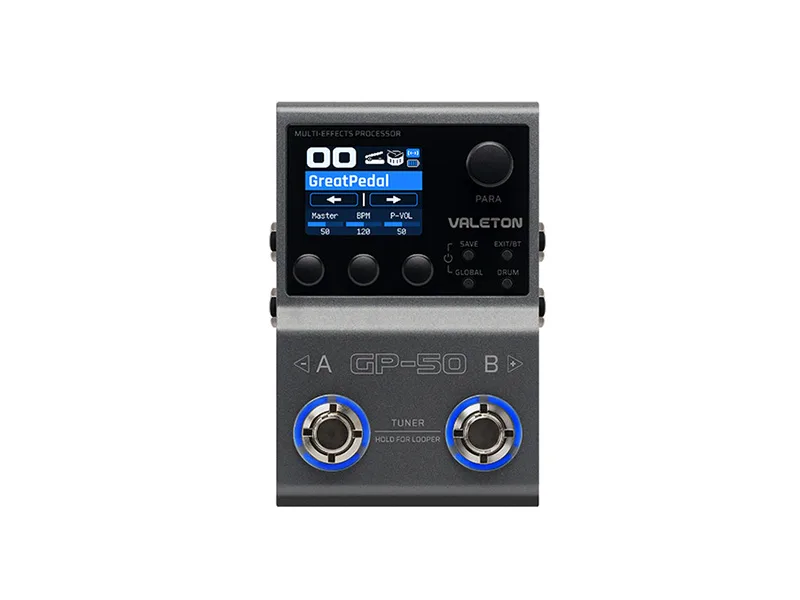
Ribeiro places the pair in the family tree in his review: the GP-150 and GP-180 "are more closely related to the GP-100 platform, positioned as more complete, floorboard-style sol[utions]" than the compact GP-5 and GP-505. So the GP-150 is effectively the GP-100's body running the GP-180's brain.
Firmware has moved since launch: Valeton's GP-150 online manual documents firmware V1.1.1, a file created and updated on 26-08-202637.
What reviewers said
Videos
Valeton
Ross Gallagher Music
Leon Brown Music
Questions
How long does the Valeton GP-150 battery last?
Valeton lists the internal battery as 3000mAh at 3.7V but does not publish a runtime figure. The unit draws at least 1A while operating, so real-world play time depends on how heavily it is used. It can also run on a standard 9V DC center-negative supply.
Can the Valeton GP-150 charge over USB-C?
Yes. Valeton says charging is supported through the Type C port or the DC port. The DC path needs at least 1A to operate and 2A to charge, while the USB-C path supports PD fast charging at up to 3A.
Does the Valeton GP-150 support MIDI?
Yes. Valeton states that MIDI control is supported through USB, Bluetooth, and a 6.35 mm TRS jack, so the unit can be driven from a controller, a computer or wirelessly depending on your setup.
Can you load IRs into the Valeton GP-150?
Yes. The GP-150 has 20 third-party IR slots, so you can load your own cabinet impulse responses alongside the factory content. IR loading is one of the features it shares with the larger GP-180.
What is a SnapTone file on the Valeton GP-150?
A SnapTone file is the GP-150's preset format. The unit stores up to 100 SnapTone files and ships with 50 curated selections included. Valeton's product page also describes patch capacity of 200 with 100 factory patches, so the two figures reflect different listings of the same unit.
Sources (7)
- Valeton GP-150 & GP-180 Multi-Effects, Premier Guitar, 2026-03-26
- GP-150GP-180, Valeton, 2026-09-15
- GP-150 - VALETON, Valeton (www.valeton.net), 2026-09-15
- Valeton GP-150 & GP-180 Multi-Effects Processors, Pedal of the Day, 2026-03-26
- Gear Review: Valeton GP-150 and GP-180 Reviews, Bass Musician Magazine, 2026-04-06
- GP-100 - VALETON, Valeton, 2026-10-14
- GP-150_Online Manual_DE_Firmware V1.1.1.pdf, valeton, 2026-08-26