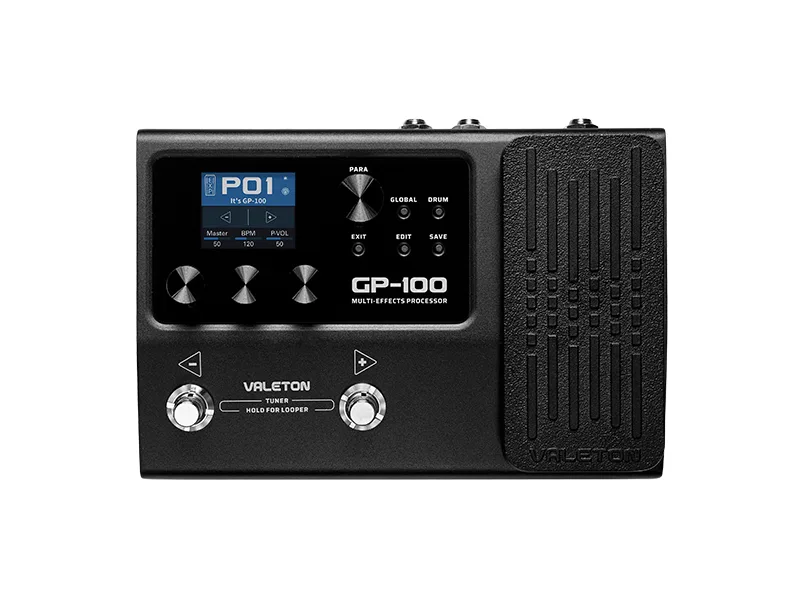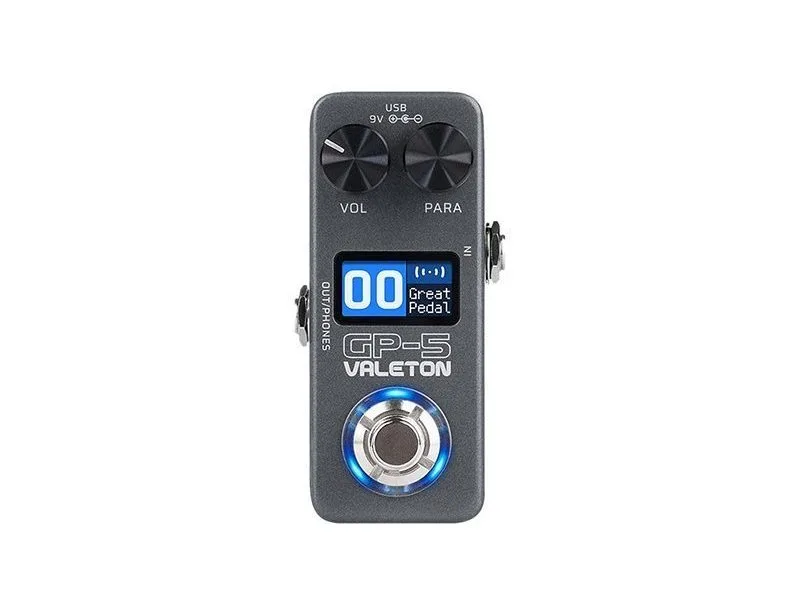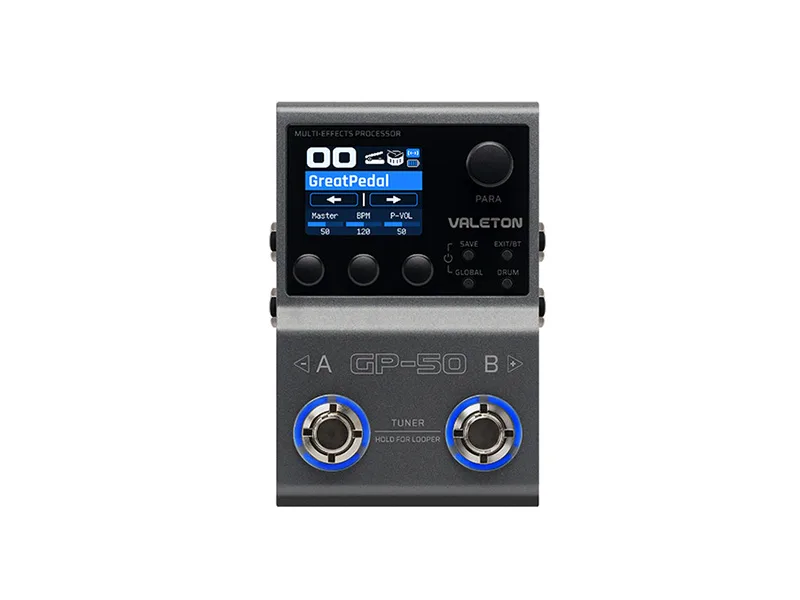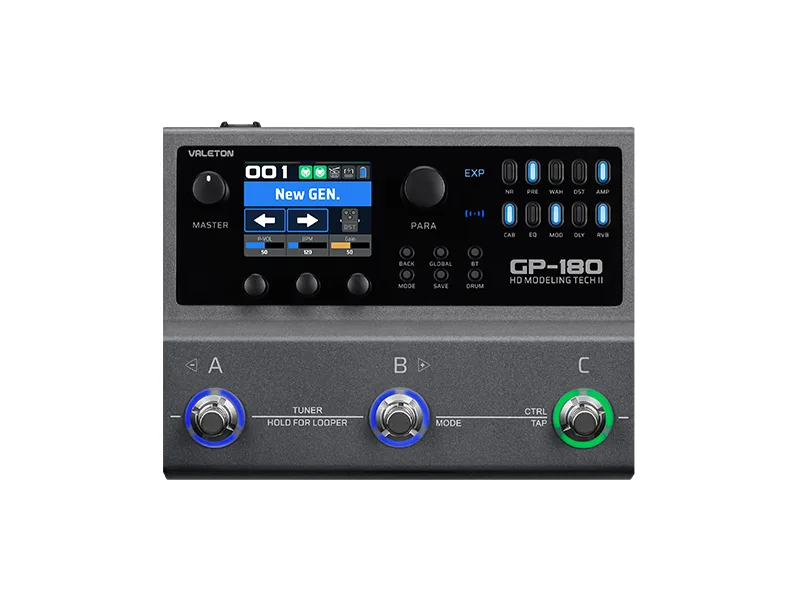


The Valeton GP-180 is a digital multi-effects processor in a compact, rugged metal chassis, built around Valeton's next-generation modeling engine and laid out to work like a small pedalboard rather than a preset-switching floor unit12. It carries a suggested retail price of $179.99 USD34.
Valeton positions the GP-180 as more than a standalone effects box. The company describes it as "the command center for players looking to build a flexible, sophisticated tone ecosystem around their rig," with expanded control ports and dual bypass modes that let it integrate into larger pedalboards2. In practice, that integration is what separates it from its smaller siblings in the GP Series.
What the GP-180 does
The GP-180 is a three-footswitch digital multi-effects processor: amp and effect modeling in one box, with the footswitches and shortcut keys arranged so individual effects can be toggled on and off the way you would stomp individual pedals on a board12. It stores up to 100 SnapTone files, with 50 curated selections included, plus 20 third-party IR slots for loading your own cabinet captures1.
Bass Musician Magazine's reviewer, Cláudio Ribeiro, found that layout is the point of the unit:
"In practice, this makes the GP-180 feel much closer to a traditional pedalboard."
That is, rather than stepping through whole presets, you can bring effects in and out individually, the way a pedalboard works. The same review places the GP-150 and GP-180 in Valeton's range as more closely related to the GP-100 platform than to the compact GP-5 and GP-50, describing both as more complete, floorboard-style solutions5.
The controls: three footswitches and ten module shortcut keys
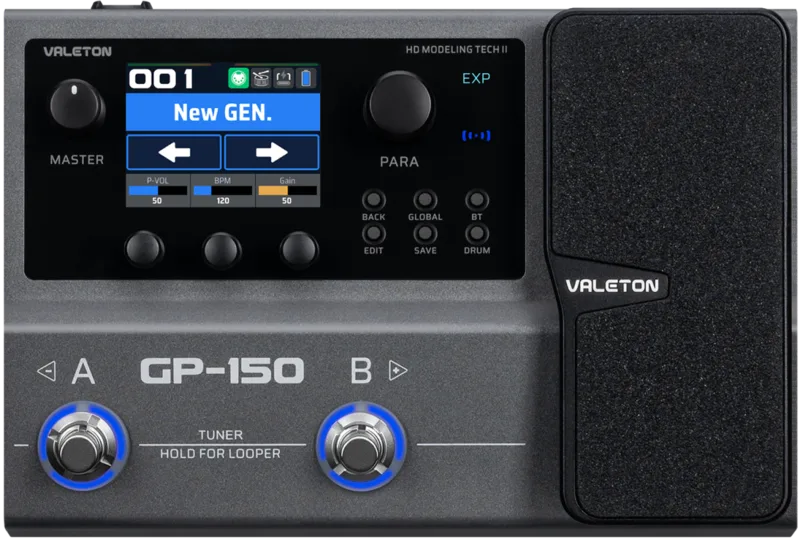
Where the GP-150 carries the GP-100 layout of dual footswitches and an expression pedal26, the GP-180 steps up the control experience with three independent footswitches and ten dedicated module shortcut keys12. The shortcut keys give direct access to effect modules without menu diving, and Pedal of the Day reports the unit also lets you use dedicated switches for tap tempo and CTRL assignments4.
A comparison of the two units' control layouts:
| GP-150 | GP-180 | |
|---|---|---|
| Footswitches | 26 | 31 |
| Module shortcut keys | None listed | 102 |
| Expression pedal | Onboard2 | Not listed |
| Module toggling | Up to six effect modules from two footswitches, plus tap tempo and sync6 | Individual effect toggling, pedalboard-style5 |
| Control ports | Standard for the GP-100 layout | Expanded, for larger pedalboards2 |
For players who want preset-style control with fewer switches, the GP-150's two footswitches toggle up to six effect modules and access tap tempo and sync functions6. The GP-180 instead spreads control across more hardware, which Bass Musician Magazine found makes it feel like a traditional pedalboard rather than a preset switcher5.
Power, connections and integration
The GP-180 runs on a 9V DC center-negative supply with a 5.5×2.1mm plug, and Valeton specifies a minimum operating current of 1A, with charging current listed at 2A1. That draw is well above what a typical compact pedal supply delivers, so it needs a power source sized for multi-effects units rather than a small daisy chain. It also has a built-in battery with a capacity of 3000mAh at 3.7V, so it can run untethered1.
For rig integration, the GP-180 offers:
- Switchable analog or digital bypass modes1
- A dedicated MIDI control page built in1, with a published MIDI list document at firmware V1.1.17
- Expanded control ports for larger pedalboards2
- A TRS balanced connection on the right output1
Videos
Valeton
Leon Brown Music
Jorge Albuquerque
Questions
Does the Valeton GP-180 have a built-in battery?
Yes. Valeton lists a built-in battery with a capacity of 3000mAh at 3.7V. The unit also runs on a 9V DC center-negative power supply with a 5.5×2.1mm plug, and the maker specifies a minimum operating current of 1A, with charging current listed at 2A.
Is the Valeton GP-180 true bypass?
Valeton does not describe it as true bypass. Instead, the GP-180 can be freely switched between analog and digital bypass modes, so you can choose which bypass behavior suits your signal chain.
Does the Valeton GP-180 have MIDI?
Yes. Valeton says a dedicated MIDI control page is built in, and the company publishes a MIDI list document for the unit. This supports integrating the GP-180 into larger rigs alongside other MIDI-controlled gear.
What is the difference between the Valeton GP-150 and GP-180?
Both share the same core technology, modeling engine and algorithms. The GP-150 keeps the GP-100-style layout with two footswitches and an expression pedal, while the GP-180 has three footswitches, ten module shortcut keys, expanded control ports and dual bypass modes for larger pedalboards.
Can the Valeton GP-180 load third-party IRs?
Yes. Valeton lists 20 third-party IR slots on the GP-180, alongside storage for up to 100 SnapTone files with 50 curated selections included.
Does the Valeton GP-180 have tap tempo?
Yes. Pedal of the Day reports the GP-180 has dedicated switches for tap tempo and CTRL assignments, so time-based effects can be synced without digging into menus.
Sources (7)
- GP-180 - VALETON, Valeton, 2026-09-15
- GP-150GP-180, Valeton, 2026-09-15
- Valeton GP-150 & GP-180 Multi-Effects, Premier Guitar, 2026-03-26
- Valeton GP-150 & GP-180 Multi-Effects Processors, Pedal of the Day, 2026-03-26
- Gear Review: Valeton GP-150 and GP-180 Reviews, Bass Musician Magazine, 2026-04-06
- GP-150 - VALETON, Valeton (www.valeton.net), 2026-09-15
- GP-180_MIDI List_EN_Firmware V1.1.1.pdf, valeton