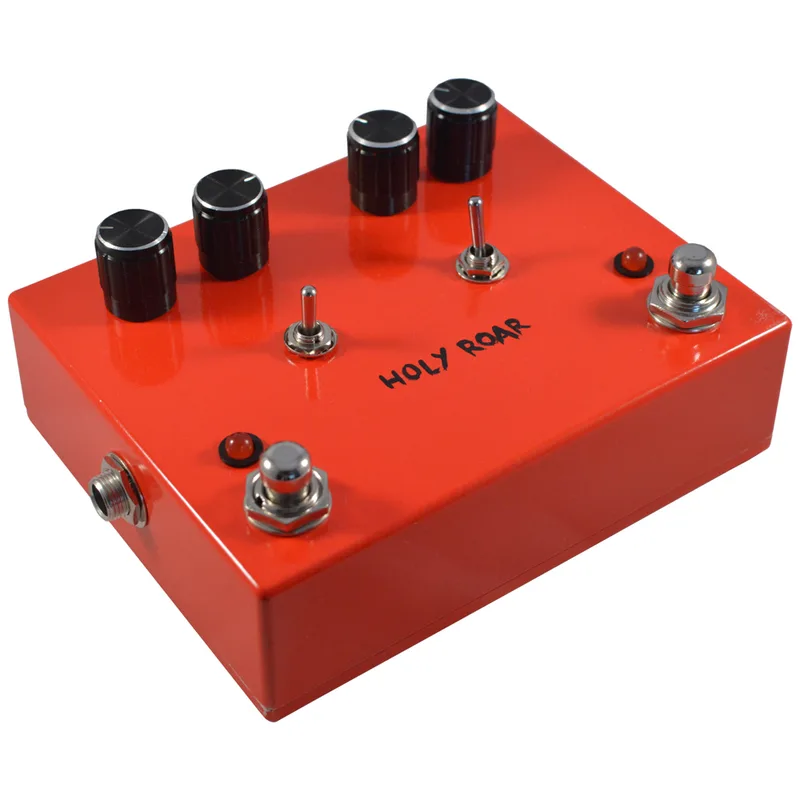

The Vein-Tap.com Holy Roar is a distortion and boost pedal that puts two independent circuits in one box: a 3-gain-stage distortion circuit on the right and a +24dB boost on the left. Vein-Tap.com voices the distortion after the classic non-master-volume Marshall amps of the 60s, describing it as a full-bodied distortion based on the Marshall JTM45 that runs from a warm crunch to full saturation1.
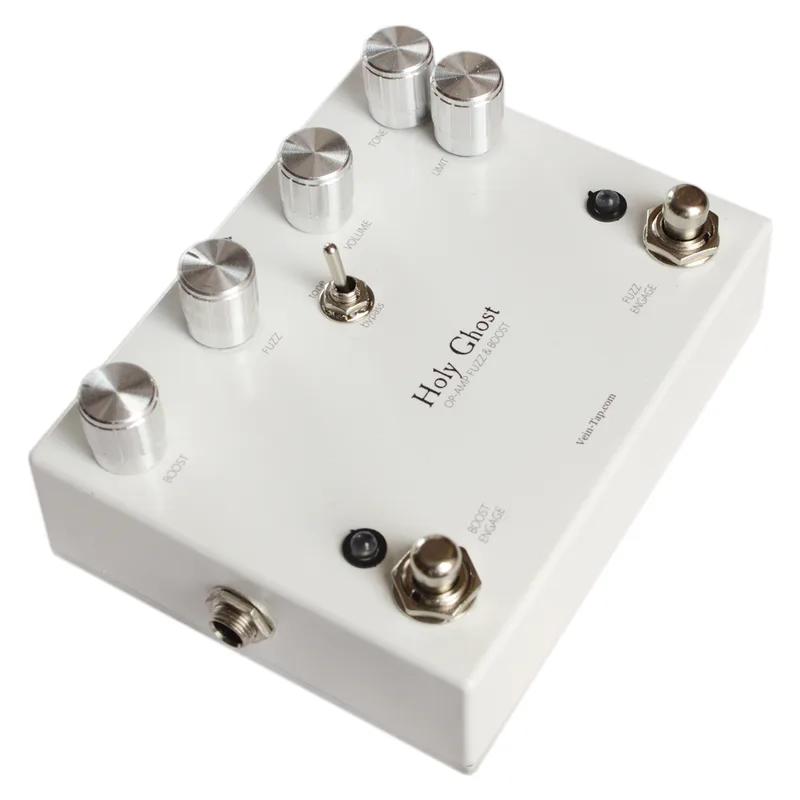
The two halves are entirely independent and can be used separately or together, which makes the pedal flexible on a board: the boost can run alongside the distortion, or sit at 0 and always on to act as a buffer. It sits alongside other two-in-one Vein-Tap.com pedals such as the Holy Ghost Fuzz and Boost Pedal1.
What the controls do
The pedal has three knobs and two switches, all described by the maker on its product page1.
| Control | What it does |
|---|---|
| Distortion | Goes from 0, for a delicate crunch, to layers of "Tufnel-esque" distortion at 11 |
| Tone | Goes from very dark at 0 to extremely bright at 11 |
| Volume | Goes from silence at 0 to "stupidly loud" at 11 |
| Boost knob | Goes from unity to +24dB volume boost |
| Rhythm / Lead switch | A toggle that reduces gain; down (Rhythm) makes more of the Distortion control's sweep usable in the lower gain stages, up (Lead) gives all the gain |
| Bass Tamer switch | Three positions that remove extreme low frequencies; uppermost knocks some out, center removes even more, down leaves the bass untamed |
The Rhythm/Lead switch is the one to reach for when the Distortion knob feels like all its usable range is crowded at the bottom: Rhythm spreads out the low-gain part of the sweep, while Lead opens the circuit up fully. The Bass Tamer works the other problem, tightening the low end so the distortion does not get flubby, and leaving it in the down position keeps the full low-frequency content intact1.
Where the two circuits come from
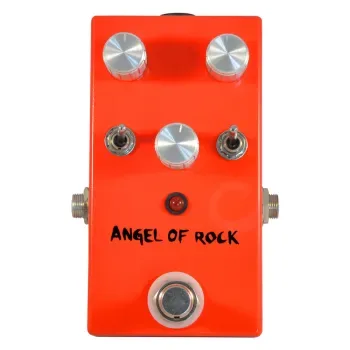
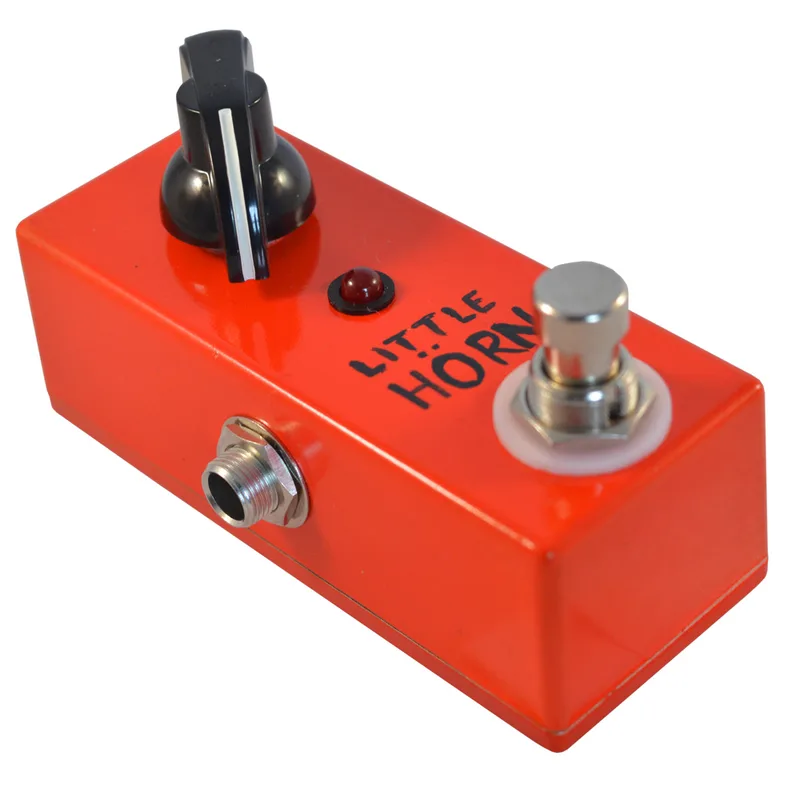
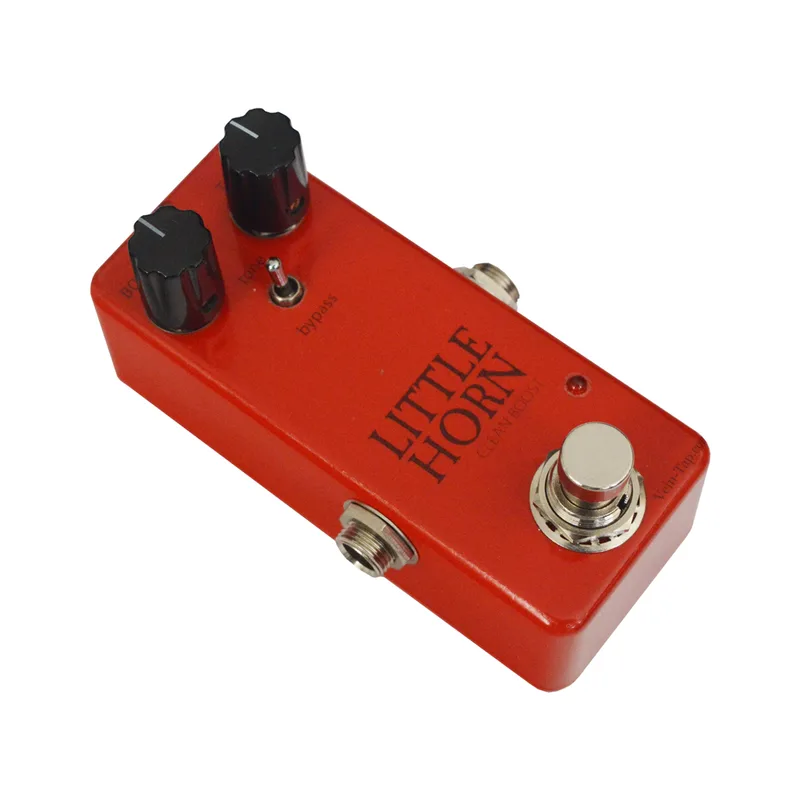
Neither half of the Holy Roar is a new design. Vein-Tap.com states that the distortion circuit is based on its Angel of Rock distortion pedal, and the boost section is based on the Little Horn boost pedal1.
The Little Horn has its own history at the company. The Holy Roar's boost circuit is based on Vein-Tap.com's Little Horn, the maker describing it as "Based on our Little Horn"1. That boost side delivers up to +24dB of clean level, matching the "mighty +24dB boost to the left" of the Holy Roar's two-sided layout21. You can read more about the Little Horn on the Little Horn Guitar Boost Pedal page3.
"Beyond proud are we to announce the Little Horn Clean Boost Pedal's v3.0 upgrade."
The Angel of Rock, the source of the Holy Roar's distortion side, is also a Marshall-voiced design in the Vein-Tap.com range1.
Using the boost on its own
Because the two circuits are entirely independent, the boost side can serve several roles beyond pushing the distortion1:
- Solo boost: up to +24dB of volume on top of your base sound1
- Amp pusher: driving the front of your amp harder on its own1
- Buffer: set at 0 and left always on, the boost section works as a buffer, restoring high-end sparkle lost to long cables1
That buffer trick is worth knowing for players with long cable runs or several true-bypass pedals in front of the Holy Roar: leaving the boost always on at unity costs nothing in volume and can brighten the whole chain. More on the technique generally is on the Boost Pedals page.
Videos
Vein-Tap.com
Questions
Can you use the boost and distortion on the Holy Roar separately?
Yes. Vein-Tap.com describes the boost and distortion circuits as entirely independent, so you can run one, the other, both, or neither at any time. The boost section sits to the left of the pedal and the distortion circuit to the right, and each is switched on its own.
What does the Bass Tamer switch do on the Holy Roar?
It is a three-position switch that removes extreme low frequencies from the distortion. The uppermost position knocks some of them out, the centre position removes even more, and the down position leaves the bass untamed. It lets you tighten up the low end to taste.
What does the Rhythm/Lead switch do on the Holy Roar?
It is a toggle that reduces gain. In the down (Rhythm) position the pedal makes more of the Distortion control's sweep available in the lower gain stages, which is useful for dialing in delicate crunch. In the up (Lead) position you get all the gain the circuit can deliver.
How much boost does the Holy Roar give?
The boost section goes from unity up to +24dB of volume boost, the same amount the Vein-Tap.com Little Horn boost pedal provides. At the lowest setting it neither adds nor cuts volume, so it can also sit in your chain doing nothing until you need it.
Can the Holy Roar boost work as a buffer?
Yes. Vein-Tap.com says you can set the boost at 0 and leave it always on, in which case the boost section works as a buffer, restoring high-end sparkle that long cable runs can take away from your guitar signal.
Sources (4)
- Holy Roar Distortion and Boost Pedal, Vein-Tap.com, 2026-09-01
- The Little Horn Cometh, Vein-Tap.com, 2014-10-28
- The Little Horn Guitar Boost Pedal from Vein-Tap.com, Vein-Tap.com, 2026-09-01
- The Little Horn Gets a v3.0 Upgrade, Vein-Tap.com, 2019-11-06