

The Vermona Filter Lancet is an analog filter and overdrive unit from VERMONA, the German maker formally known as Elektroakustische Manufaktur. It is a desktop effects unit rather than a stompbox: a box about 21 cm wide that sits next to a synth or mixer and reshapes whatever passes through it, from single tracks to full mixes. Vermona calls it "Our Swiss army knife to tweak individual tracks, voices and full mixes."1
The filter is a multimode design with three modes: 24-db-lowpass, 24-db-highpass and 12-db-bandpass. Vermona says the range of effects runs "from classic filter sweeps to wah- and tremolo-sounds and more," depending on which modulation source drives the cutoff.1
The controls: filter, LFO and envelope
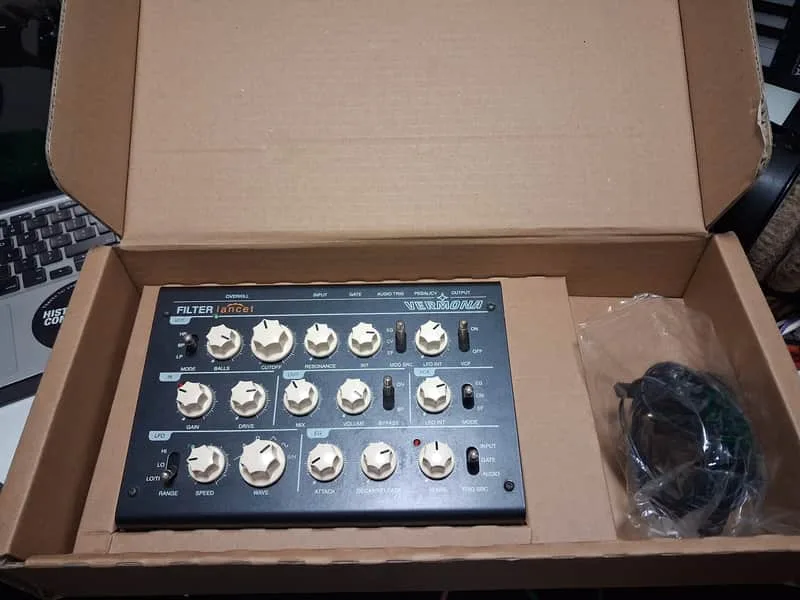
The filter's cutoff can be driven by four modulation sources: an envelope generator, an envelope follower, external CV, and an LFO.1
The LFO offers six waveforms: ramp up, ramp down, square, triangle, sine and sample-and-hold, with a frequency range of 0.05 Hz to 300 Hz. At the slow end that is a sweep lasting twenty seconds; at the fast end it moves into audio-rate territory, and Vermona lists tremolo-style sounds among the effects the unit can produce.1
The envelope generator works in AD or ASR modes, with attack from 1 ms to 10 s and decay/release from 1 ms to 15 s. The envelope follower instead tracks the level of the incoming audio, so the filter opens and closes with the dynamics of the signal itself, the way an auto-wah responds to a picking attack.1
| Section | What it does | Range |
|---|---|---|
| Filter | 24-db-lowpass, 24-db-highpass, 12-db-bandpass | three modes1 |
| LFO | Cutoff modulation, six waveforms | 0.05 Hz to 300 Hz1 |
| Envelope generator | AD and ASR modes | attack 1 ms to 10 s, decay/release 1 ms to 15 s1 |
| Envelope follower | Tracks incoming audio level | drives cutoff1 |
| Overdrive | Built-in drive circuit before the filter | 1 |
Power and connections: CV, gate and audio trigger
The Filter Lancet is built to sit in a synth and studio setup as much as a guitar rig. Its trigger and CV inputs accept an audio trigger, a gate signal with a minimum voltage of +4 V, and external control voltage of ±10 V. That means a synthesizer's gate and CV outputs, or a modular system, can fire the envelope generator and sweep the filter directly.2
Audio-wise, the input impedance of 1 MΩ and maximum input sensitivity of -32 dBu mean it will take instrument-level sources, and the output can reach 20 dBu into a 600 Ω load. Signal-to-noise is better than 80 dB on the direct path and better than 75 dB with the filter fully open.2
The unit runs on an external DC adapter supplying 12 V at 1000 mA1, not a battery, so it needs its own power supply on the pedalboard.
The Filter Lancet and the Retroverb Lancet
The Filter Lancet shares its filter design with Vermona's Retroverb Lancet: both units use the same multimode filter with lowpass, highpass and bandpass modes, an overdrive circuit and a discrete built VCA. The difference is what surrounds it. The Retroverb Lancet is a spring reverb unit with the filter and VCA sections built in, while the Filter Lancet is the filter and overdrive on its own, without the reverb.13
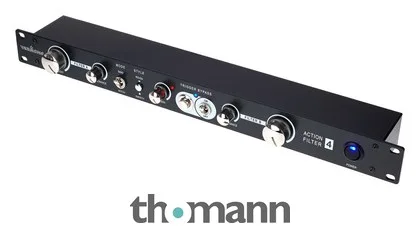
Vermona also lists the Action Filter 4 and the twinVCFilter as related products in the same family of filter units.2
Videos
AudioCentralMagazine
AudioCentralMagazine
Davii Heidini
Questions
Can you use the Vermona Filter Lancet with a guitar?
Yes, in principle. Its audio input has a 1 MΩ impedance and a maximum input sensitivity of -32 dBu, so it accepts instrument-level signals, and Vermona describes it as a tool to tweak individual tracks, voices and full mixes. It is a desktop unit rather than a floor pedal, so it suits a studio desk more than a pedalboard.
Is the Vermona Filter Lancet a pedal?
No. It is a desktop or tabletop effects unit, about 21 cm wide, 14.5 cm deep and 5.5 cm tall, weighing about 0.75 kg, with wooden side panels available as an accessory. It is built for studio and synth use rather than the floor.
What power supply does the Filter Lancet need?
It needs an external DC adapter supplying 12 V at 1000 mA. That rules out the 9 V power most guitar pedals use, so it cannot share a typical pedalboard power supply.
What is the difference between the Filter Lancet and the Retroverb Lancet?
Both units share the same multimode filter, including an overdrive circuit and a discrete built VCA. The Retroverb Lancet adds a spring reverb section, making it a reverb unit with filter and VCA sections, while the Filter Lancet is a filter and overdrive unit on its own.
Does the Filter Lancet have an envelope follower?
Yes. The filter's modulation sources are an envelope generator, an envelope follower, external CV and an LFO. The envelope follower lets the filter respond to the dynamics of the incoming audio signal itself.
Sources (3)
- VERMONA - Filter Lancet, VERMONA / Elektroakustische Manufaktur
- VERMONA - Filter Lancet, VERMONA (Elektroakustische Manufaktur)
- VERMONA - Ist Federhall noch aktuell?, VERMONA (vermona.com), 2016-09-01