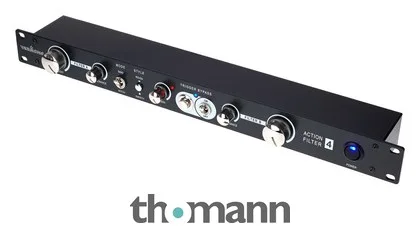

The Vermona Action Filter 4 is an analog stereo filter in a 1U 19-inch rack unit, made by VERMONA (HDB electronic GmbH) in Erlbach, Germany1. Vermona describes it as a filter "designed to mainly process complex audio sources"1, and the whole design pushes you toward playing it by hand: sweeping the cutoffs, switching modes, and rhythmically cutting the effect in and out with a big trigger button in the middle of the front panel2. There is no MIDI, no CV and no presets. Vermona puts it plainly: "Knowingly, Action Filter 4 does not offer any automation"2.
Each channel carries two high-pass/low-pass filters with 24 dB per octave slopes, and the two channels work in stereo, so a full mix, a stereo keyboard rig or a re-amp loop can all go through it3. Vermona positions it as a live tool, and the front panel is built for that: the trigger button is meant to be hit hard on stage2.
The controls: Cutoff, Trigger, Mode and Style
The front panel is organized around two filters, labeled FILTER A (left) and FILTER B (right). Vermona changed the knob labels from "High" and "Low" to these new names on the Action Filter 41. Two CUTOFF controls, which Vermona describes as soft and smooth turning, let you vary the band and notch zones for what the maker calls "purposeful killing or boosting of specific frequencies"2.
| Control | What it does |
|---|---|
| CUTOFF (FILTER A and FILTER B) | Sets the cutoff frequencies of the two filters; in Band mode FILTER A controls the highpass and in Notch mode it controls the lowpass1 |
| RESONANCE | Produces an emphasis around the cutoff frequency via internal feedback, deliberately restricted so the filter will not reach self-oscillation1 |
| MODE | BAND or NOTCH: series wiring for a bandpass, parallel wiring for a band reject filter1 |
| STYLE | ROUGH or SMOOTH: two different filter circuits (see below)1 |
| TRIGGER | Momentary button that activates or deactivates the filters while pressed1 |
| BYPASS | Latching on/off switch for the effect1 |
The RESONANCE control is worth a note for players used to synth filters: Vermona deliberately caps it. "The resonance in Action Filter 4 will not reach self-oscillation"1, so you can push the emphasis hard without the filter breaking into a whistle.
The TRIGGER button is the performance heart of the unit. Vermona explains that it "works like a transformer function on a DJ-mixer, activating or deactivating the filters for the period of the button-pressing, contrarily to the BYPASS switch"1. Where the bypass switch latches, the trigger is momentary: the filter effect is active only while the button is held down. Vermona notes that the TRIGGER button was designed to be hit harder than usual on stage2.
Band and Notch modes, and the Rough and Smooth circuits
The MODE switch chooses how the two filters per channel are wired. With MODE set to BAND, both filters are connected in series, forming a bandpass: only the slice of the spectrum between the two cutoffs gets through. In the NOTCH position the filters are wired in parallel, forming a band reject filter: a slice of the spectrum is removed and the frequencies above and below it pass untouched1. MusicRadar's review of the Action Filter 3, whose filters carry the same design, describes Notch mode as letting you "pull out the middle of the frequency spectrum and leave the top and bottom untouched"4.
The STYLE switch is a piece of the Action Filter's own history inside the current unit. Vermona explains that the first Action Filter used a slightly raw sounding circuit, and that the sound was optimized in the next revision, which led to a rounder sounding filter. Both are in the Action Filter 4: ROUGH equals the original Action Filter 1 circuit, SMOOTH the optimized revision1. You choose per patch which character you want.
Power and connections
The Action Filter 4 runs on 12V DC at 1A, and the power requirements are strict: Vermona states the supply's current must neither be under-run nor exceed 1A, and a stabilized power supply is required1. A 12V/1A DC supply is included in the box, along with a cable holder that can be attached next to the POWER connector to fix the supply cable in place1.
This is a rack unit, not a pedalboard pedal. Vermona warns that using the wrong power supply, particularly one delivering AC, may damage the unit. Polarity can be disregarded when connecting the supply, since the rear labeling refers to the provided unit1.
On the audio side, the L and R input jacks connect the source to be processed, and unlike the inputs, the jack and RCA outputs can be used in parallel, so you can feed a mixing console, an audio interface and an amplifier at the same time1. The inputs are unbalanced TS and RCA2, with input sensitivity from -16 dBu and a maximum input level of +22 dBu; the maximum output level is +15 dBu3. Input impedance is 10 kΩ3.
The fourth Action Filter
Vermona announced the Action Filter 4 on 14 April 2015, presenting the fourth version of what the maker calls its filter classic, now with 6.3 mm jack inputs and outputs in addition to the Cinch (RCA) connections5. The Action Filter line goes back further: MusicRadar traces its origins to the Vermona DAF-1 Dual Analog Filter, distilled into a live performance filter aimed at DJs and licensed to Stanton as the Stanton DJF-1 Professional Filter4. The line has always been about real-time, manual filtering rather than programmed sweeps, and the Action Filter 4 keeps that approach: no automation, no presets, just knobs, switches and a button built to be slapped.
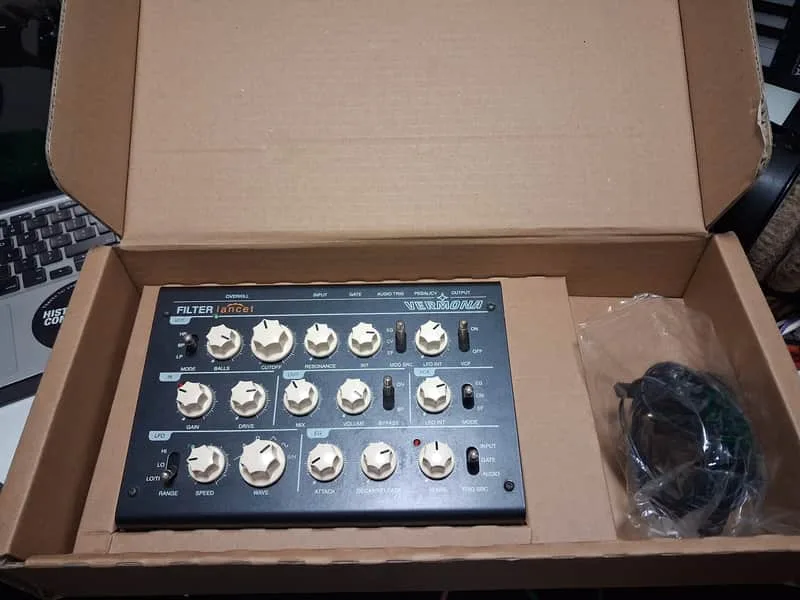
For players who want the same manual filter character in a stompbox, Vermona shows the Vermona Filter Lancet as a matching product3, and the maker's range also includes the VERMONA twinVCFilter and the filter section of the Vermona Retroverb Lancet. Compared with a filter pedal on a pedalboard, the Action Filter 4 trades foot control and automation for stereo operation, dual filters per channel and a level of input and output connectivity aimed at studio and live rigs rather than a guitar-to-amp chain.
One caution from the manual: opening the unit violates the warranty rules, and the manufacturer prohibits installing additional components or modifying the existing circuits1.
Videos
Geek Gear
Questions
Can you use the Vermona Action Filter 4 with a guitar?
Yes, in the sense that it accepts any line-level or instrument-level source through its unbalanced TS and RCA inputs, with input sensitivity from -16 dBu up to a maximum input level of +22 dBu. It is a stereo rack unit rather than a stompbox, so it sits after your other gear and is controlled by hand rather than by footswitch.
Does the Vermona Action Filter 4 have MIDI?
No. Vermona states plainly that Action Filter 4 does not offer any automation: there is neither MIDI nor control voltage (CV) control. Everything is done in real time with the front panel knobs, switches and the Trigger button.
What is the difference between Band and Notch mode on the Action Filter 4?
In Band mode the two filters per channel are wired in series, forming a bandpass that lets a slice of the frequency range through. In Notch mode they are wired in parallel, forming a band reject filter that pulls a slice out and leaves the frequencies above and below it untouched.
Can the Vermona Action Filter 4 use a standard 9V pedal supply?
No. It runs on 12V DC at 1A, and Vermona requires a stabilized power supply whose current is neither under-run nor exceeded. A standard 9V pedal supply will not power it, and a wrong supply delivering AC can damage the unit. A suitable 12V/1A supply is included.
How does the Trigger button work on the Action Filter 4?
The Trigger button works like a transformer function on a DJ mixer: it activates or deactivates the filters only for as long as you hold it down, which is the opposite of the Bypass switch, which latches. Vermona says it is designed to be hit hard on stage.
Sources (5)
- acf4-manual-en.pdf, VERMONA (HDB electronic GmbH), 2017
- VERMONA - Action Filter 4, VERMONA
- VERMONA - Action Filter 4, VERMONA (Elektroakustische Manufaktur)
- Vermona Action Filter 3 review, MusicRadar, 2012-09-27
- VERMONA - Neu: Action Filter 4, VERMONA (vermona.com), 2015-04-14