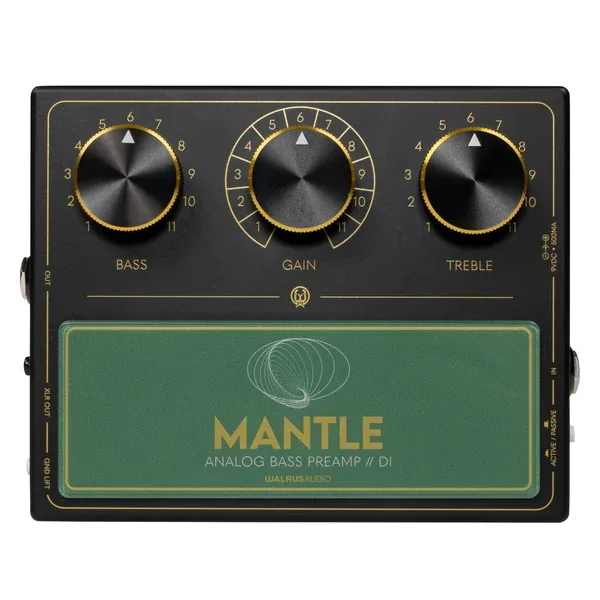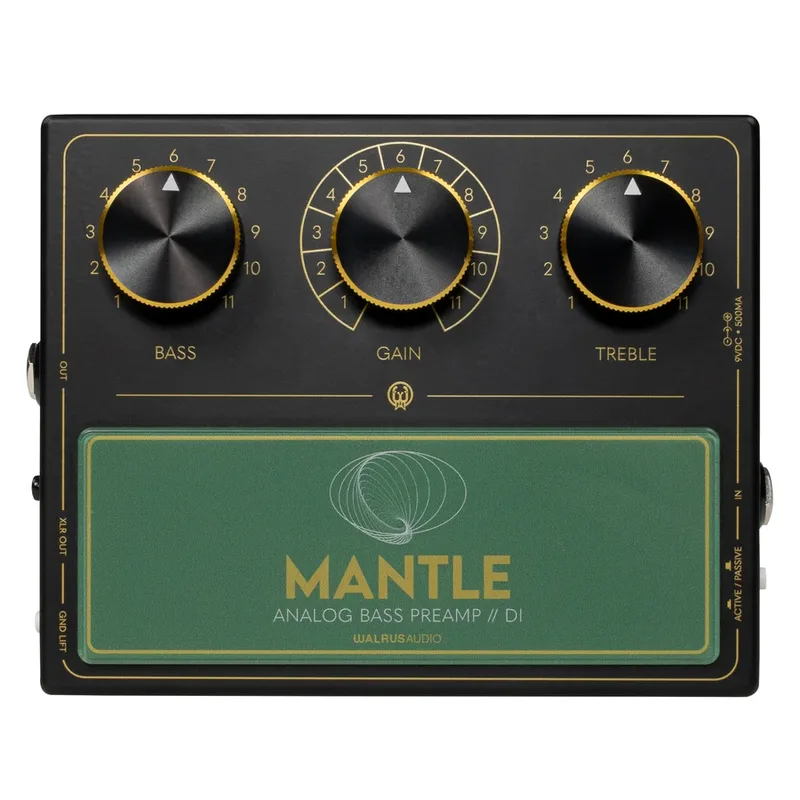


The input transformer is based on Neve designs and is built to handle large signals without added distortion, while the output transformer takes its influence from an API 312 output stage, which Walrus says balances the signal quietly and effectively while adding rich harmonic content to the amplified signal12. The company calls these proprietary parts Sapphire Transformers2. The result, in Walrus's own words, is a range running from "sparkling cleans to subtle transformer saturation without unpleasant breakup"3, with up to +23dB of transformer-based gain on tap3.
What the Mantle does to a bass signal
The Mantle sits at the front of a bass rig as a preamp pedal: it takes the instrument's high-impedance signal through a JFET input buffer, runs it through the transformer stages, and delivers it both to an amplifier and to a mixing desk or interface via the balanced XLR output21. Its Gain control is not a drive control in the usual sense. As Cláudio Ribeiro put it in his Bass Musician Magazine review:
"Instead of pushing the signal into distortion, it adjusts how the internal stages are engaged."
Ribeiro found that as gain increases the tone becomes denser and more harmonically rich without obvious saturation, and he described the overall character as a hybrid: vintage input-stage weight and density combined with the articulation and forward presence of punchier output circuits, "not a nostalgic recreation"5. On the direct output specifically, he reported "a noticeable sense of dimension and cohesion, closer to what you might expect from a well-mic'd amplifier," which he contrasted with flat DI signals5.
Controls and connections
The front of the pedal carries the audio path, and the rear carries the switching and DI connections. Guitar World's review lists the feature set as an active/passive switch, a ground lift, and the custom Sapphire input and output transformers4.
| Control or connection | What it does |
|---|---|
| Gain | Engages the internal transformer stages; up to +23dB of transformer-based gain35 |
| Bass and Treble | EQ boost; each increment adds +3dB, up to +15dB, with boost positions 7 to 111 |
| Active/Passive pad | Push button applying a -10dB pad; default out (passive)4 |
| Ground Lift | Push button; default out, ground connected4 |
| Input | 1/4" TS unbalanced, Hi-Z, JFET buffered, with the Active/Passive switch24 |
| Outputs | 1/4" output and male XLR balanced output14 |
The EQ controls behave in a way worth noting for players used to simple shelving tone stacks: Walrus says each control "begins as a shelf, gradually transitioning into a broad, musical bell as you increase gain," with each increment adding +3dB up to +15dB1.
The ground lift and balanced output
The XLR output is transformer-balanced, which Walrus describes as delivering "elevated DI tones that feel at home in high-end studio and live environments"1. The Ground Lift push button defaults to the out position with the ground connected; pressing it breaks the ground connection between the pedal and the desk, the standard fix for ground-loop hum when a DI and an amplifier are plugged into different mains circuits4. Output impedance is 150 ohms on both the balanced and unbalanced outputs, and the measured noise floor is -101dBV balanced and -94dBV unbalanced2.
Why transformers are unusual in a pedal
Transformers are everyday parts in high-end studio equipment but rare in pedal format, and their inclusion is central to what the Mantle is doing. Ribeiro identified the transformer-based stages as "a key part of this identity," noting that they ground the low end and add midrange complexity and depth5. The input transformer's Neve-based design handles large signals cleanly, while the API 312-derived output transformer provides the quiet, balanced output and the harmonic character23. That combination of a clean front end and a harmonically rich output stage is what reviewers kept returning to as the pedal's defining trait5.
What reviewers said
Guitar World's review found the Mantle delivers on its aims but flagged the cost, concluding that it "achieves what it sets out to, but it comes at a high price relative to its nearest (available) competition"4. The same review praised the enclosure: matte black powder coating with gold lines and labeling, and branding under a raised plexi window that illuminates when the pedal is switched on4.
Bass Musician Magazine's review was more expansive, describing the Mantle as a studio-quality bass front end with stepped EQ and a balanced output with ground lift, and finding the direct output closer to a well-mic'd amplifier than a flat DI5.
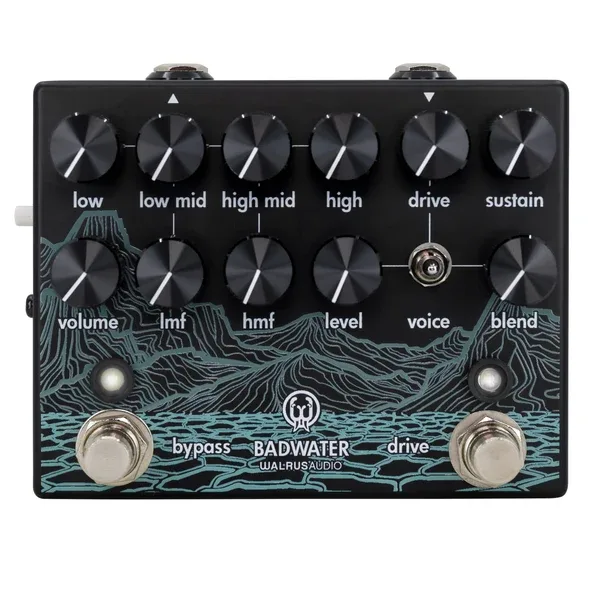
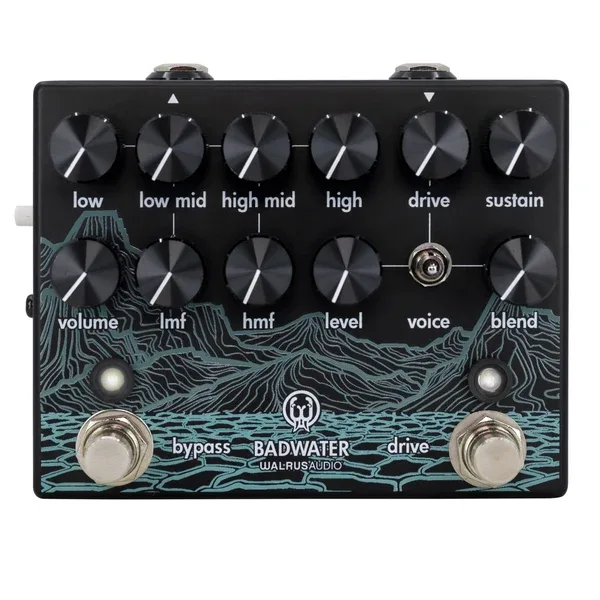
The Mantle sits at the premium end of bass preamp/DI pedals, with pre-orders opening at $749.992. Players comparing Walrus Audio bass options can also look at the Walrus Audio Badwater, another bass preamp and DI in the maker's range.
Videos
walrusaudioeffects
walrusaudioeffects
Scott's Bass Lessons
Questions
What does the Walrus Audio Mantle cost?
The Mantle lists at $749.99 USD. Walrus opened pre-orders at that price on January 13, 2026, with shipments beginning in early February. UK pricing was quoted at £749 and EU pricing at €859 at launch, though the US list price is the figure to plan around.
Is the Walrus Mantle a distortion pedal?
No. It is an analog bass preamp and DI. Its Gain control adjusts how the internal transformer stages are engaged rather than pushing the signal into distortion, and Walrus describes its range as sparkling cleans through subtle transformer saturation without unpleasant breakup. Reviewers found the tone gets denser and more harmonically rich rather than obviously saturated.
Does the Mantle have a balanced output?
Yes. It has a male XLR balanced output that Walrus describes as transformer-balanced for DI tones suited to high-end studio and live environments. Output impedance is 150 ohms balanced and 150 ohms unbalanced, with a measured noise floor of -101dBV balanced and -94dBV unbalanced.
Does the Mantle have a ground lift?
Yes. A push-button Ground Lift is on the rear panel, defaulting to the out position with the ground connected. Pressing it lifts the ground to break ground loops, a common source of hum when a DI feeds a mixing desk alongside an amplifier.
Why are transformers unusual in a pedal?
Transformers are standard in high-end studio consoles and DI boxes but rare in stompbox format because of cost and size. The Mantle uses custom-wound Sapphire transformers, an input transformer based on Neve designs and an output transformer based on an API 312 output stage, which Walrus says balance the signal quietly while adding harmonic content.
Sources (5)
- Mantle Analog Bass Preamp // D.I., Walrus Audio
- Mantle Analog Bass Preamp // D.I., Walrus Audio
- Walrus Audio Introduces The Mantle Analog Bass Preamp / D.I., Bass Magazine, 2026-01-13
- Walrus Audio Mantle Analog Bass Preamp & DI review, Guitar World, 2026-05-21
- Review: Walrus Audio Mantle... Rethinking the Bass Preamp Pedal, Bass Musician Magazine, 2026-05-18
 Ian Allison