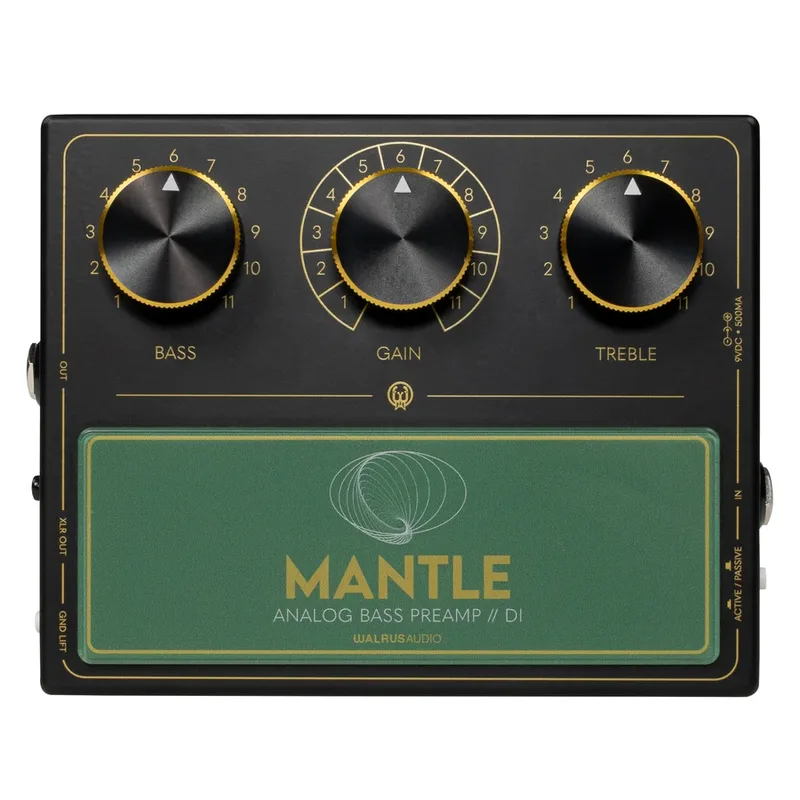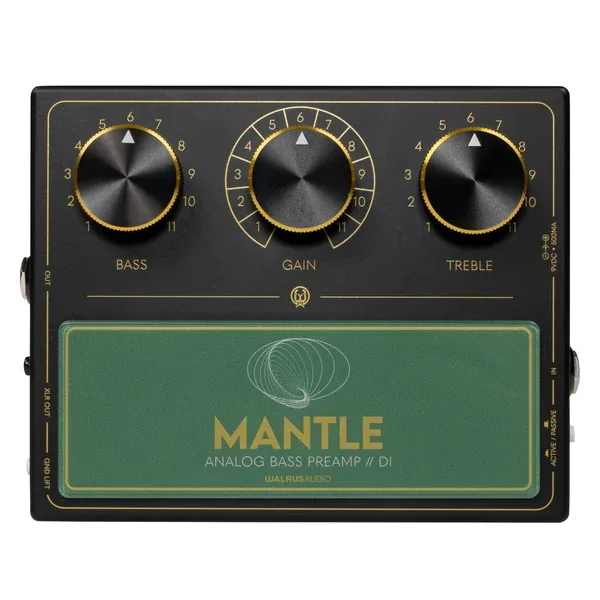


The Walrus Audio Mantle Analog Bass Preamp // D.I. is a premium analog preamp and DI for electric bass, built around proprietary custom-wound Sapphire Transformers rather than an IC-based tone stack. It was created in close collaboration with session bassist and bass educator Ian Martin Allison, and it joins Walrus Audio's Monarch series alongside the Meraki Analog Stereo Delay and the Highpoint Analog Optical Compressor1. Pre-orders opened January 13, 2026, with shipments beginning early February2.
For a player, the Mantle sits at the front of a bass pedalboard and does two jobs at once: it shapes the instrument's core tone with transformer-based gain and a stepped EQ, and it feeds the mixing desk directly through a transformer-balanced male XLR output, alongside a 1/4" unbalanced output for an amp or further pedals1. Walrus Audio describes its range as running from sparkling cleans to subtle transformer saturation without unpleasant breakup2.
What it does: an analog transformer preamp and DI for bass
The Mantle's gain comes directly from its input transformer, with a gain range of -6dB to +23dB1. The input is a high-impedance JFET buffer stage, which Walrus Audio credits with articulate, touch-sensitive response and exceptional clarity, and the input impedance is 1 MΩ1. On the output side, both the 1/4" and XLR jacks are transformer-balanced, with an output impedance of 150 ohms balanced and 150 ohms unbalanced1.
Measured performance figures from Walrus Audio:
| Specification | Value |
|---|---|
| Gain range | -6dB to +23dB1 |
| EQ boost range | 0dB to +15dB1 |
| Input impedance | 1 MΩ1 |
| Output impedance | 150 ohms balanced, 150 ohms unbalanced1 |
| THD | 0.04% at 1kHz, 1Vrms1 |
| Frequency response | 20Hz to 20kHz1 |
| Noise floor | -101dBV balanced, -94dBV unbalanced1 |
| Enclosure size (with knobs) | 6.09" x 4.7" x 2.28"1 |
The Active/Passive switch on the input is the headroom tool. Engaged, it introduces a -10dB input pad that Walrus Audio calls ideal for active basses or instruments with high-output preamps; disengaged, the pad is bypassed for full-strength passive bass output1. Bass Magazine's announcement likewise describes it as an Active or Passive pad to optimize signal headroom2.
The controls
The Mantle keeps its front panel to three controls plus the input pad switch: Gain, Bass, and Treble3.
| Control | What it does |
|---|---|
| Gain | Adjusts the amount of transformer-based gain applied to the signal, from -6dB to +23dB across the control range1 |
| Bass | Eleven-position rotary switch. Positions 7 to 11 boost, beginning as a shelf and transitioning into a broad, musical bell as gain increases, +3dB per increment up to +15dB. Positions 5 to 1 cut, introducing a steep -18dB/oct high-pass filter at selectable points: 30Hz, 50Hz, 80Hz, 100Hz, 120Hz1 |
| Treble | Eleven-position rotary switch, same boost behavior as the Bass control, +3dB per increment up to +15dB1 |
| Active/Passive switch | Engages a -10dB input pad for active or high-output basses1 |
Both Bass and Treble use eleven-position rotary switches rather than free-turning knobs, which Walrus Audio describes as giving a satisfying studio feel, easily reproducible settings, and a true flat response at noon, position 61. For a gigging player, stepped EQ means a setting dialed in at soundcheck can be found again exactly, and the Bass control's cut side doubles as a tunable high-pass filter for tightening up a boomy stage or keeping sub-bass out of the PA.
Power and connections
The Mantle runs on 9V DC, center-negative, through a 2.1mm barrel jack, and draws 500mA1. The 9V supply is internally boosted to +24V to feed the analog circuitry1.
No power supply is included with the Mantle. Guitar World's reviewer flagged this directly: you will either need a dedicated supply or a free 500mA output on your pedalboard power unit3. At 500mA, the Mantle will not run from a typical 100mA daisy-chain output.
Connections are straightforward: a 1/4" TS unbalanced Hi-Z input optimized for electric bass, a 1/4" TS unbalanced output for an amp or additional pedals, and a male XLR balanced output for the desk1. Guitar World lists the same connectivity: input with Active/Passive switch, output, and XLR output3.
Inside the circuit: Neve- and API-style transformers
The Mantle's character comes from its two custom-wound Sapphire Transformers, each modeled on classic recording-console designs. The input transformer is based on Neve designs and is built to handle large signals without added distortion while maintaining strong low end and midrange presence1. Bass Magazine describes it as inspired by classic Neve approaches to deliver strong low-end and midrange presence with clean handling of large signals2.
The output transformer is based on the output stage of an API 312, which Walrus Audio credits with a quiet, balanced output and rich harmonic character1. Bass Magazine echoes this, noting the API 312 influence provides quiet, balanced output and rich harmonics2.
The full signal path, as Walrus Audio documents it1:
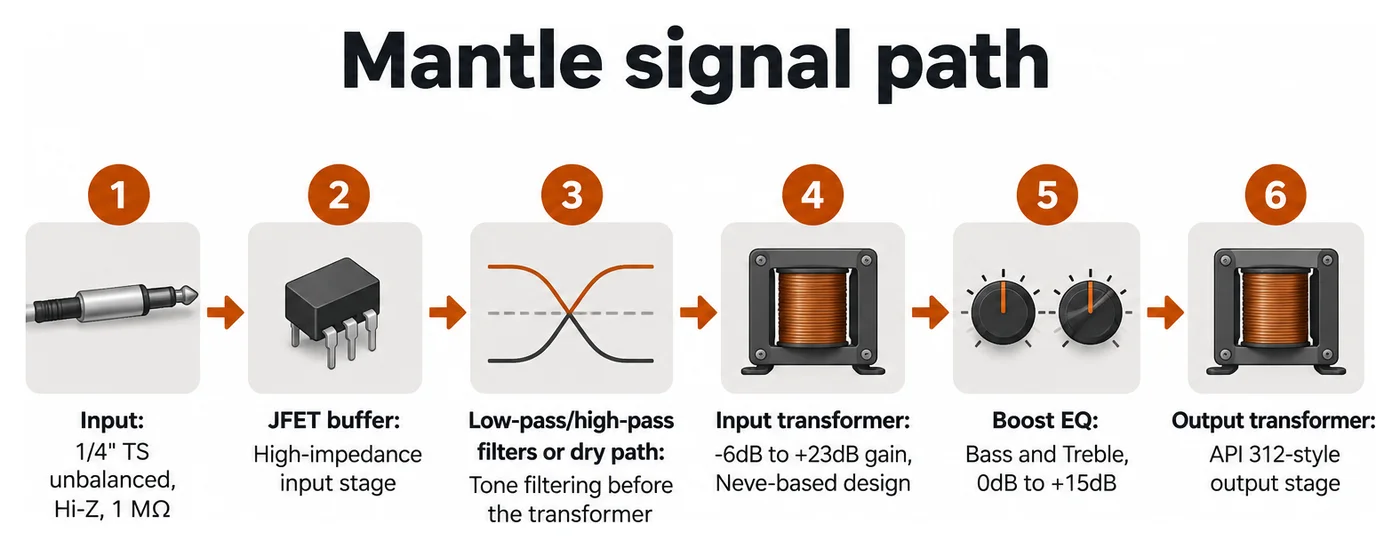
For context, the Mantle takes a different approach from a typical bass preamp and DI pedal: no compressor or overdrive, but studio-console transformer stages, stepped EQ, and a higher price point at $749.991.
Price and availability
The Mantle launched at $749.99 in the US, with Guitar World also listing launch prices of £749 in the UK and €859 in the EU3. Walrus Audio also sells blemished units at $637.49, where the blemish is cosmetic only, such as scratches or dents in the finish of the pedal1. All Walrus Audio products, the Mantle included, carry the company's limited lifetime warranty4.
Videos
walrusaudioeffects
walrusaudioeffects
Scott's Bass Lessons
Questions
Can the Walrus Mantle be used with an active bass?
Yes. The Active/Passive switch on the input engages a -10dB input pad that Walrus Audio describes as ideal for active basses or instruments with high-output preamps. With the switch disengaged, the pad is bypassed so a passive bass runs at full strength into the preamp.
Does the Walrus Mantle come with a power supply?
No. The Mantle requires a 9V DC, center-negative, 2.1mm supply delivering 500mA, and Walrus Audio does not include one in the box. Guitar World's reviewer noted you will need a dedicated supply or a free 500mA output on an existing pedalboard power unit.
How much does the Walrus Audio Mantle cost?
The Mantle launched at $749.99 in the US, with Guitar World also listing launch prices of £749 in the UK and €859 in the EU. Walrus Audio also sells blemished units, cosmetic flaws only, at $637.49.
Who designed the Walrus Mantle with Walrus Audio?
The Mantle was created in close collaboration with Ian Martin Allison, a session bassist and bass educator whom Guitar World also describes as a tone connoisseur. He is credited on Walrus Audio's own product page for the pedal.
Is the Walrus Mantle analog or digital?
It is fully analog. The signal path runs through a JFET input buffer, low-pass and high-pass filters or a dry path, a custom-wound input transformer, a boost EQ stage, and an output transformer, with no digital conversion anywhere in the chain.
Sources (4)
- Mantle Analog Bass Preamp // D.I., Walrus Audio
- Walrus Audio Introduces The Mantle Analog Bass Preamp / D.I., Bass Magazine, 2026-01-13
- Walrus Audio Mantle Analog Bass Preamp & DI review, Guitar World, 2026-05-21
- Mantle Analog Bass Preamp // D.I., Walrus Audio
 Ian Allison