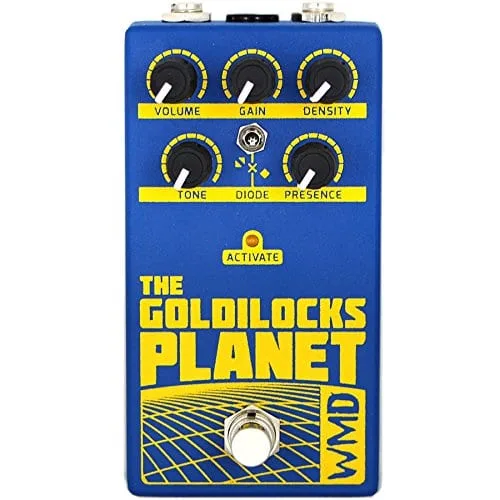



The WMD Goldilocks Planet is a compact analog distortion pedal from WMD. WMD describes it as a distortion pedal with three different methods of clipping, a variable tone stack, and a density knob that brings out more low end and body in your signal1. The name comes from the idea behind it: not too hot, not too cold, but just right, aimed at players who want to dial in a good tone fast on a small pedal1.
The Goldilocks Planet is discontinued. WMD's product page states it plainly, so it is no longer sold new and is mostly found on the used market1.
What it does and how it is controlled
The three clipping modes are the core of the pedal. Clipping is what shapes a distorted signal: the circuit slices off the peaks of your guitar's waveform, and how it does that sets the character of the distortion. Giving you three methods of clipping in one box means the Goldilocks Planet can cover a range of distortion voices without changing pedals1.
The controls WMD gives, and what each one does:
| Control | What it does |
|---|---|
| Clipping mode switch | Selects among three different methods of clipping, setting the character of the distortion1 |
| Tone stack | Variable tone stack for shaping the frequency balance of the distorted signal1 |
| Density | Brings out more low end and body in your signal1 |
WMD's own words on the density control:
"brings out more low end and body to your signal"
That control is useful for players who find small distortions thin, especially on the low strings or with a bass, since low end retention is a common weak point in compact distortion circuits.
Power and connections
The Goldilocks Planet runs on 9V DC with a center negative plug, the standard arrangement for compact pedals, and draws only 10mA1. That light draw means it shares a pedalboard supply easily. The input impedance is 100K and the output impedance is variable1. Switching is true bypass, so with the pedal off your signal passes through untouched1.
The electrical and mechanical specifications at a glance:
| Specification | Value |
|---|---|
| Bypass | True bypass1 |
| Power | 9V DC, center negative1 |
| Current draw | 10mA1 |
| Input impedance | 100K1 |
| Output impedance | Variable1 |
| Dimensions | 4.625″ x 2.5″ x 2.25″ with knobs1 |
Size and build
WMD lists the enclosure at 4.625″ x 2.5″ x 2.25″ including the knobs1. That is a small, standard pedalboard footprint. WMD warrants every product it makes for 12 months after purchase1, though for a discontinued unit bought secondhand that warranty applies only from the original purchase date.
Where it sits among distortion pedals
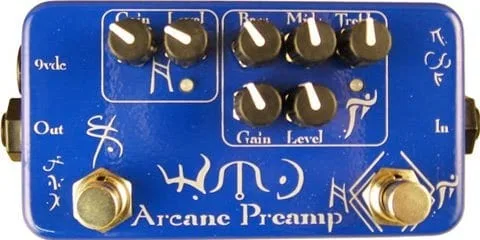
Compared with a fixed voice overdrive or fuzz, the Goldilocks Planet's appeal is the choice of three different modes of clipping plus a variable tone stack. WMD also made the Arcane Preamp. For players comparing compact distortions, the Goldilocks Planet's density control is a distinguishing feature, since it brings out more low end and body to your signal1.
Videos
WMDevices
WMDevices
Pedals and Effects
Questions
Is the WMD Goldilocks Planet true bypass?
Yes. WMD lists the Goldilocks Planet with true bypass switching, so with the pedal off your signal passes through without the circuit coloring it. It runs on 9V DC with a center negative plug, like most modern compact pedals.
How much current does the Goldilocks Planet draw?
WMD lists a current draw of 10mA at 9V DC, center negative. That is a light draw, so it shares a typical 9V pedalboard supply easily and leaves plenty of headroom on an isolated output.
Is the WMD Goldilocks Planet discontinued?
Yes. WMD's product page states plainly that the Goldilocks Planet is discontinued, so it is no longer made new. Players who want one generally look for used units, and WMD's 12 month warranty applies from the original purchase date.
How big is the WMD Goldilocks Planet?
WMD lists the enclosure at 4.625 inches by 2.5 inches by 2.25 inches including the knobs. That is a standard small footprint, close to a typical compact pedal, so it fits easily on a crowded pedalboard.
Sources (2)
- Goldilocks Planet, WMD (wmdevices.com)
- The Goldilocks Planet by WMD, RockBoard PedalPedia, 2026