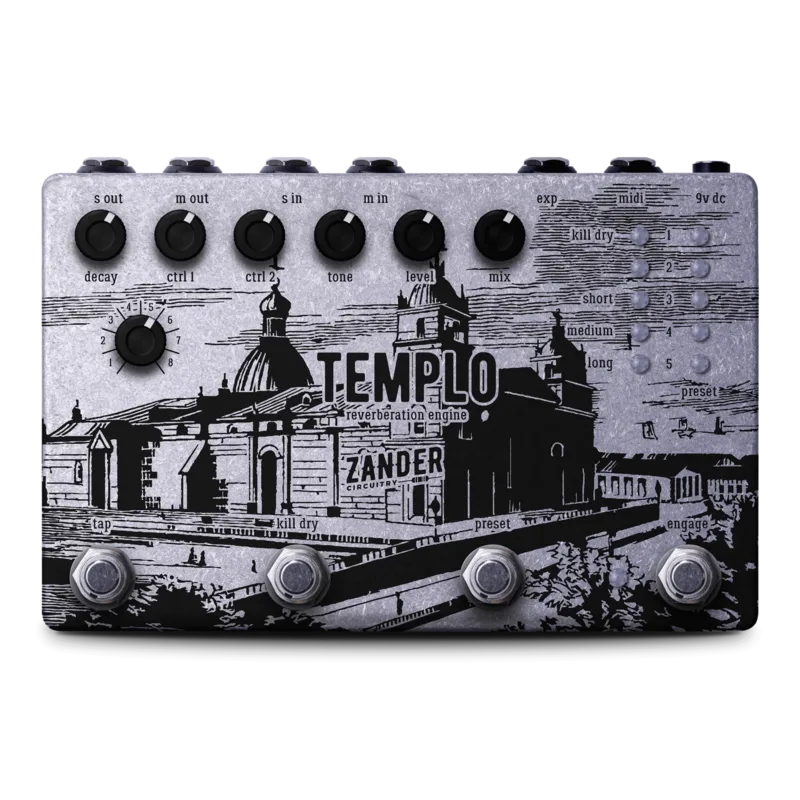


The Zander Circuitry Templo is a multi-reverb pedal from Zander Circuitry, the boutique builder run by Alex Millar1. It houses eight reverb modes, four that Zander calls more traditional and four that are quite experimental, covering ground from spring and hall emulations to granular and lo-fi treatments2. Delicious Audio describes it as Millar's take on "the fully stereo multiverb workstation"1.
Zander's own framing of what the pedal offers: "From the humble twang of a spring to the vast expanses of chasms and caves, you're sure to find a multitude of uses for adding a bit (or a lot) of space and depth to your sound."2
Zander Circuitry states the Templo is not available for purchase in the UK or EU due to ROHS non-compliance, because of the optocouplers used in the pedal2.
The eight reverb modes
The Templo's modes split evenly between familiar reverb types and more unusual treatments. Delicious Audio lists the full set as Spring/tile, Room/hall, Cave, Solid State, Whirl, Spectral, Lo-Fi and Granular1.
| Mode | What it does | CTRL 1 | CTRL 2 |
|---|---|---|---|
| Spring/tile | Spring-style reverb | Extends the pre delay time to emulate a larger spring tank | Alters the short delay time, adding more "springiness" to the sound2 |
| Room/hall | A flexible "all-rounder" offering room (short decay/pre delay) and hall (long decay/pre delay) sounds1 | Alters the predelay | Affects the low frequency loss2 |
| Cave | A deep, dark verb capable of long decay times combined with a wide-ranging modulation section | Modulation rate | Modulation depth2 |
| Solid State | Based around the delay time structure of the MN3011 bucket brigade delay chip used in many analog and solid state reverb units2 | ||
| Whirl | A large church style reverb combined with a four voice chorus2 | ||
| Spectral | A large church style reverb combined with a lower octave duplication and a higher octave shimmer effect2 | ||
| Lo-Fi | A shorter, thinner reverb with very intense high pass filtering and sharper sounding modulation | Modulation speed | Frequency of a 2 pole high pass filter2 |
| Granular | Granular reverb treatment | Aliaser frequency | Aliaser mix2 |
The two CTRL knobs change jobs from mode to mode, so what CTRL 1 does in Spring/tile is unrelated to what it does in Cave. The Decay knob sets reverb time, and Zander notes that the maximum decay varies across the patches2.
The Solid State mode is the one with a specific circuit lineage: it is built around the delay time structure of the MN3011 bucket brigade delay chip, the same chip family used in many analog and solid state reverb units2. Delicious Audio highlights this as the mode's point of reference1.
The footswitches
Four footswitches sit on the Templo, each with its own job1:
- Engage: turns the pedal on and off2
- Kill dry: removes the dry signal, and has both a momentary and a latching mode2
- Preset: accesses your saved sounds2
- Tap: quickly taps between short and long decay times; hold it down for maximum decay time2
The kill dry switch is worth noting for anyone running the Templo in a parallel loop or a stereo rig: removing the dry signal entirely lets the pedal carry only the wet reverb, and the momentary mode gives you that effect only while the switch is held2. Delicious Audio also notes the pedal's momentary max decay capability, reachable through the Tap switch's hold function1.
Power, presets and connections
The Templo runs on a 9V DC center-negative supply and draws 250 mA2. That current draw is well beyond what a typical battery or a small daisy chain can comfortably supply, so plan on an isolated or adequately rated power outlet.
At 250 mA, the Templo needs a power supply rated for that draw on its output; it is not a low-current pedal2.
Connections are top-mounted in/out jacks with full stereo options2. The pedal holds 5 on-board presets, and it is MIDI-compatible, so with a MIDI controller the preset count expands to 1282. Full expression pedal control is also on the spec sheet, letting you sweep parameters with an expression pedal rather than bending down mid-song2.
Where it came from
The Templo comes from Zander Circuitry, a boutique builder whose pedals Delicious Audio credits as full-fledged multi-mode designs, with Alex Millar named as the designer1. Delicious Audio's coverage frames the Templo as Millar's take on a fully stereo multi-reverb workstation, released in a market where few small builders attempt that format1.
Videos
Zander Circuitry
Zander Circuitry
Zander Circuitry
Questions
Can you buy the Zander Templo in the UK or EU?
No. Zander Circuitry states the Templo is not available for purchase in the UK or EU because it is ROHS non-compliant, owing to the optocouplers used in the pedal. Players in those regions cannot buy it new from the maker while that restriction stands.
How many presets does the Templo hold?
The pedal holds 5 on-board presets, reachable from the Preset footswitch. It is also MIDI-compatible, and with a MIDI controller the preset count expands to 128.
Does the Templo work with an expression pedal?
Yes. Zander Circuitry lists full expression pedal control for the Templo, with an expression pedal input on the pedal, so you can sweep parameters hands-free while playing.
Is the Zander Templo stereo?
Yes. The Templo has top-mounted input and output jacks with full stereo options, and Delicious Audio describes it as a fully stereo multi-reverb workstation.
Sources (2)
- Zander Templo Stereo Multi-Reverb, Delicious Audio, 2022-02-01
- Templo - Zander Circuitry, Zander Circuitry, 2022-02-01