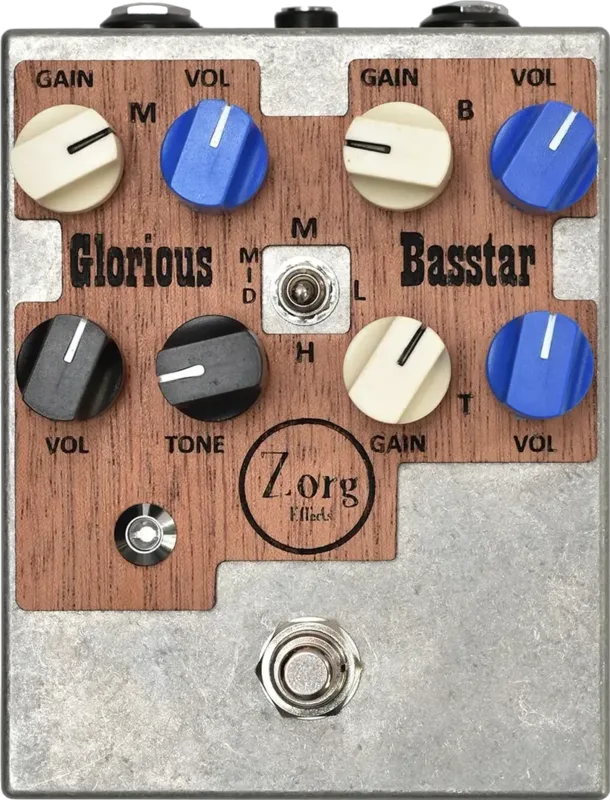


The Glorious Basstar is an analog three-band overdrive pedal for bass from Zorg Effects, listed as combining overdrive, booster and equalizer functions in one unit1. Instead of distorting the whole signal at once, it cuts the signal into three frequency bands, bass, mids and trebles, saturates each band independently, and mixes them back together1. Zorg Effects positions it as an answer to the usual complaints about bass overdrive: "no more bass, too compressed, loss of precision, not violent enough, too muddy... The glorious basstar can fix all these"1.
How the three-band design works
The core idea is that each band can be pushed into distortion on its own, and each band can also be left clean to prop the sound back up. According to the circuit's creator, Gabriel, who shared the schematic on the FSB forum, the results differ by band2:
- Saturating the bass gives acid fuzz distortion2
- Saturating the mids gives vintage overdrive tones2
- Saturating the trebles gives more modern overdrive2
Leaving bands clean does the opposite job: "By adding clean bass, you'll get back subs in your tone. By adding clean mids, you'll get back bite. By adding clean trebles, you'll get back attack"2. That is the mechanism behind the pedal's pitch: the low end and definition that a single-band overdrive tends to lose can be carried by the clean portion of the same band. It sits among bass pedals generally, and its drive character overlaps with overdrive pedals, distortion pedals and fuzz pedals depending on which bands you saturate.
Clipping options and circuit details
Each band's clipping is switchable. Green diffused LEDs with a 1.6V forward threshold do the default clipping, and DIP switches inside the pedal add or remove 1N4148 diodes with a 1V threshold for each channel. Because the 1N4148's lower threshold is reached first, switching it in changes when and how each band clips2.
The circuit uses TL074 opamps and an ICL7660SCPAZ charge pump. Gabriel's advice on parts is specific: "Be sure to use a ICL7660SCPAZ, as others devices use frequencies lower than 20KHz and will result in a high pitch tone"2. In other words, a non-S 7660 or some CPAZ-labeled parts can leave an audible high frequency tone in the signal.
The charge pump part matters: substituting a different 7660 variant can introduce an audible high pitched tone, because those parts switch below 20KHz2.
Origins and the DIY layout
Gabriel, the pedal's creator, shared the schematic on FSB for everyone to use, and Alex of the Guitar FX Layouts blog published a vero (stripboard) layout of the circuit in November 20152. The layout went through corrections: on 2 December 2015 the volume pot pinout was fixed so pin 3 goes to ground, and the input 1M resistor to ground was moved to after the 10n capacitor2. On 4 December 2015, after a builder successfully built and tested it, Alex wrote "You can now tag this as vero! :)"2.
For builders, the layout notes also record that the gain pots are 1M, though less works: "plenty of it already on 200K, i used A500K"2. The 78k resistors in the filter are hard to find, with suggested substitutes of 75k + 3k in series, 82k, or 68k + 10k in series2.
What players said
The documented reaction from the DIY community is positive. One builder using Gabriel's PCB wrote in October 2016: "Wow! This thing is absolute amazing! Never played anything like this before"2. That comment comes from a hobbyist on the layout blog rather than a published review, so it reflects one player's enthusiasm rather than a critic's verdict.
Videos
Zorg Effects
Zorg Effects
Zorg Effects
Questions
Is the Glorious Basstar analog?
Yes. Zorg Effects lists the Glorious Basstar as an analog circuit on its product page. It is a pedal, not a rack unit, and it combines overdrive, boost and equalizer functions in one box by splitting the signal into three frequency bands and saturating each one independently before mixing them back together.
What power does the Glorious Basstar need?
The Glorious Basstar runs on 9V DC with a center negative plug and draws 40mA. That current draw is higher than many simple overdrives, so it is worth keeping in mind when budgeting a daisy chain or an isolated power supply on a pedalboard.
Is the Glorious Basstar center negative?
Yes. Zorg Effects specifies 9V DC, center negative power for the Glorious Basstar, which is the standard polarity used by most pedal power supplies.
Where can I find the Glorious Basstar manual?
The English user manual is available as a PDF from Zorg Effects' own site, at zorgeffects.com under the images/Manuels folder, titled Glorious_Basstar_Users_Manual_Eng.pdf. The pedal's product listing links to it directly.
What clipping diodes does the Glorious Basstar use?
Each band clips through green diffused LEDs with a 1.6V forward threshold, and internal DIP switches let you add 1N4148 diodes with a 1V threshold in parallel. Because the 1N4148's lower threshold is reached first, switching it in changes how each band distorts.
Sources (2)
- Glorious Basstar by Zorg Effects, RockBoard PedalPedia, 2026
- Guitar FX Layouts: Zorg Effects, Guitar FX Layouts (tagboardeffects.blogspot.com), 2015-11-26