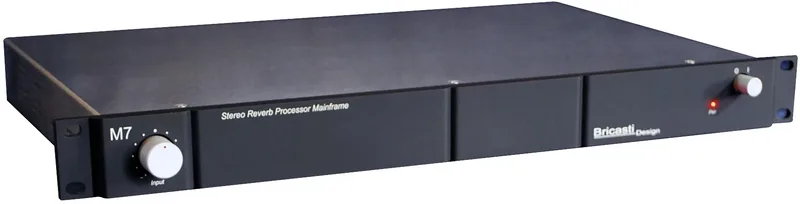
The Bricasti M7M is a rackmount stereo digital reverb processor made by Bricasti Design. It is, in the maker's own words, "an exact duplicate of the M7 Stereo Reverb Processor with reduced front panel controls"1: the same reverb engine in a box designed to be driven from a separate controller rather than from its own faceplate. That controller is the M10 Remote Console, which Bricasti says is necessary for operating the M7M1.
The point of the design is expansion. Bricasti positions the M7M for "customers wishing to add more channels of Bricasti processing to their M10 based setup" without duplicating user interface controls on every unit1. One M10 can therefore front a system of one or more M7Ms, each adding another stereo pair of reverb processing.
A rack reverb controlled from the M10
Because the M7M has no full control surface of its own, everything a player would reach for lives on the M10. Bricasti sells the M7M bundled with the M10 "in several different configurations, with one or more M7Ms", and also as a stand alone product for existing M10 owners1. If you are starting from scratch, the bundle is the practical route; the stand alone unit only makes sense when an M10 is already in the rack.
For guitarists used to reverb pedals with a few knobs, this is a different way of working: the reverb lives in the rack, the controls live on a remote console, and the two are connected as a system.
Presets and parameters
The M7M carries more than 200 unique reverb presets, spanning classic and new programs in four families: halls, plates, chambers and ambient spaces3. Each program is built from 12 parametric program parameters, which is what you reach for when you want to shape a preset into your own space3.
Each preset can be edited through 12 parametric program parameters3. The control ranges come from the M7 manual, whose engine the M7M duplicates:
| Parameter | Control range |
|---|---|
| Reverb Pre Delay | 0 to 500 ms4 |
| Reverb Time | 0.1 to 30 sec, mid-frequency reverb time4 |
| Reverb Diffusion | Low 1 to 9 High4 |
| Reverb HF RT MPY | 0.2 to 1.04 |
| Early Rolloff | 80 Hz to 20 kHz4 |
In practice, pre delay sets how long the dry sound hangs before the reverb begins, reverb time sets how long the tail sustains, diffusion controls how quickly the tail smooths from discrete echoes into a wash, HF RT MPY scales how quickly high frequencies in the tail decay relative to the midrange, and early rolloff trims which frequencies feed the early part of the reverb at all.
Audio specs and connections
The M7M is a digital reverb with an analog I/O section, and it offers both analog and digital connections: balanced XLR analog I/O and AES 24 bit digital I/O, plus MIDI I/O23. On the digital side it supports AES single wire at 192k2.
| Specification | Value |
|---|---|
| Dynamic range | >116 dB, A-weighted, analog input2 |
| Frequency response | 10 Hz to 20 kHz, ± < 0.05 dB2 |
| THD+N | <.001%, analog input2 |
| Maximum input level | +24 dBu2 |
| Maximum output level | +24 dBu2 |
| Minimum input level for 0 dBFS | +4 dBu2 |
| CMRR | > 60 dB at or below 1 kHz2 |
The M7's converter architecture uses dual D/A converters5, and the M7M, as an exact duplicate of that engine, shares the same design. The +4 dBu sensitivity for 0 dBFS is worth noting for anyone wiring a pedalboard or line-level source into the unit: consumer-level gear will land well below full scale, while hot line sources have +24 dBu of headroom before clipping.
How it relates to the M7
The M7 is the original: a self-contained stereo reverb processor with its own front panel controls. The M7M is the same processor with those controls stripped back, intended to sit in a rack and answer to an M101. Choose the M7 if you want one reverb you program at the unit; choose the M7M if you are building a multi-unit system around a single remote, or adding a second or third pair of Bricasti reverb channels to a setup that already has an M10.
Questions
Can the Bricasti M7M be used without an M10?
No. Bricasti states that an M10 Remote Console is necessary for control of the M7M, because the unit itself has reduced front panel controls. It is sold bundled with an M10 in several configurations, and also on its own for players who already own an M10 and want to add more channels of Bricasti processing.
What is the difference between the Bricasti M7M and the M7?
Bricasti describes the M7M as an exact duplicate of the M7 Stereo Reverb Processor with reduced front panel controls. The reverb engine, presets and processing are the same; the M7M simply moves day to day operation to the M10 Remote Console.
Does the Bricasti M7M have MIDI?
Yes. The M7M has MIDI I/O, which allows program changes and other control messages alongside the M10 Remote Console.
Is the Bricasti M7M stereo?
Yes. Bricasti lists it as the Model 7 Mainframe Stereo Reverb Processor, with balanced XLR analog I/O and AES 24 bit digital I/O.
Where is the Bricasti M7M made?
Bricasti states that the M7M is hand crafted in the USA, in a non corrosive stainless steel chassis and top cover.
What reverb types does the Bricasti M7M include?
The M7M ships with more than 200 unique reverb presets covering classic and new programs: halls, plates, chambers and ambient spaces. Each preset can be edited through 12 parametric program parameters.
Sources (5)
- Bricasti Design, Bricasti Design
- Bricasti Design, Bricasti Design
- Bricasti Design, Bricasti Design
- Owner’s Manual, Bricasti Design, 2019
- Bricasti Design, Bricasti Design