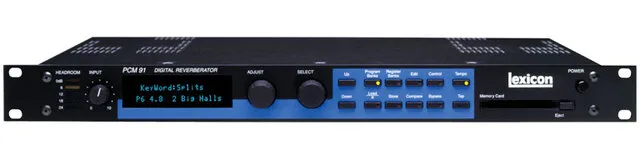

The Lexicon PCM91 is a 2-in/2-out rack reverb processor that Lexicon Pro describes as a "Studio Standard/Live Sound Reverb Processor," offering "Lexicon's highest quality reverbs in a compact, affordable package"1. It is a studio and live sound piece of gear rather than a pedal: a 1U rack unit that takes line-level signals, adds reverb, and returns them in analog or digital form. Lexicon Pro lists it as discontinued1.
For players, the PCM91 belongs to the world of rack processing that guitarists used heavily in the 1980s and 1990s, where a processor like this sits in an amp's effects loop or in a mixer insert rather than on a pedalboard. Lexicon says one of its advances is "the ability to create incredibly realistic small spaces such as a phone booth or very small drum room"1, which points at its strength in realistic room and ambience reverbs rather than only big hall effects.
What the PCM91 does
The PCM91 is a dedicated reverb processor. Lexicon Pro positions it as carrying the company's highest quality reverb algorithms in a compact package, with a particular strength in small, realistic spaces1. It is a 2-in/2-out design, meaning it processes a stereo input pair and returns a stereo output pair, which suits stereo effects loops, mix bus use and live sound systems.
According to Lexicon Pro, the PCM91 "includes all of the features of the acclaimed PCM 90, plus full AES/EBU I/O, Dual Reverb algorithms, and presets with dynamic spatialization effects for 2-channel or surround applications"1. In practice that means it can run two reverbs at once, and its spatialization presets can move or place the reverb in the stereo field, including surround setups.
Inputs, outputs and digital I/O
The PCM91 offers both analog and digital connections, which is one of the features that separates it from the PCM901.
| Connection | Details |
|---|---|
| Analog audio input | XLR and 1/4" balanced (T/R/S) |
| Analog audio output | XLR and 1/4" T/R/S balanced |
| Digital audio input | XLR AES/EBU; coaxial RCA S/PDIF |
| Digital audio output | XLR AES/EBU; coaxial RCA S/PDIF |
| Digital format | AES/EBU balanced; S/PDIF unbalanced |
| MIDI | 5-pin DIN for MIDI IN, THRU and OUT |
| Footswitch | 1/4" T/R/S for two independent momentary footswitches |
| Foot controller | 1/4" T/R/S for a foot pedal, 100Ω to 10kΩ impedance |
| Memory card | PCMCIA type I cards, 68 pins |
All from Lexicon Pro's product page1.
The digital I/O runs at 44.1kHz and 48kHz sample rates, with 24-bit A/D and D/A conversion and a 20-bit internal audio DSP1. The footswitch input supports two independent momentary switches, and the system detects whether they are normal-open or normal-closed at power up, so a player can wire up remote control of the unit from a footswitch board1. There is also a remote power input, a 2.5 mm 9 volt AC jack, with the supply not included1.
The memory card slot accepts PCMCIA type I cards of up to 1MB of SRAM, with attribute memory not required, following PCMCIA 2.0 and JEIDA 4.0 standards1. Cards like these were used to store user programs and presets outside the unit.
Specifications
Lexicon Pro publishes a full set of audio measurements for the PCM911:
| Specification | Value |
|---|---|
| Frequency response | 10Hz to 20kHz, ±.5dB |
| THD | <0.006%, 10Hz to 20kHz |
| Crosstalk | -55dB, 10Hz to 20kHz |
| Dynamic range, A/D | >105dB typical, 10Hz to 20kHz |
| Dynamic range, D/A | >98dB typical, 10Hz to 20kHz |
| Dynamic range, A/A | >96dB typical, 10Hz to 20kHz |
| Input level | -2dBu to +20dBu balanced; -22dBu to 0dBu unbalanced |
| Input impedance | 100kΩ balanced; 50kΩ unbalanced |
| Output level | +18dBm balanced; +4dBm unbalanced |
| Output impedance | 125Ω, balanced |
| Operating temperature | 32° to 104°F (0° to 40°C) |
| Maximum humidity | 95% without condensation |
The balanced input and output levels are line-level figures, which is why the unit fits effects loops and mixers rather than a guitar's direct output into an amp input1.
The PCM91 and the PCM90
The PCM91 is an expansion of the PCM90 rather than a replacement in a different class. Lexicon Pro states that all of the PCM 90's features are included, with the additions being full AES/EBU digital I/O, Dual Reverb algorithms and the dynamic spatialization presets1. A player choosing between the two on the used market is effectively choosing whether the digital connections, dual reverb algorithms and spatialization presets matter; the core reverb engine carries over. The related Lexicon PCM92 continues the same rack line.
Videos
Christopher Freedom
italoop
italoop
Questions
Can you use a Lexicon PCM91 with a guitar amp?
The PCM91 is a line-level rack processor rather than a stompbox, so it is not designed to sit in front of a guitar amp's input. Players who use rack reverbs typically run it in an amp's effects loop or through a mixer. It also has a 1/4-inch footswitch input for two momentary switches and a foot controller input, so it can be operated hands-free in a rack setup.
Is the Lexicon PCM91 discontinued?
Yes. Lexicon Pro lists the PCM91 as discontinued on its product page. It remains available on the secondhand market, and Lexicon's product page still carries its full specifications for reference.
What is the difference between the PCM90 and PCM91?
According to Lexicon Pro, the PCM91 includes all of the features of the PCM 90 plus full AES/EBU digital I/O, Dual Reverb algorithms, and presets with dynamic spatialization effects for 2-channel or surround applications. The PCM91 also uses 24-bit A/D and D/A conversion, while its internal audio DSP is 20-bit.
How much rack space does the PCM91 take?
One rack unit. The PCM91 measures 19 inches wide by 1.75 inches high by 12 inches deep (483 x 45 x 305 mm) and uses a standard rack mount. It weighs 6.4 lbs (2.9 kg).
Does the PCM91 have MIDI?
Yes. The PCM91 has 5-pin DIN connectors for MIDI IN, MIDI THRU and MIDI OUT, so it can be connected to MIDI controllers, footswitch systems or other rack gear for program changes and control.