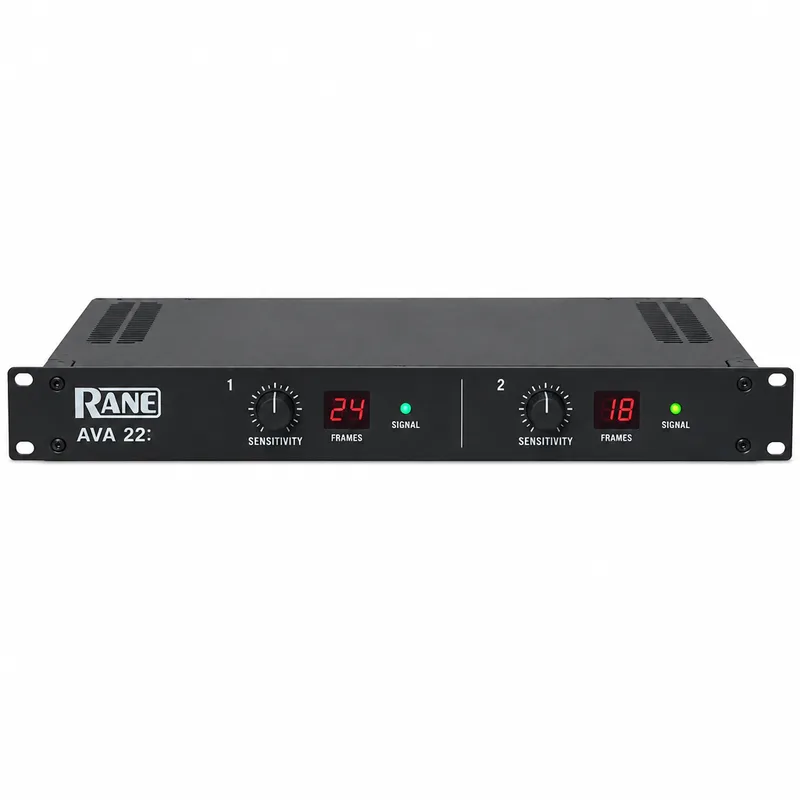
The Rane AVA 22 is a rack-mount Audio Video Alignment Delay: a two-channel unit built to delay an audio signal by whole video frames so that sound lines up with picture. Where a delay pedal is made for echo and ambience, the AVA 22 is made for broadcast and video production, where video processing introduces a lag in the picture and the audio has to be pushed back to match it. Each channel has a current delay value that is always active and heard, and the delay is set and displayed in video frames rather than in milliseconds1.
The unit is a two-channel device that can run in LINK mode for stereo operation or in DUAL MONO operation, so one box can handle a stereo pair or two independent signals. To avoid audible anomalies, the AVA 22 bypasses the audio signal any time the delay value is changed1.
What it does: audio-to-video alignment delay
The AVA 22 exists to solve a specific problem: video equipment such as frame synchronizers and digital effects processors delays the picture, and the audio arriving at the same time ends up ahead of it. The AVA 22 delays the audio so the two line up again, with a maximum delay time of 327.68 msec, which provides up to 9.5 NTSC Frames or 8.0 PAL/SECAM Frames1.
The delay is measured in frames because that is the unit the video side works in. Rane's manual gives the conversion:
| Broadcast standard | Fields per second | Frames per second | One frame equals |
|---|---|---|---|
| NTSC | 59.94 | 30 | 33.33 msec |
| PAL/SECAM | 50 | 25 | 40 msec |
The displayed delay uses slightly different figures: 1.0 NTSC frame equals 33.37 msec of displayed delay, and 1.0 PAL/SECAM frame equals 40.00 msec. The maximum delay time of 327.68 msec provides up to 9.5 NTSC frames or 8.0 PAL/SECAM frames1.
The unit is specified for a nominal +4 dBu input, a voltage-referenced level of 1.228 Volts RMS, and at that level it provides 16 dB of headroom below 8 kHz. The inputs are electronically balanced XLR connections with Pin 2 hot per AES standards, and Rane specifies using only balanced wiring. The outputs are balanced line drivers, also Pin 2 hot, and the output signal is adjusted so the AVA 22 always passes signal with unity gain into 600 ohm loads1.
The controls, memories and display
Each channel has a 2-digit FRAMES display showing the current delay value for that channel. On power up, this display also shows the installed software revision level before settling into its normal job1.
The front panel includes:
- SENSITIVITY controls: rotary controls that vary the incoming signal levels to the A to D converter1
- SIGNAL indicators: green LEDs that illuminate approximately 42 dB before actual clipping1
- CLIP indicators: red LEDs that illuminate 5 dB before clipping at the A to D converter input1
- Broadcast mode buttons: toggle the broadcast mode for the given channel between NTSC and PAL/SECAM, and the mode is stored with the delay value1
- LINK button: toggles between LINK mode for stereo operation and DUAL MONO operation1
Each channel also has two nonvolatile memories, A and B, so a delay setting can be stored and recalled later without losing it when the unit is powered down1.
Bypass and power-off behavior
Each channel has a hard-wired bypass, toggled by momentary push buttons on the front panel. The bypass uses fail-safe relays, so the AVA 22 passes audio even when it is unpowered. The first time you power the AVA 22 it comes up in bypass, which Rane's manual describes plainly1:
"The first time you power the AVA 22 it is in BYPASS, and functions like an expensive wire."
The unit contains no wear parts, according to the manual1.
Remote control and front panel lockout
The AVA 22 has REMOTE BYPASS/RECALL terminals on the rear. These use CMOS (+5 volt) logic levels and sink only 3 mA maximum each, so they are meant to be driven by simple switch closures or control systems, not audio-level signals. When a remote recall switch closes, both channels' Memory B settings are recalled; when the switch opens, both Memory A settings are recalled1.
The front panel can also be locked out. In Front Panel Lockout mode, all front panel controls are disabled except the RECALL buttons. The RECALL buttons still work to temporarily display the other stored memory, but they do not actually recall it1.
Internal jumpers add further configuration:
- J11 redefines the REMOTE RECALL function
- J102 and J302 enable or disable the BYPASS buttons in Front Panel Lockout mode, with the default set to disable them1
Power and grounding
The AVA 22 uses an 18 volt AC center-tapped transformer only, fed through a remote AC power supply jack. Rane specifies using only a model RS 1, RAP 10 or other remote AC power supply approved by Rane1.
The AVA 22 does not get its chassis ground through the AC cord. A #6-32 screw and toothed washer is provided for chassis ground, so the unit must be grounded at that point in installations that need it1.
The unit complies with the limits for a Class A digital device pursuant to Part 15 of the FCC Rules and with the European EMCD 89/336/EEC1.
Questions
What is the maximum delay time of the Rane AVA 22?
The maximum delay time is 327.68 milliseconds, which equals up to 9.5 NTSC frames or 8.0 PAL/SECAM frames. Each of the two channels has a current delay value that is always active and heard.
Does the Rane AVA 22 pass audio when powered off?
Yes. Each channel has a hard-wired bypass with fail-safe relays that pass audio when the unit is unpowered. On first power up the AVA 22 also starts in bypass, and it passes signal with unity gain into 600 ohm loads.
Can the AVA 22 delay be set in video frames?
Yes. Delay is displayed in frames, with a broadcast mode of NTSC or PAL/SECAM selectable per channel and stored with the delay value. One NTSC frame equals 33.37 msec of displayed delay and one PAL/SECAM frame equals 40.00 msec.
What power supply does the Rane AVA 22 need?
It uses an 18 volt AC center-tapped transformer only, connected through a remote AC power supply jack. Rane specifies using only a model RS 1, RAP 10 or other Rane-approved remote AC power supply.
Sources (1)
- ava22man, Rane Corporation, 2025