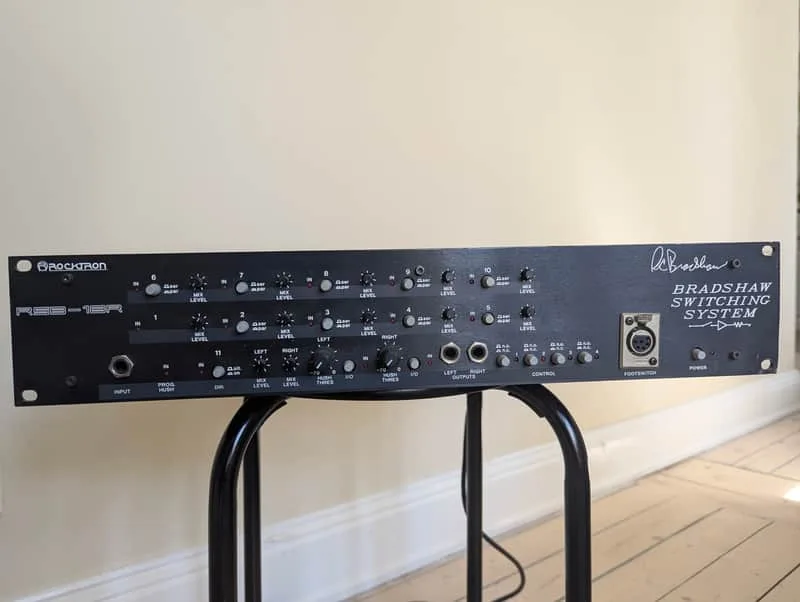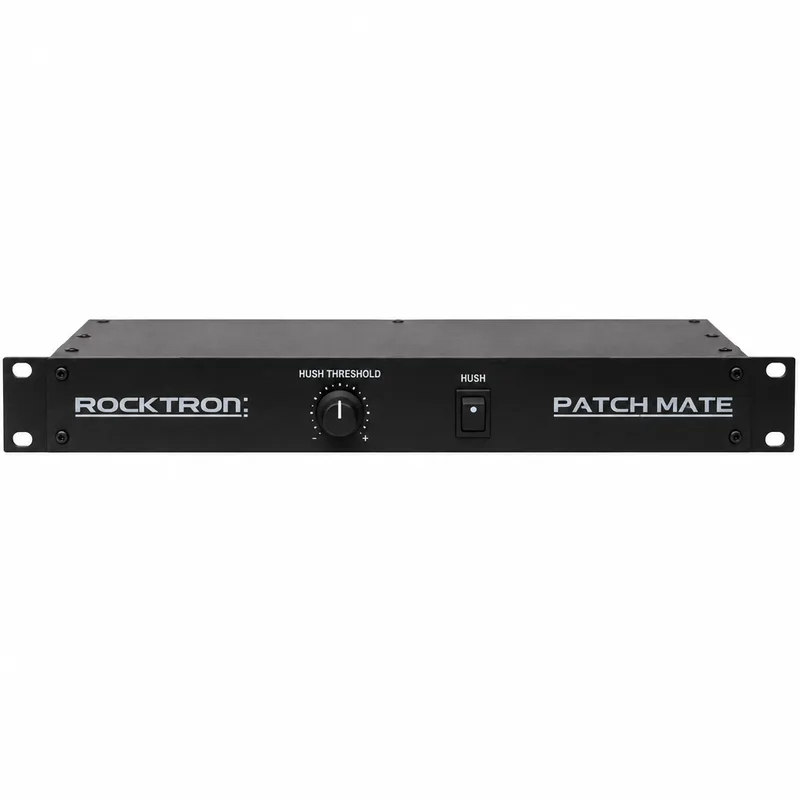
The Rocktron Patch Mate is a programmable switching system designed to give musicians more control over their equipment. It is a 1U rack unit with nine stereo loops/controls and one stereo channel of HUSH, HUSH Systems' patented noise reduction1. Unlike a switching pedal on a pedalboard, the Patch Mate sits in a rack and routes audio through relays, so effects and amps can be brought in and out of the chain remotely, by MIDI or from the front panel.
The key to how it sounds is what is not in the path. Rocktron states that each loop consists of only relays, with no buffers in the signal path, and that the unit is totally transparent, using relays to route the audio with no circuitry in the audio path to add noise1. That makes it a different animal from a buffered loop switcher: nothing in the loop path boosts, cuts or loads the signal. The manual's specifications back the claim up with measured figures, listed below.
What the Patch Mate does
Each of the nine loops consists of four stereo jacks: IN, SEND, RETURN and OUT, and each loop can be configured as a mono loop, a stereo loop or a latching control function1. When a loop is set up as a control function rather than an audio loop, the SEND jack works as a normally closed control function and the OUT jack works as a normally open control function1. That means the same loop hardware can switch amp channels or other gear by relay contact instead of passing audio.
Because the loops are relay only, a loop can also be used for jobs a buffered switcher cannot do, such as the multiple preamps with a mixer configuration documented in the manual's appendix. The appendix covers five documented configurations: device in/bypass, device job, device input mute, stereo application, and multiple preamps with a mixer1. For stereo applications, Rocktron offers a mono to split-mono adaptor, Part# 006-0119, available from Rocktron dealers1.
The tenth channel is HUSH, the noise reduction. The HUSH button inserts the programmable HUSH into the signal path where it is patched in; the LED off means bypassed and the LED on means active1. The HUSH threshold is adjustable from -70dB to 0dB1.
The Patch Mate's measured loop performance, from the manual's specifications:
| Specification | Value |
|---|---|
| Maximum input level | +20dBu (HUSH loop +11dBu)1 |
| Maximum output level | No gain in loops (input = output)1 |
| Frequency response | +/-.1 dBu 20Hz to 30KHz (each loop)1 |
| Total harmonic distortion | .005% @ 0dBu (1 KHz)1 |
| Noise | .0017% @ +10dBu (1KHz), .001% @ +15dBu (1 KHz)1 |
| Noise floor | -120 dBu "A"-weighted (each loop)1 |
| Cross talk | -108 dBu @ 1 KHz (tip to ring), -81 dBu @ 20KHz (tip to ring)1 |
Rocktron's manual carries a blunt warning: do not insert the output of any power amplifier into any jack on the Patch Mate, as it may damage the unit and the amplifier1. Speaker-level signals do not belong anywhere near it.
The front-panel controls
The front panel is built around a display and a small set of controls. The display consists of 6 alphanumeric characters of 14 segments each, used for preset numbers and titles1.
| Control | What it does |
|---|---|
| LOOP/CONTROL buttons | Switch the corresponding loop/control from one status to another1 |
| HUSH button | Inserts the programmable HUSH into the signal path where it is patched in; LED off is bypassed, LED on is active1 |
| RECALL button | With SELECT in PRESET position, recalls the preset flashing on the display; in HUSH position, toggles between the stored and altered HUSH value; steps through MIDI options; no function in TITLES position1 |
| EDIT/STORE button | Stores the current HUSH and loop settings into a preset; stores title characters; stores the power-on preset and MIDI options1 |
| ADJUST knob | Chooses a preset in PRESET position; changes the HUSH threshold in HUSH position; chooses a title character in TITLES position; changes MIDI options in MIDI position1 |
| PARAMETER SELECT control | 4 positions: Preset, HUSH, Titles and MIDI options, from full counterclockwise to full clockwise1 |
The Patch Mate holds 128 total presets, each with a preset number and title, and all 128 presets can be copied over1. A power-on preset can be stored, so the unit boots into a known switching state.
Power: 9VAC adaptor and phantom power
The unit accepts power from the 9VAC/1500mA adaptor supplied with it, and the specifications list power requirements of 9VAC 1116mA1. This is AC, not the 9V DC center negative supply most pedals use, so it cannot share a typical pedalboard power brick or daisy chain. Internally, the 9V RMS AC voltage is processed by a voltage doubler, generating +/-15V to maintain headroom1.
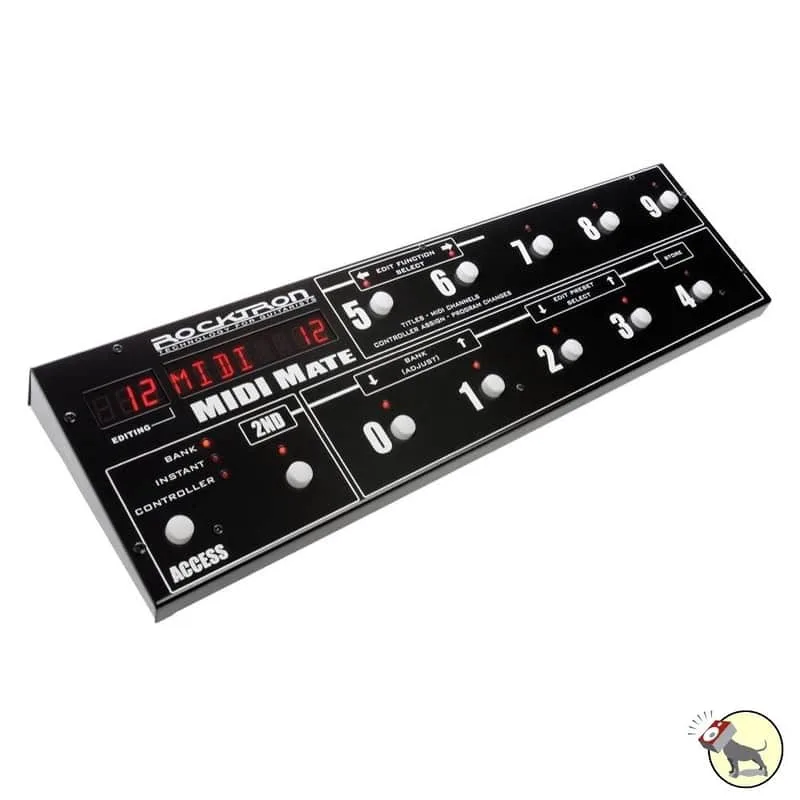
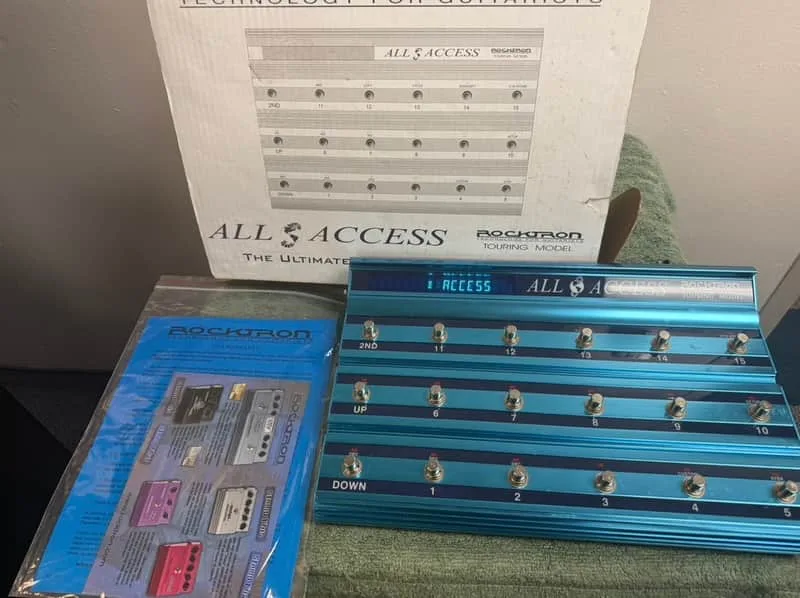
The rear-panel PHANTOM POWER jack powers the Rocktron MIDI Mate and All Access foot controllers through a 7 pin MIDI cable, using pins 6 and 71. For a player running a MIDI pedal controller at the front of the stage, that removes one power supply from the floor.
MIDI connections and mapping
The rear panel carries a MIDI IN jack, a 7 pin DIN connector that receives MIDI information from the transmitting device, and a MIDI THRU/OUT jack, a standard 5 pin DIN connector that passes the MIDI information received at MIDI IN on to other MIDI-compatible devices1.
The MIDI channel may be set to 1 through 16, OMNI (receives on all channels) or OFF, which stops the Patch Mate from receiving1. Program mapping is initially programmed for a one to one correspondence between MIDI program numbers and presets, so MIDI program number nine recalls preset nine out of the box; each mapping can then be set to any preset or to OFF1. Mapping status turns program mapping ON or OFF; when OFF, the preset recalled simply equals the program number sent via MIDI1.
Controller mapping works the same way: a loop/control can be mapped to a MIDI controller number from zero through 120, or set to OFF1. The manual's MIDI implementation chart, dated March 29, 1991, for model Patch Mate version 1.2, gives the default assignments1:
Any of these parameters may be reassigned to any control number from 0 through 120, or set to OFF1.
Where it came from
The Patch Mate dates to the early 1990s: the manual's MIDI implementation chart is dated March 29, 1991, for version 1.2 of the firmware1. Rocktron later carried the Patch Mate name forward on later loop products. The original rack unit found its way onto major tours: Rocktron reported in June 1996 that it had shipped a Patch Mate for use by Richie Sambora on the latest Bon Jovi tour2.
Questions
Does the Rocktron Patch Mate have buffers in the signal path?
No. Each loop consists of only relays, with no buffers in the signal path. Rocktron describes the unit as totally transparent, using relays to route the audio with no circuitry in the audio path to add noise or color the tone.
How many presets does the Rocktron Patch Mate hold?
The Patch Mate holds 128 total presets, each with a preset number and title. All 128 presets can be copied over, and a power-on preset can be stored so the unit starts in a chosen state.
Can the Patch Mate power a Rocktron All Access foot controller?
Yes. The PHANTOM POWER jack powers the Rocktron MIDI Mate and All Access foot controllers through a 7 pin MIDI cable, using pins 6 and 7, so the controller does not need its own power supply at the stage end.
Can the Patch Mate loops run in stereo?
Yes. Each of the nine loops consists of four stereo jacks: IN, SEND, RETURN and OUT. Any loop can be configured as a mono loop, a stereo loop or a latching control function, and the manual documents a stereo application setup in its appendix.
What MIDI controller numbers does the Patch Mate use?
By default, controller 8 is HUSH THRESHOLD, controller 9 is HUSH, and controllers 10 through 18 are loops and controls L1/C1 through L9/C9. Any parameter may be reassigned to any controller number from 0 through 120, or set to OFF.
Sources (2)
- Rocktron PATCH MATE Manual, Rocktron, 2024-08-28
- Rocktron News: ROCK NOTES, Rocktron (www.rocktron.com), 2024-08-28