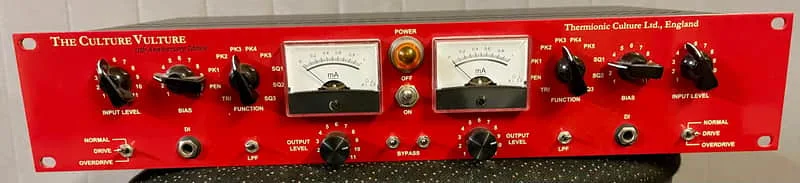


The Culture Vulture is a 2U rackmount valve distortion processor from Thermionic Culture, a specialist British manufacturer of valve-based audio equipment1. It is a dual-channel line-level unit with identical facilities on each channel, and it was claimed by its maker to be "the first and only valve unit dedicated to producing the best harmonic distortion money can buy"1. Where a distortion pedal clips your signal with diodes or op-amps, the Culture Vulture generates its distortion in valves, and the whole circuit is all-valve (analog)1.
The design is credited to Vic Keary, who MusicRadar reports "designed the Culture Vulture in a pub, over a beer, and it soon became a unique and iconic chunk of hardware"2. The unit is hand built in the traditional way, with full-size components strung between tag-strips in the lower section, and the valves, big reservoir capacitors and mains transformer mounted in the top section under a perforated lid1.
The controls: Drive, Bias, mode switch and output
Each channel carries a pair of traditional chicken-head Bakelite rotary controls for Drive and Bias, both calibrated from one to 111. The Drive knob adjusts the input level and can reduce the input signal all the way down to complete silence1. The Bias knob sets the current flowing through the main distortion valve1.
A three-position rotary switch reconfigures the operating mode of the distortion valve, with T, P1 and P2 positions1. A toggle switch labeled Overdrive increases both the Drive gain and Bias range, for a more pronounced effect1. A matching rotary control adjusts the output level of the channel, again calibrated from one to 11, with unity gain between the seven and eight positions; unlike the Drive control, it does not reduce the output all the way to silence1. A pair of bypass switches lets the effect of each channel's processing be auditioned independently, connecting the input directly to the output and bypassing all of the electronics1.
| Control | What it does |
|---|---|
| Drive | Sets input level, one to 11; can go down to complete silence1 |
| Bias | Sets current through the distortion valve, one to 111 |
| Mode switch | Three positions, T, P1 and P2, reconfiguring the distortion valve1 |
| Overdrive toggle | Increases Drive gain and Bias range for a more pronounced effect1 |
| Output level | One to 11, unity gain between seven and eight1 |
| Bypass switches | One per channel, hard bypass of all electronics1 |
Triode and pentode modes
The three mode positions change how the distortion valve is wired, and that changes which harmonics the unit produces.
- T (Triode): a triode configuration which generates mainly even-order harmonics1
- P1 (Pentode): a pentode configuration which creates odd-order harmonics1
- P2: an alternative pentode configuration providing far more drastic distortion effects, especially with high bias settings1
The distinction matters to players chasing a particular flavor of breakup. Even-order harmonics, the triode mode's specialty, are often described as smoother and more musical; odd-order harmonics from P1 read as edgier and more aggressive. P2 is the extreme setting, and it comes with a quirk worth knowing.
In P2 mode there is a kind of null point of extremely horrid, almost clipping distortion at about 0.5mA; above or below that point the sound is fine1.
Bias settings and how they change the distortion
The Bias control is where the Culture Vulture earns its reputation for range. A normal setting provides between 0.2mA and 0.4mA, which produces a very subtle effect in the triode configuration, not dissimilar to saturated analog tape1. Setting the current to about 0.6mA provides a more obvious warm kind of distortion, while less than about 0.1mA starves the valve and gives a rather lean and much quieter sound1. Combined with the Overdrive toggle's expanded Bias range1, the same knob can take you from near-clean thickening to full saturation.
Connections and specifications
The rear panel carries four quarter-inch sockets, providing unbalanced inputs and outputs, plus the IEC mains inlet and a fuse holder. A pair of quarter-inch sockets on the front panel take priority over the rear-panel sockets1. The handbook gives the input impedance as just 30kΩ for both the front and rear sockets1, which is low for a passive guitar pickup and is worth bearing in mind before plugging straight in.
| Specification | Value |
|---|---|
| Channels | Two, identical facilities on each1 |
| Rack spaces | 2U1 |
| Circuitry | All-valve (analog)1 |
| Input impedance | 30kΩ, front and rear1 |
| Max output level | +17dBV (about +19dBu)1 |
| Noise floor | Better than 75dB below max output, around -56dBu1 |
| Frequency response | ±1.5dB between 50Hz and 15kHz at a low-distortion setting1 |
| UK price (2003) | £992.88 including VAT1 |
Because it is a dual-channel unit with identical facilities on each channel, it can easily be used for processing a stereo mix, although you need to take care to match all the controls in each channel1.
What Sound On Sound said
Hugh Robjohns reviewed the Culture Vulture for Sound On Sound in August 2003 and found it versatile, with a wide range of characters available from the mode and Bias controls. His overall verdict:
"This is certainly a very musical tool which can be used to 'dirty things up a little', adding a little character and warmth to digital recordings, or to create much more overt distortion effects spanning the tasteful to the completely manic!"
He also noted the unit's unpredictable side, particularly the P2 null point1, which is part of why the Bias control rewards careful listening rather than dialing by numbers.
The Vulture family and its pedal descendants
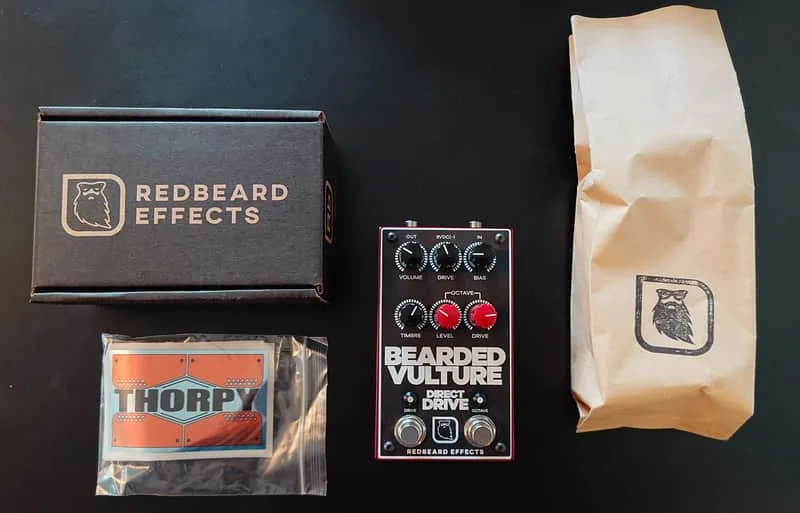
The Culture Vulture's influence has reached the pedal world. The Redbeard Effects Bearded Vulture is a compact stompbox inspired by the heavily saturated tones of the Vulture, which Guitar.com described as "a high-end rack preamp billed as 'the only studio unit dedicated to just adding valve-produced harmonic distortion'"3. Redbeard's Bearded Vulture Direct Drive octave fuzz extends the idea further, listed at £219 / $290 in December 20254.
Thermionic Culture itself later produced the Solo Vulture, a single-channel 2U rack unit descended from the Culture Vulture design, developed with input from guitarist and circuit designer Ricky Sharp2. It adds a 1/4-inch instrument DI input on the front, Clean and Dirty channels with their own output level controls, and channel switching that MusicRadar found makes it viable for guitar rigs2. MusicRadar's reviewers found that with a Telecaster into an AC30, the amp sounded seriously good, thicker with more defined edge than they had ever heard, and that a Kemper profile of a Wallace Redhead amplifier was made instantly better by running it through the unit2. They called it "a highly desirable item for those who appreciate what valves can do in the right hands," while noting it weighs in at over a grand2.
Videos
ThermionicCULTURE
D Ramirez
OoraMusic
Questions
Can you plug a guitar straight into the Culture Vulture?
The Culture Vulture is a line-level unit, and its handbook gives an input impedance of just 30kΩ on both front and rear sockets, which is low for a passive guitar pickup. The front-panel sockets take priority over the rear ones. Players wanting a Vulture designed for instruments generally look at the later Solo Vulture, which adds a 1/4-inch instrument DI input on the front.
What tubes does the Culture Vulture use?
Each channel uses three valves: an EF86 on the input, a 6AS6 to provide the controllable distortion, and a 5963 (an ECC82 or 12AU7 equivalent) to handle the output. That is six valves across the two channels, all hand-built with full-size components strung between tag-strips.
Can the Culture Vulture process a stereo mix?
Yes. Sound On Sound found it can easily be used for processing a stereo mix, since it is a dual-channel unit with identical facilities on each channel. The catch is that you need to take care to match all the controls in each channel, because the two channels are set independently.
How much does the Thermionic Culture Culture Vulture cost?
Sound On Sound listed the UK price as £992.88 including VAT in 2003. A 2025 Guitar.com review of the Redbeard Bearded Vulture, a pedal inspired by the unit, referenced the real Culture Vulture at £1,980. The later single-channel Solo Vulture was described by MusicRadar in 2026 as weighing in at over a grand.
Sources (4)
- Thermionic Culture The Culture Vulture, Sound On Sound, 2003-08
- Thermionic Culture Solo Vulture review, MusicRadar, 2012-10-22
- Redbeard Effects Bearded Vulture review: ingenious and loud, Guitar.com, 2025-05-12
- Guitar Pedal X, Guitar Pedal X, 2025-12-08