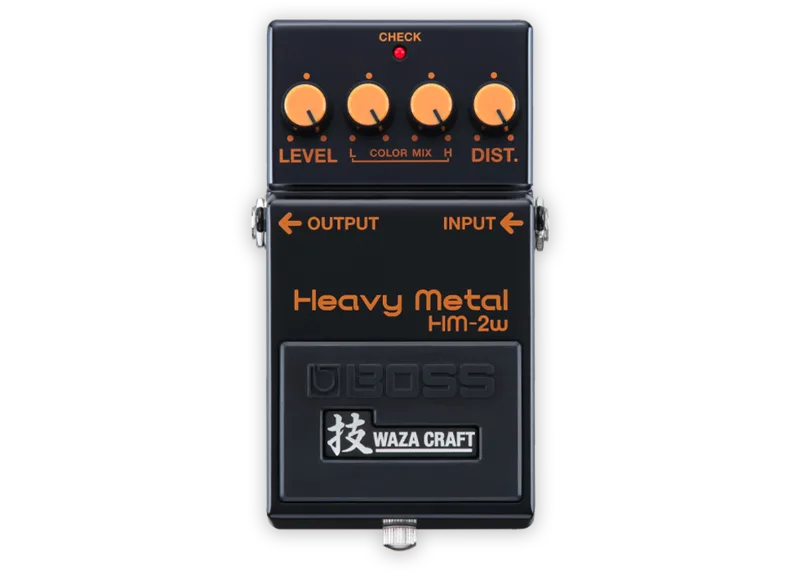
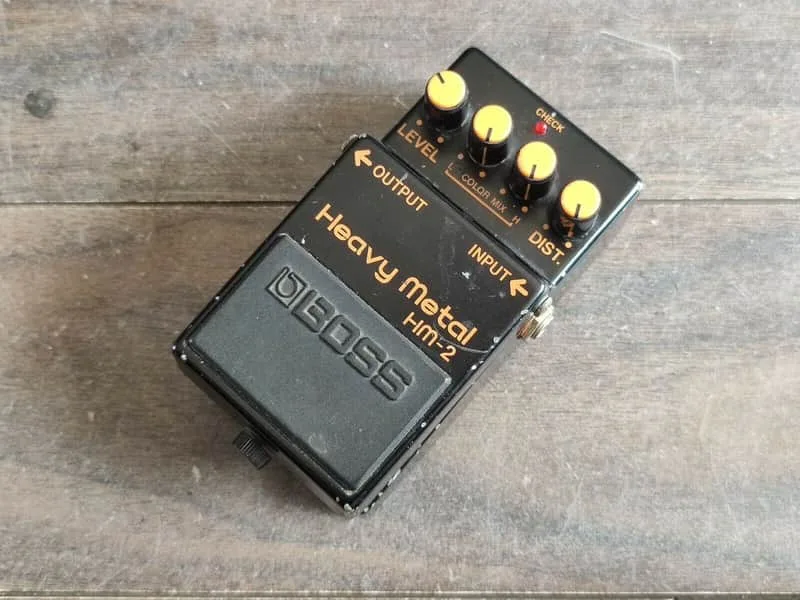
The Boss HM-2 Heavy Metal is an analog distortion pedal that Boss positions as "a true legend in the history of distortion pedals"1. Released in the early 1980s and long out of production, it was one of the first "amp in a box" pedals, built around a Boss circuit designed to replicate the sound of early '80s British stack amps1. Its reputation rests on one extreme setting: with every knob maxed, it produces the raw, aggressive "chainsaw" tone that came to define Swedish death metal guitar234.
The pedal matters to more than metal players, though. Wren and Cuff notes that shoegaze bands from My Bloody Valentine to The Jesus and Mary Chain used it to help craft their walls of distorted guitar noise5. Producer Tom Dalgety has also described using it in an entirely different way, as a Rangemaster-style treble booster6.
Where the HM-2 came from
The HM-2 arrived as part of Boss's early 1980s compact pedal expansion, when the company was filling out its lineup beyond the original overdrive and distortion models. Boss describes it as one of the first "amp in a box" pedals ever, using what the company calls an innovative Boss circuit to replicate the sound of early '80s British stack amps1.
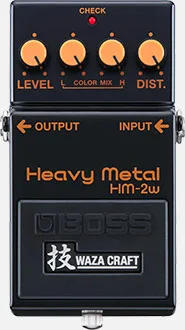
The production history is not settled in the sources. TONEHOME, an independent Boss reference site, dates the pedal to 1981 and splits its run into two periods: made in Japan from 1981 to 1987, and made in Taiwan from 1988 to 19937. Boss's own product page for the HM-2W reissue says the original was produced from 1983 to 19911, and Wren and Cuff also gives 1991 as the year the last units rolled off the line5. The honest summary is that the HM-2 appeared in the early 1980s, production moved from Japan to Taiwan at some point, and the pedal was gone by the early 1990s, with sources disagreeing on the exact dates at both ends.
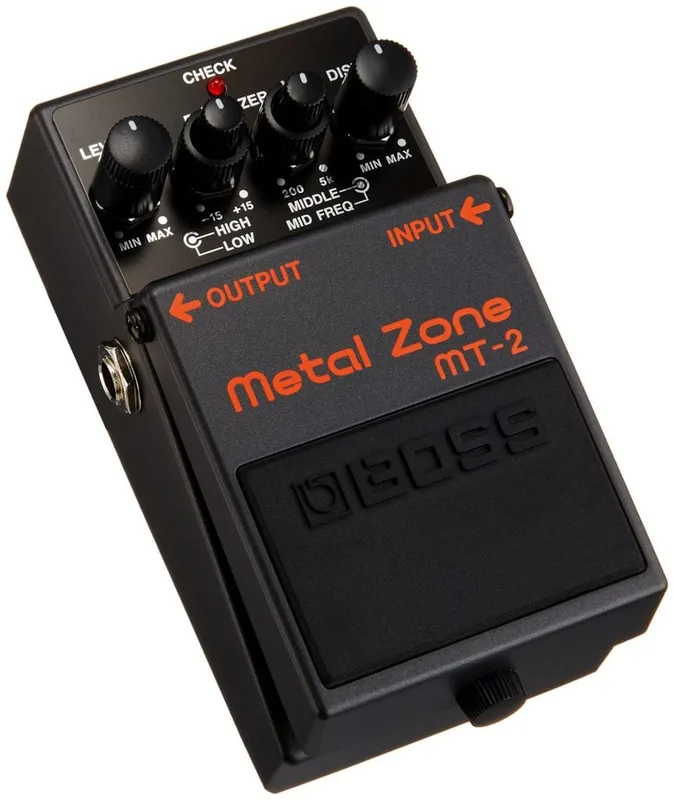
What is not disputed is what happened next. TONEHOME reports that Boss replaced it with the MT-2 Metal Zone, which offers a similar midrange control7. The HM-2 then spent years as a cheap used pedal before its second life. KMA Audio Machines describes the original HM-2 MIJ as a key element of the Swedish chainsaw metal sound and now a sought-after, out-of-production pedal8.
"Calling a pedal legendary or a cult classic is often stretching the truth, but when it comes to the Boss HM-2 MIJ it's a..."
How it works: diode clipping and a gyrator EQ
The HM-2 is a hard-clipping distortion design in the family of Boss distortion circuits, where diodes placed in the feedback path or after an op-amp stage clip the signal's peaks and create the distorted waveform. The overall architecture follows the pattern Boss used across its distortion pedals of that era: an op-amp gain stage driving clipping diodes, followed by active tone shaping. In an article for Boss analyzing the HM-2W, Colin Scott of CSGuitars reported that "The HM-2W uses pretty much every trick in the book when it comes to distortion generation"10, which points to how much clipping and shaping is packed into the original circuit.
The distinctive part of the HM-2 is its tone section. Rather than the passive treble roll-off of simpler pedals, it uses gyrator-based EQ: an op-amp or transistor circuit that behaves like an inductor, forming a resonant filter at a specific frequency. This is what lets the pedal boost or cut at chosen frequencies rather than just cutting highs, and it is the reason the HM-2 can push such extreme low-end and midrange111213.
For a player comparing circuits, the gyrator EQ is what separates the HM-2 from pedals like the Tube Screamer, whose tone control is a passive high-frequency cut, or the RAT, which uses a simple passive filter after the clipping stage. The HM-2's EQ is active and frequency-selective, closer in spirit to a graphic EQ than a tone knob11.
The Color Mix controls: 87Hz low and a dual-peak high
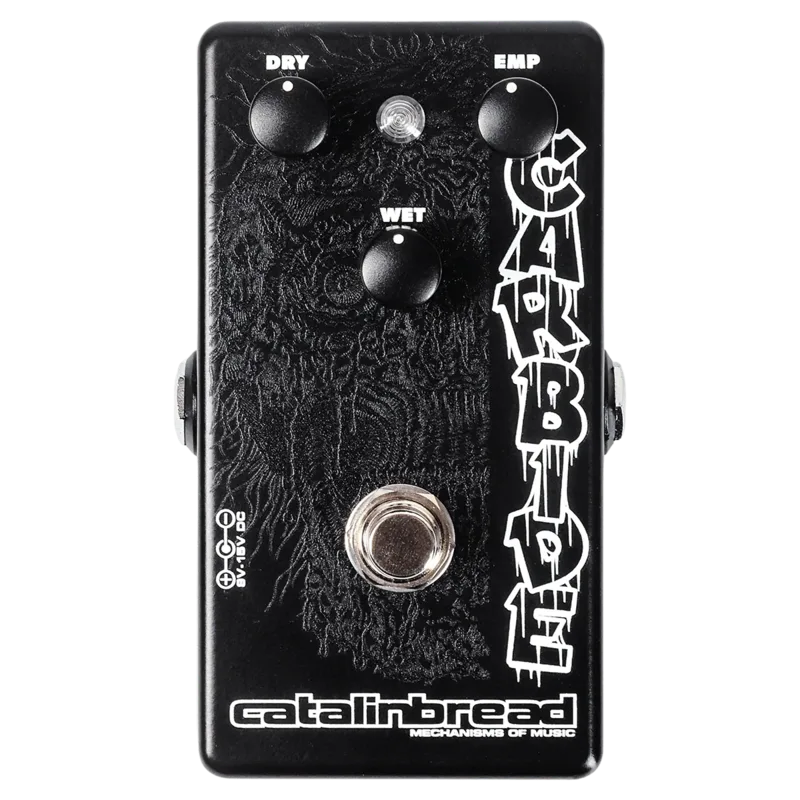
The control layout is where most players meet the HM-2's character. Catalinbread, whose Carbide pedal is built around the HM-2's EQ behavior, describes the stock circuit as giving you two "color mix," or EQ knobs: L(ow) and H(igh)12.
| Control | What it does |
|---|---|
| L (Low) Color Mix | Controls a frequency boost at 87Hz12 |
| H (High) Color Mix | Boosts or cuts mids7 |
| Distortion | Sets the gain of the clipping stage |
| Level | Sets the output volume |
The low control is unusually specific. In the Boss article on the HM-2W, the Low control is described as affecting a single filter around 80 to 90Hz, which the article calls the sonic sweet spot near the fundamental frequency of the low E string tuned to standard pitch10. That is why the maxed HM-2 has so much weight: it is boosting a narrow band right where the bottom strings live.
The high control is equally unusual. TONEHOME describes it as giving the ability to boost or cut mids7, which is not what its name suggests. Because both Color Mix knobs can be run at full while the Distortion control is set low, the pedal can be used almost as an EQ and boost rather than a distortion. Tom Dalgety, whose production credits include Ghost, Pixies, Royal Blood and The Cult, described this approach in a Boss interview:
"I also like using the HM-2 as a Rangemaster-style treble booster by turning the high frequencies up with the H Color Mix"
Dalgety pairs that with the distortion control down to about ten o'clock6. That trick, running the EQ hard and the gain low, is one reason the pedal survived beyond death metal: it works as a shaping tool, not just a wall of gain.
The famous chainsaw setting is the opposite: everything at maximum. Boss's own description of the pedal is that with all knobs maxed, it pummels an amplifier's input to produce the signature "chainsaw" tone that defines the Swedish death metal guitar sound234. KMA Audio Machines calls the original HM-2 MIJ's sound a key element of the Swedish chainsaw metal sound8, and Wren and Cuff describes its buzz-saw brand of high-gain distortion5.
Versions: Japanese originals and the HM-2W
Original HM-2s come in two production flavors, and players distinguish them by country of manufacture. TONEHOME's dating puts the made-in-Japan units first, from 1981 to 1987, followed by made-in-Taiwan units from 1988 to 19937. The Japan-made pedals carry the premium on the used market; KMA Audio Machines builds its own HM-2-based pedals specifically around "the classic and now sought-after original Boss HM2 MIJ"14.
In 2021 Boss issued the HM-2W as part of its Waza Craft series, its line of reissued and re-engineered classic circuits. Boss says the HM-2W delivers the authentic analog sound of the original in all its glory1. In the Boss analysis article, the pedal's Standard Mode is described as faithfully recreating the sound of the original HM-210, with the noise floor reduced compared to the original1. The HM-2W carries a Boss five-year warranty1.
| Version | Period | Notes |
|---|---|---|
| HM-2 (Japan) | 1981 to 1987 per TONEHOME7 | The sought-after original715 |
| HM-2 (Taiwan) | 1988 to 1993 per TONEHOME7 | Later production run |
| HM-2W | Current Waza Craft reissue | Analog, Standard Mode recreates the original, lower noise floor110 |
Pedals based on the HM-2
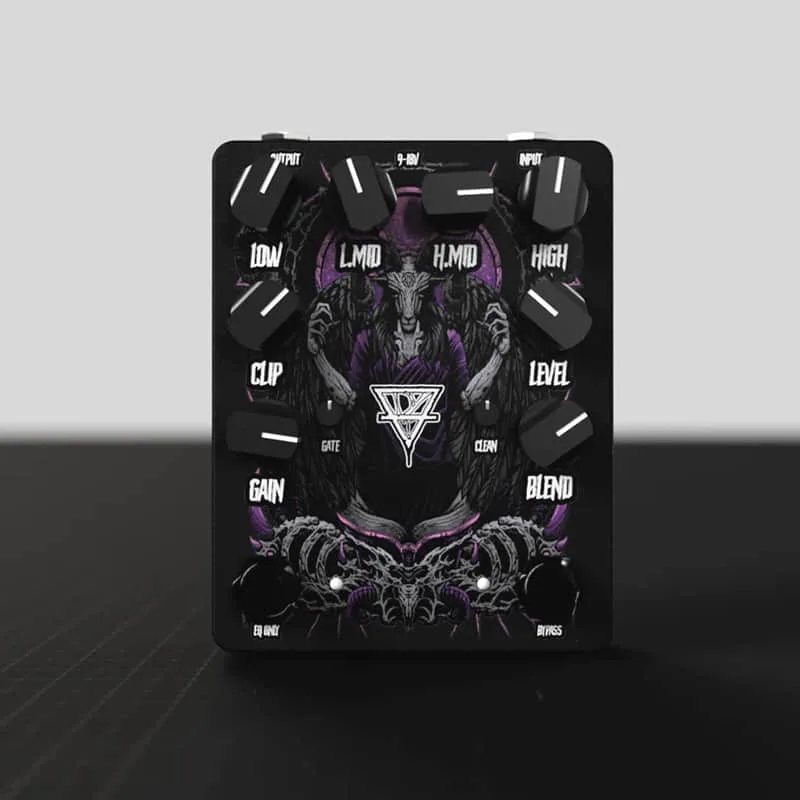
Because the original is out of production and expensive used, a cluster of makers has built pedals on the HM-2 circuit16158.
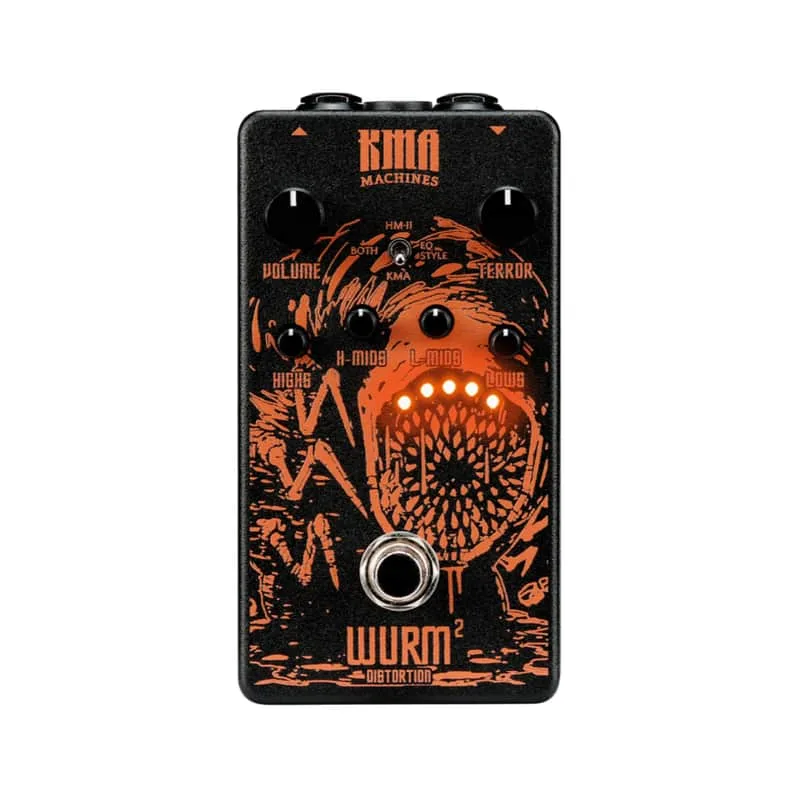
- KMA Audio Machines WURM and WURM 2: KMA describes the WURM as built on the out-of-production Boss HM2 MIJ pedal8, and the WURM 2 as a modern take on the classic and now sought-after original Boss HM2 MIJ14. KMA also makes the Guardian of the Wurm, another pedal in the family drawing on the HM-2's sound16.
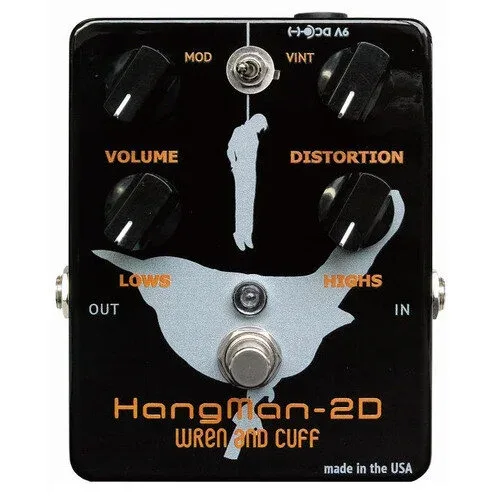
- Wren and Cuff Hangman 2D: A detailed recreation of Boss's Heavy Metal pedal5.
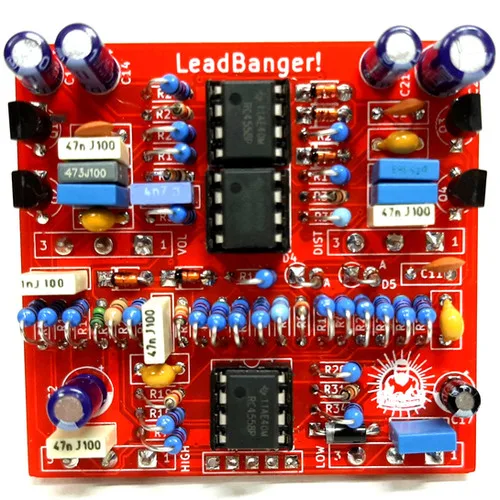
- Jed's Pedals LeadBanger: A kit that compares to the HM-2 by Boss17.
- GUP Tech Heavy Metal Distorsion clone: GUP Tech calls it "Our tribute to the classic Boss HM-2 distortion"18.
- This Heavy Earth CRUSTIFIXION v2: Based on the classic Boss HM-2 Heavy Metal circuit19.
- Catalinbread Carbide: Catalinbread's page discusses the stock HM-2 circuit's two color mix EQ knobs in explaining its own design12.
These vary in how closely they follow the original: some are straight clones, others take the HM-2's EQ concept and build a new pedal around it. A player chasing the exact Swedish chainsaw character will want to check how faithfully each one reproduces the 87Hz low boost and the mid-boosting high control161211.
The Heavy Metal Lite and other DIY layouts
The HM-2 has also become a DIY project. Jed's Pedals sells the LeadBanger as a kit that compares to the HM-2 by Boss17, aimed at builders who want to assemble their own version of the circuit. GUP Tech's clone is another budget route into the circuit18, and This Heavy Earth's CRUSTIFIXION v2 extends the classic HM-2 Heavy Metal circuit in its own direction19.
For a builder, the HM-2 is a manageable project: a distortion stage followed by the gyrator EQ section. The circuit's behavior is well documented across the clone makers' own descriptions of what they copied. What a builder gives up versus an original is the Japan-made pedigree that collectors pay for, and what they gain is a working chainsaw circuit at a fraction of used-HM-2 prices20167.
FAQ
What is the Swedish chainsaw sound on the HM-2?
With all of its knobs turned up to maximum, the HM-2 drives an amplifier's input so hard that it produces a raw, aggressive distortion with a uniquely voiced midrange and powerful low end. Boss itself calls this the signature "chainsaw" tone, and it became the defining guitar sound of Swedish death metal234. KMA Audio Machines describes the original HM-2 MIJ as a key element of that sound8.
How is the HM-2 different from the MT-2 Metal Zone?
The MT-2 Metal Zone replaced the HM-2 in the Boss lineup and offers a similar midrange control7. The HM-2, though, is one of the first amp-in-a-box pedals, built to replicate early '80s British stack amps1, and its tone shaping comes from the two Color Mix controls rather than the MT-2's parametric-style mid circuit.
When was the Boss HM-2 discontinued?
Sources disagree. Boss's own product page says the original was produced from 1983 to 19911, and Wren and Cuff also gives 1991 as the end of the line5. TONEHOME gives a longer run, ending in 1993, with Taiwan production from 19887.
Why do Japanese HM-2 pedals cost so much used?
The made-in-Japan run was short, 1981 to 1987 by TONEHOME's dating7, and the pedal has been out of production for decades. KMA Audio Machines calls the original HM-2 MIJ a sought-after, out-of-production pedal8, and its role in the Swedish chainsaw sound keeps demand high among death metal and shoegaze players alike.
Pedals on this page
Questions
What is the Swedish chainsaw sound on the HM-2?
With all of its knobs turned up to maximum, the HM-2 drives an amplifier's input so hard that it produces a raw, aggressive distortion with a uniquely voiced midrange and powerful low end. Boss itself calls this the signature chainsaw tone, and it became the defining guitar sound of Swedish death metal in the late 1980s and early 1990s.
How is the HM-2 different from the MT-2 Metal Zone?
The MT-2 Metal Zone replaced the HM-2 in the Boss lineup and offers a similar midrange control, but the two circuits are different designs. The HM-2's tone shaping comes from its two Color Mix knobs, a low boost around 87Hz and a high control that boosts or cuts mids, while the HM-2 is also one of the earliest amp-in-a-box pedals, aimed at early 1980s British stack amps.
When was the Boss HM-2 discontinued?
Sources disagree on the exact end date. Boss's own product page for the HM-2W says the original was produced from 1983 to 1991, and Wren and Cuff likewise date the end of production to 1991. TONEHOME gives a longer run, with Japan-made units from 1981 to 1987 and Taiwan-made units from 1988 to 1993.
Why do Japanese HM-2 pedals cost so much used?
The Japan-made HM-2 was only produced for a limited window, TONEHOME dates the made-in-Japan run from 1981 to 1987 before production moved to Taiwan, and the pedal has been out of production for decades. KMA Audio Machines describes the original HM-2 MIJ as a sought-after pedal, and its association with the Swedish chainsaw sound keeps demand high.
Sources (20)
- BOSS - HM-2W | Heavy Metal, BOSS (boss.info)
- BOSS - PX-1 | Plugout FX, BOSS (www.boss.info)
- BOSS - PX-1 | Plugout FX, BOSS (boss.info)
- BOSS - PX-1 | Plugout FX, BOSS (boss.info)
- Hangman-2D, Wren and Cuff, 1991
- Behind the Board: Tom Dalgety with Ghost, Pixies, Royal Blood, and The Cult, BOSS (articles.boss.info), 2024-09-04
- TONEHOME, TONEHOME
- Wurm - DISCONTINUED | KMA Machines, KMA Audio Machines
- GUARDIAN of the WURM, KMA Machines
- Gain Appreciation: Analyzing the BOSS HM-2W, articles.boss.info, 2021-05-27
- State of the Stomp: The Boss HM-2 - Premier Guitar, Premier Guitar, 2026-06-18
- Carbide Distortion, Catalinbread Effects
- Catalinbread Carbide offers Chainsaw Distortion tones, gearnews.com, 2023-06-14
- WURM 2 - High-Gain Distortion with Active 4-Band EQ | KMA Machines, KMA Machines
- 13 Best Distortion Pedals For 2026 (Top Picks), Tone Island (toneisland.com), 2026
- Guitar Pedal X, Guitar Pedal X, 2025-09-05
- LeadBanger, Jed's Pedals (jedspeds.co.uk)
- Torch HM-2 Clone, GUP Tech (guptech.ca)
- CRUSTIFIXION v2 by This Heavy Earth, RockBoard PedalPedia, 2026
- Guitar Pedal X - GPX Blog - Freqscene massively evolves and enhances the HM-2 circuit into a superb all-rounder Cleanless Amp-like Gain Machine, Guitar Pedal X