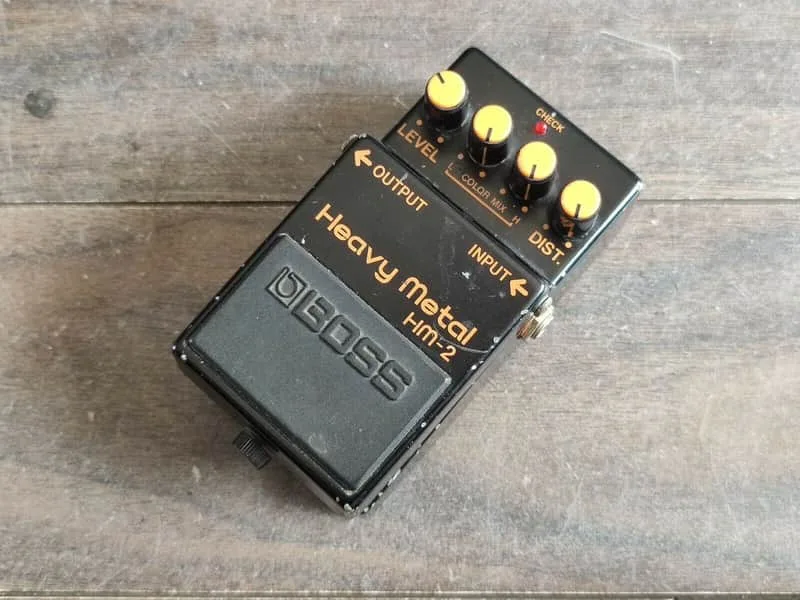


The Boss HM-2 Heavy Metal is a distortion pedal introduced by Boss in 1983, delivering what the maker describes as raw, aggressive distortion with a uniquely voiced midrange and a powerful low end1. Its reputation rests on one sound above all: with all knobs maxed, Boss says it pummels an amplifier's input to produce the signature "chainsaw" tone that defines the Swedish death metal guitar sound1. Guitar.com notes the original is endearingly referred to as the "Swedish Chainsaw" and is most associated with Swedish death metal2.
The pedal's standing in metal history is not just fan lore. MusicRadar calls it one of the most important pedals in the history of metal guitar, foundational to death metal, and famously used on Entombed's 1990 debut album Left Hand Path3. MusicRadar also reports that the HM-2's tone spawned the Swedish death metal sound's chainsaw wall of distortion, pioneered by bands like Dismember and Entombed4. Premier Guitar's reviewer adds that the original was among the first pedals to wear the amp-in-a-box mantle5.
The chainsaw distortion behind Swedish death metal
The HM-2's place in metal was earned in Sweden in the late '80s and early '90s. Mattias Johansson, speaking to Boss's own articles site about growing up in Sweden, said the pedal was monumental to him and his friends, and recalled the recipe plainly4212:
"We read in a magazine that to achieve the signature Swedish death metal sound, the HM-2's controls were set to their maximum"12
Mattias Johansson, in a Boss interview12
He described running the pedal with the controls set to maximum, or "dimed," into a Peavey Bandit to sound like Entombed12. RockBoard's PedalPedia makes the same connection from the other side, noting that from its brutal, grinding distortion tones, bands like Dismember and Entombed birthed Swedish chainsaw metal13.
The pedal's reach went well beyond death metal. Producer Tom Dalgety told Boss he used the HM-2 on bass for the Pixies' album Head Carrier, easily heard on the track "Baal's Back"14. He also liked using it as a Rangemaster-style treble booster by turning the high frequencies up with the H Color Mix knob and the distortion down to about ten o'clock14. MusicRadar reports the same pedal that produced such brutal tones was also in David Gilmour's touring rig at one point15, and Guitar World notes he used it on the '80s albums About Face and A Momentary Lapse of Reason16.
On the used market, MusicRadar listed original HM-2s at £150 to £250 (used) in a 2018 history article17.
The controls: two Color Mix EQ knobs
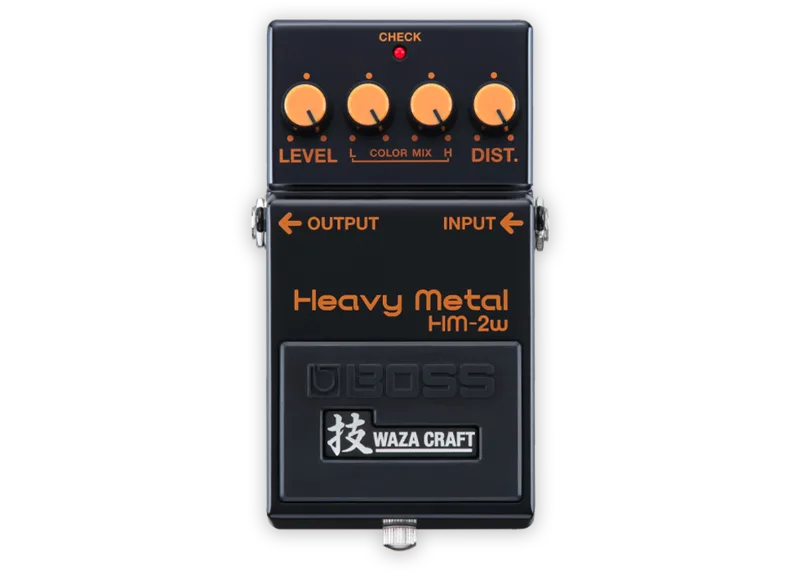
The original pedal has four knobs: Level, Lows, Highs and Distortion18. What sets it apart from most distortion pedals is the pair of EQ controls Boss called "Color Mix." Catalinbread, whose Carbide pedal is built around the HM-2 circuit, explains the layout:
| Control | What it does |
|---|---|
| Distortion | Sets the gain of the distortion circuit |
| Level | Sets the output volume |
| L (Low) Color Mix | Boosts or cuts the low end, part of the dual EQ |
| H (High) Color Mix | Boosts or cuts the high end and mids |
The Color Mix controls are unusually powerful. Guitar World reports they offer plus or minus 20dB of boost or cut to the distortion circuit16, and Gearnews describes the same dual control with the same range on the original version19. The H knob is also doing more than its label suggests: Catalinbread notes it actually controls two different bands simultaneously, at 958Hz and 1279Hz20. TONEHOME highlights the ability to boost or cut mids using the H (high) Color Mix knob7.
Under the hood, Guitar Pedal X describes the Low and High EQ knobs as studio console style gyrator controls21. That gyrator tone stack is a distinctive part of the circuit: a DIY analysis on the Tagboard Effects blog, building a simplified "HM-2 Lite," noted how much smaller the circuit would be without the gyrator tone stack the original uses22.
How the circuit clips
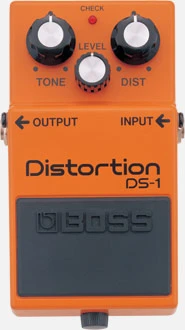
The HM-2 is a development of the core idea behind the Boss DS-1, but MusicRadar's history of the circuit says it goes overboard, with soft clipping diodes, hard clipping and crossover distortion combining to make the chainsaw sound17. Guitar Pedal X likewise calls it quite a hard-clipping device, producing what it describes as a distinctive Twin-Peaks Frequency Output Shape23.
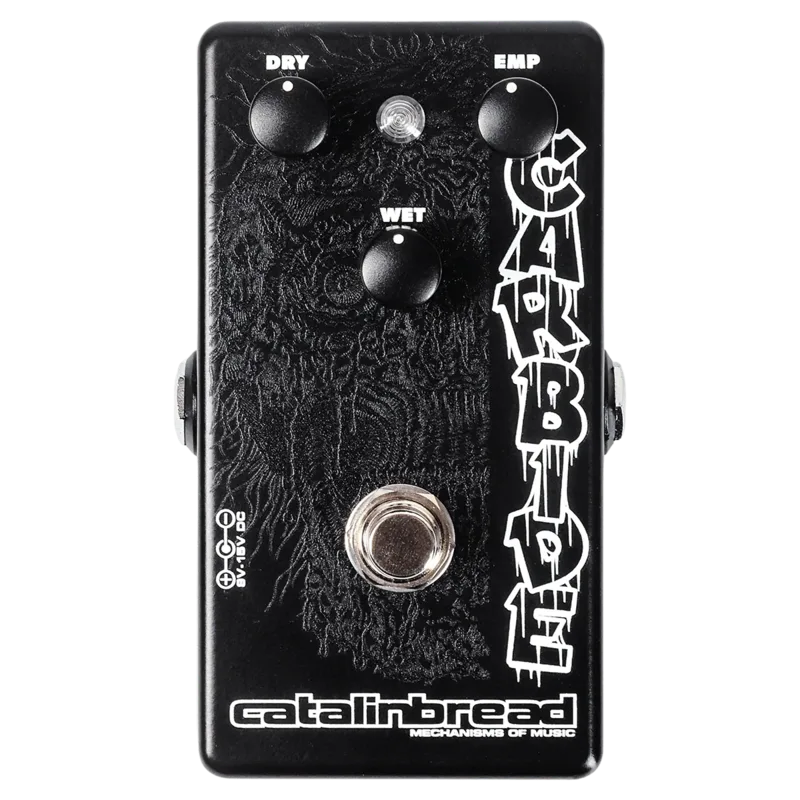
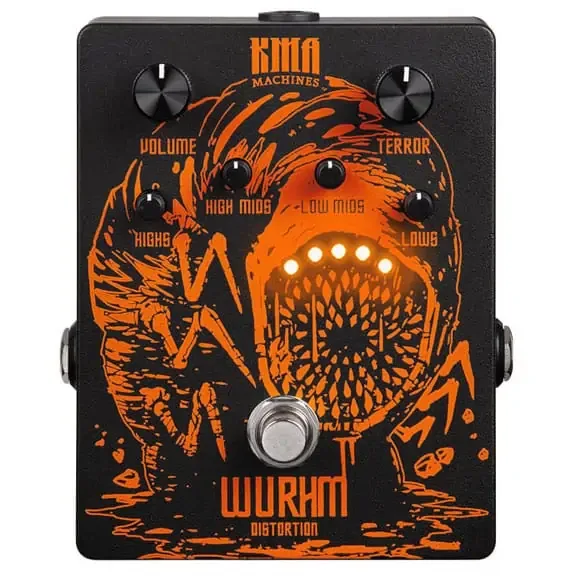
That combination of clipping types into a hard-edided, mid-heavy output is what players hear as the chainsaw character. The DIY community has kept the circuit alive in other forms: the Tagboard Effects HM-2 Lite was judged by mirosol to have output level and gain sufficiently close to the original, though the original's Color Mix L/H controls boost the Qs of their frequencies a lot more22. Several makers have built expanded HM-2 circuits, including Catalinbread's Carbide, offered as chainsaw distortion tones24, and KMA Audio Machines' Wurhm, an HM-2 tribute whose original circuit KMA describes as a key element of the Swedish chainsaw metal sound24.
The HM-2W reissue and what replaced the original
Boss discontinued the original HM-2 after a production run dated differently by different accounts: Boss itself says 1983 to 19918257, Wren and Cuff says the last units rolled off the line in 19918257, while TONEHOME lists production ending in 1993, with Taiwan-made units built from 1988 to 1993 and Japan-made units from 1981 to 19877. TONEHOME also reports the Boss MT-2 Metal Zone replaced it, offering a similar midrange control7.
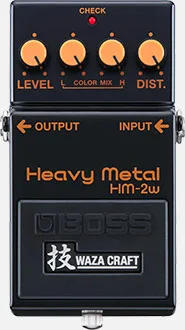
The story did not end there. In November 2020, Guitar World reported that Boss president Yoshi Ikegami had confirmed a Waza Craft version of the HM-2 was in the works, to be launched the following year, and that for the first time the company would seek input from fans of the pedal16. The resulting HM-2W reissue carries the same chainsaw lineage: Gearnews describes its aggressive, so-called chainsaw sound as characteristic of Swedish death metal26. Guitar World's review lists the HM-2W at $179, with input, output and power sockets10. Boss has also brought the HM-2 into its PX-1 Plugout FX system as a Model Pass effect27.
Videos
BOSSchannel
blondegraemey
Taylor Danley
Questions
What settings give the HM-2 chainsaw tone?
The signature chainsaw tone comes from setting every knob to maximum. Boss says that with all knobs maxed the pedal pummels an amplifier's input to produce the tone that defines the Swedish death metal guitar sound. Mattias Johansson, who grew up in Sweden, recalls reading that the HM-2's controls were set to their maximum into a Peavey Bandit to sound like Entombed.
When was the Boss HM-2 discontinued?
Boss states the original was produced from 1983 to 1991, and Wren and Cuff likewise says production ceased in 1991. TONEHOME, however, lists production ending in 1993, with Taiwan-made units built from 1988 to 1993. Either way, the original has been out of production for decades.
What is the difference between the HM-2 and the HM-2W?
The HM-2W is Boss's Waza Craft reissue of the original HM-2 Heavy Metal, launched after Boss president Yoshi Ikegami confirmed the reissue was in the works in late 2020. For the first time Boss sought input from fans of the pedal when developing the new version. Guitar World's review lists the HM-2W at $179.
Are Japan-made HM-2 pedals different from Taiwan-made ones?
TONEHOME lists Japan-made HM-2s as produced from 1981 to 1987 and Taiwan-made units from 1988 to 1993. TONEHOME also notes that tone gourmets deem the earlier Japan-made Boss pedals to sound better than the later Taiwan-made ones, though that remark concerns the DS-1 rather than the HM-2 specifically.
Did David Gilmour use a Boss HM-2?
Yes. MusicRadar reports that the same pedal used for brutal Swedish death metal tones was also in David Gilmour's touring rig at one point, and Guitar World notes he used it on the '80s albums About Face and A Momentary Lapse of Reason.
What pedal replaced the Boss HM-2?
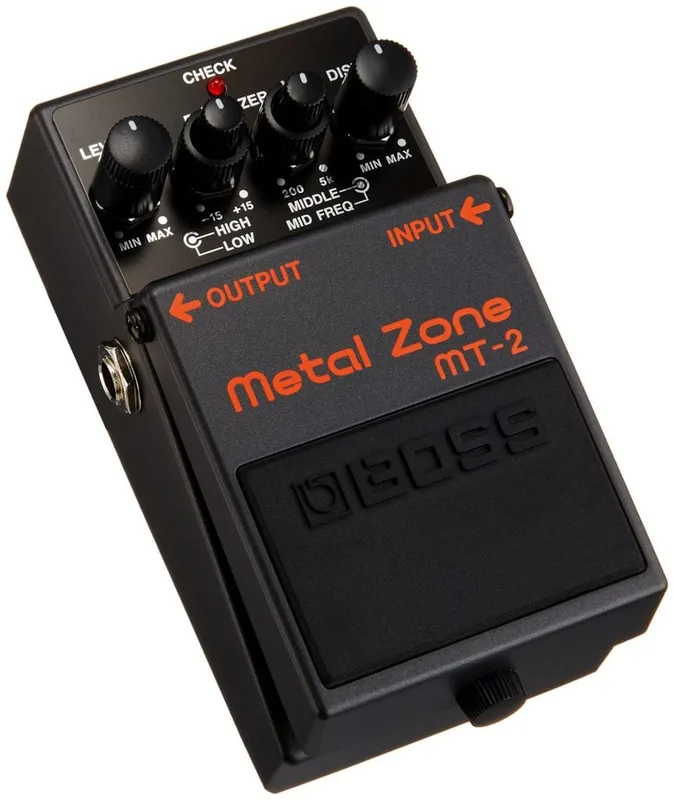
TONEHOME reports that the Boss MT-2 Metal Zone replaced the HM-2, offering a similar midrange control. The MT-2 carries the idea further with four tone controls, High, Low, Mid and Mid Freq, each offering 15dB of cut or boost.
Sources (27)
- BOSS - PX-1 | Plugout FX, BOSS (boss.info)
- Here's a first look at the Boss HM-2 Waza Craft reissue, Guitar.com, 2021-03-04
- Catalinbread's new Carbide distortion pedal offers metal guitarists the ultimate in necro HM-2 “chainsaw” tone, MusicRadar, 2023-06-16
- KMA Machines reveals limited edition WURHM HM-2 tribute distortion pedal, MusicRadar, 2020-11-26
- Boss HM-2w Waza Craft Heavy Metal Review, Premier Guitar, 2021-09-09
- BOSS - HM-2W | Heavy Metal, BOSS (boss.info)
- TONEHOME, TONEHOME
- BOSS Announces the HM-2W Heavy Metal Pedal, Premier Guitar, 2021-06-17
- 13 Best Distortion Pedals For 2026 (Top Picks), Tone Island (toneisland.com), 2026
- Boss HM-2W Heavy Metal review, Guitar World, 2021-10-06
- Boss reignites the Hyper Fuzz Hype with new teaser, Guitar.com, 2020-11-13
- Behind the Board: Mattias Johansson With The Cure, Dinosaur Jr., and The Black Crowes, BOSS (articles.boss.info), 2025-12-18
- Wurm 2 by KMA Machines, RockBoard PedalPedia, 2026
- Behind the Board: Tom Dalgety with Ghost, Pixies, Royal Blood, and The Cult, BOSS (articles.boss.info), 2024-09-04
- Katatonia / Bloodbath guitarist Anders Nyström pays tribute to the Boss HM-2 distortion pedal, MusicRadar, 2021-08-20
- Boss confirms an HM-2 Heavy Metal reissue is in the works, Guitar World, 2020-11-25
- The FX files: Boss DS-1, MusicRadar, 2018-11-16
- Guitar Pedal X, Guitar Pedal X, 2026-07-27
- Boss to reissue HM-2 as a Waza Craft pedal, gearnews.com, 2020-11-25
- Carbide Distortion, Catalinbread Effects
- Guitar Pedal X, Guitar Pedal X, 2026-10-06
- Guitar FX Layouts: Boss HM-2 Heavy Metal Lite, tagboardeffects.blogspot.com (Guitar FX Layouts), 2014-05-02
- Guitar Pedal X, Guitar Pedal X, 2025-09-05
- Wurm - DISCONTINUED | KMA Machines, KMA Audio Machines
- Hangman-2D, Wren and Cuff, 1991
- The Best Distortion Pedals in Every Price Range, Gearnews (www.gearnews.com), 2025-04-14
- BOSS - PX-1 | Plugout FX, BOSS (boss.info)