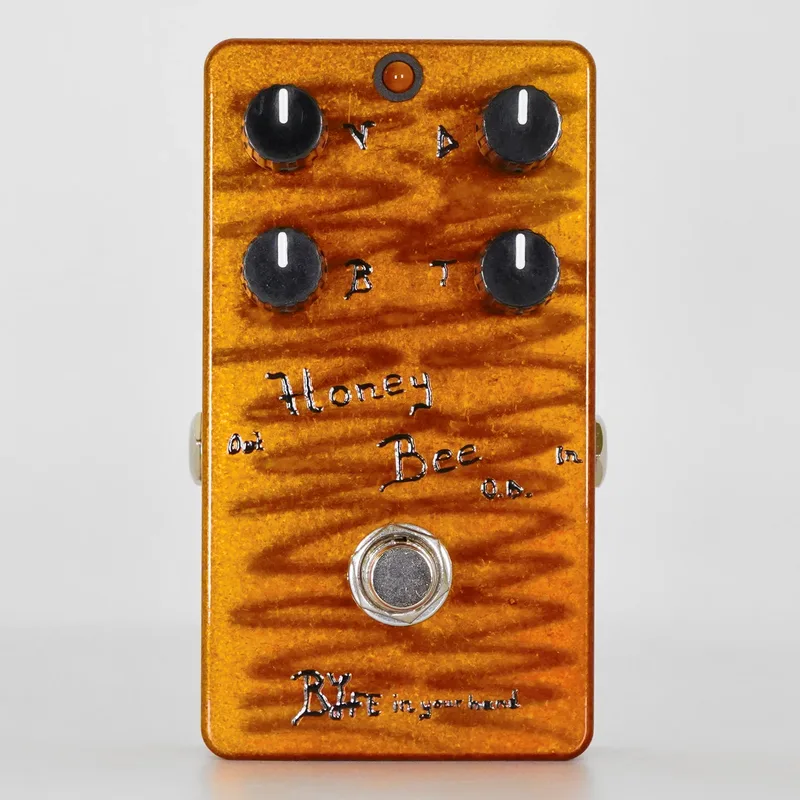
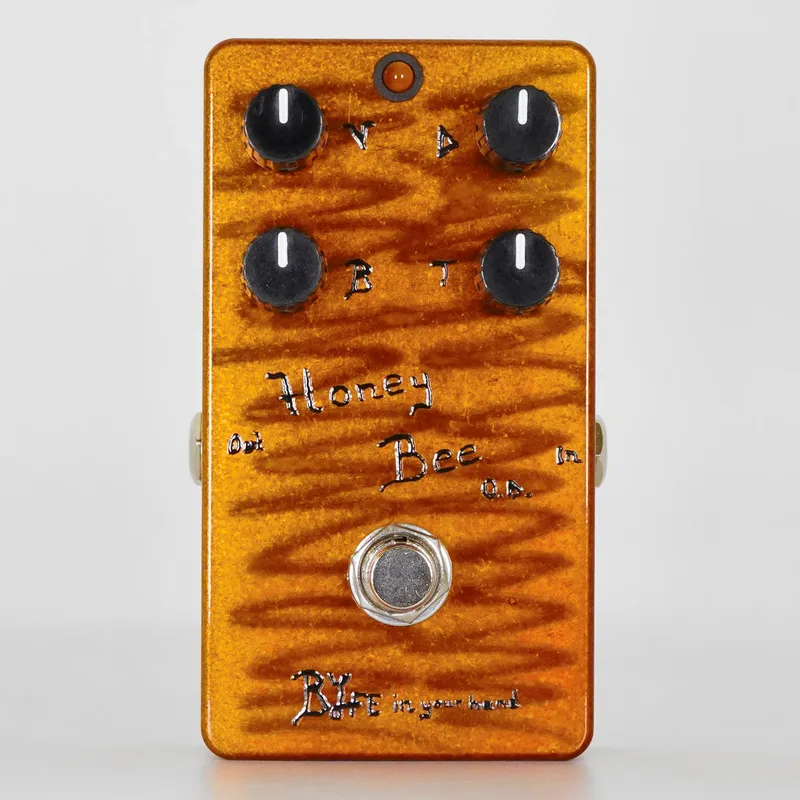
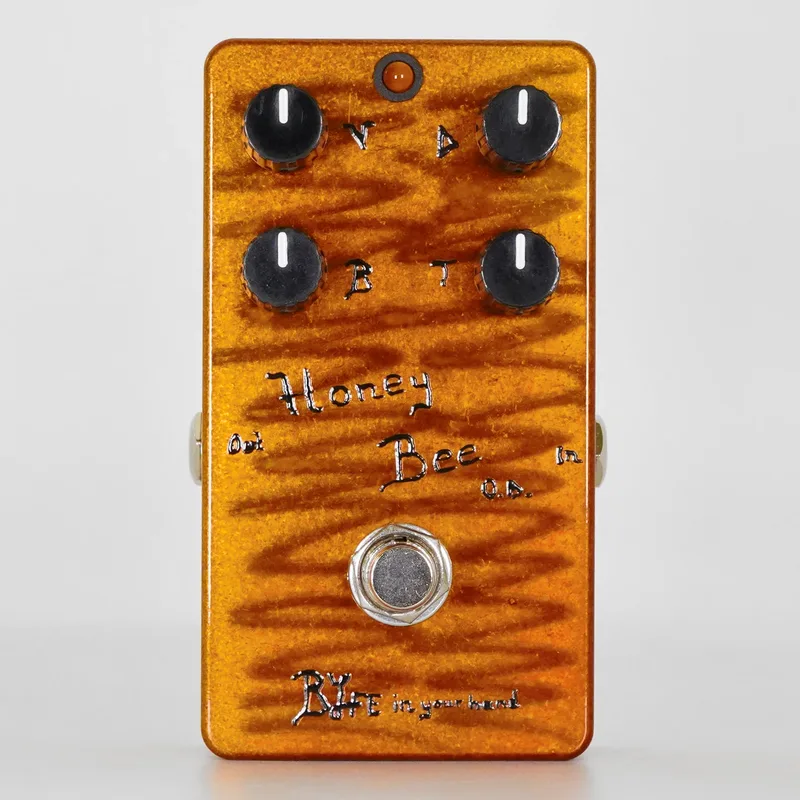
The Honey Bee Overdrive is a low-gain overdrive circuit designed by Bjorn Juhl, a Swedish designer whose pedals have a long following among players who want amp-like breakup at low volume. The first Honey Bee was released on December 4, 2002 under Juhl's own BJFE imprint, and those original units now sell for several hundred dollars on the used market1. The circuit was later revived under BearFoot FX and then made by One Control, and it has become one of the most-cloned and most-traced low-gain overdrives in the DIY world [2, 3].
Delicious Audio describes the pedal's character plainly: it "resembles a guitar amp that is set to a 'crunch' setting," with a "warm overdrive crunch which is easily adjustable by a twist of a knob"1. BearFoot FX puts it in similar terms, saying the Honey Bee "sounds and reacts like small vintage combos with nicely worn tubes and speakers"2.
Where the Honey Bee came from: Bjorn Juhl and BJFE
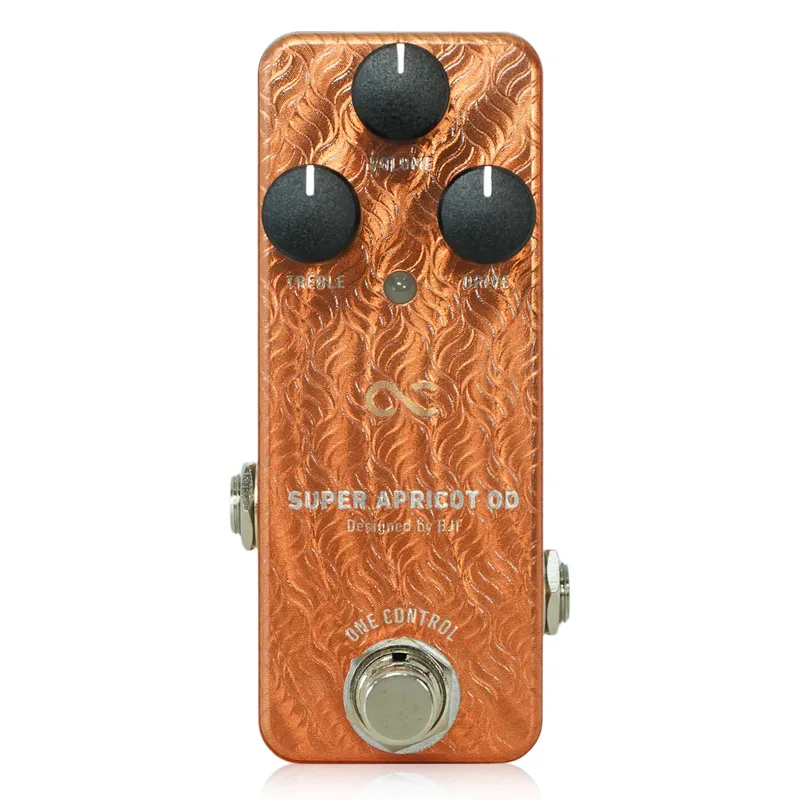
Bjorn Juhl's most popular stompbox design predating his involvement with third parties is the Honey Bee OD1. One Control, which now builds Juhl's designs, credits him as "the designer of the SUPER APRICOT OD, as well as the Honey Bee OD, another pedal known to be inspired by" vintage amps3. The original Honey Bee OD was inspired by the sound of an old Supro amp, though as One Control notes elsewhere, the pedal is a true overdrive effect rather than a literal amp copy [2, 5].
The pedal's life spans three makers. It was originally released under the BJFE imprint, later revived under BearFoot FX, and is currently made by One Control1. That long production run, with hand-built units changing hands for several hundred dollars, is part of why the circuit has been traced and rebuilt so widely by the DIY community [2, 3].
How the circuit works
The Honey Bee is a JFET-based overdrive. In general terms, overdrive circuits work as a two-step process: op-amps boost the signal, and at a certain point diodes are triggered to soft-clip the boosted signal4. The Honey Bee's own implementation centers on a JFET input stage and an op-amp with a 220n capacitor in its feedback path to ground. Aion FX's technical analysis of traced units notes that the original Honey Bee units never had a bass cut and only ever used that 220n capacitor in the op-amp's feedback path5.
One detail from the trace work matters to anyone building or repairing one: the JFET source bias resistor is 2.2k, not 5.6k as appeared in an earlier draft trace that circulated in the DIY community5. Aion FX published its re-examination of the original Free Stomp Boxes trace in November 2023, concluding that the final 2009 schematic was a hybrid of two differing units, and published an annotated schematic comparing all traced versions5.
"This was the source schematic for most DIY adaptations of the circuit since 2009."
That single sentence explains a lot of the confusion around the circuit: builders working from the 2009 schematic were unknowingly building a pedal made of parts from two different units, which is one reason cloned Honey Bees have never all sounded alike5.
The Nature control and its two wirings
The Nature knob is the Honey Bee's signature control, and it is also the source of the circuit's biggest structural variation. Delicious Audio describes it as a "frequency range control that fine tunes the overall color of your tone. At the counter-clockwise position, the lows and low mids are more predominant. In the clockwise direction, a softer output is obtained"1. BearFoot FX keeps it shorter: "Nature adjusts the EQ"2.
Under the hood, the Nature pot can be wired two different ways, and both arrangements were used in production5:
| Wiring | Where Nature connects | Coupling component | Used in |
|---|---|---|---|
| First arrangement | Lug 3 of the volume pot | 4n7 capacitor | First unit; confirmed in the One Control version and the Blueberry bass variant |
| Second arrangement | Q1 source | 220n capacitor, generally with either a 4.7k or 5.1k resistor | Second unit; BearFoot and One Control versions |
This is the major structural difference between versions, and it is not just a component swap but an actual schematic difference5. The One Control version has both options switchable, which is what its Vintage/Modern switch selects [1, 2].
Revisions and production differences
Beyond the two Nature wirings, the Honey Bee went through documented revisions across its production life. Aion FX found that there are many different versions of the circuit, "not just component variants, but actual schematic differences"5. Delicious Audio's history of the pedal, published in collaboration with Bjorn Juhl, lists the revisions1:
| Revision | Change |
|---|---|
| Revision 1 | Increased output level |
| Revision 2 | Increased upper midrange response |
| Revision 3 | Nature control full clockwise changed from mild treble cut to mild treble boost, at approximately serial number 147 |
| Revision 4 (One Control) | All revisions above plus a 6dB gain increase |
Revision 3 is the one collectors and used-market shoppers encounter most often: two BJFE units with close serial numbers can sound noticeably different with the Nature knob dimed, because the pedal changed from a treble cut to a treble boost at that position around serial number 1471.
The One Control version adds a Vintage/Modern switch that lets a player choose between "the sound of the original Honey Bee Overdrive (Vintage) and the sound of the current version (Modern)"1. Because the One Control unit has both Nature connection options built in and switchable, it effectively puts the whole revision history in one enclosure5.
From BJFE to BearFoot FX and One Control
After the BJFE originals, BearFoot FX took up the design. The BearFoot standard version "provides extended Drive range and additional tweakability with the Treble control," ranging "from a tasty 'Honey Boost' with drive down to extra grunt and gristle with everything up"2. BearFoot's control set is Drive, Nature and Treble, with the Drive knob varying "the distortion complexity and saturation"2.
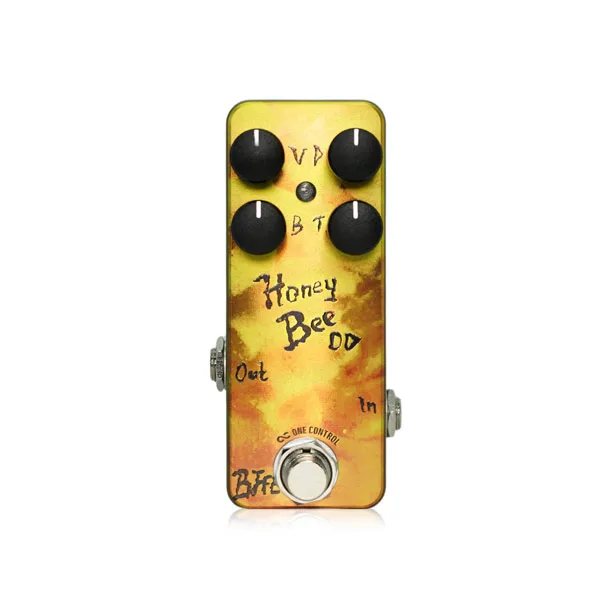
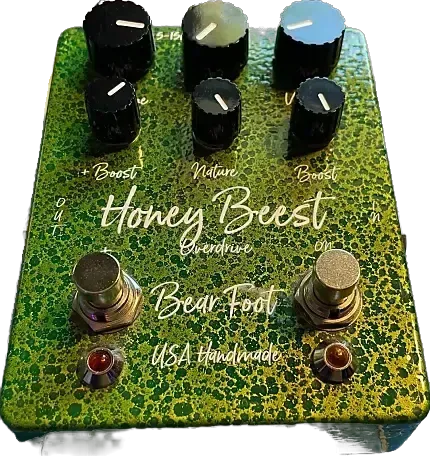
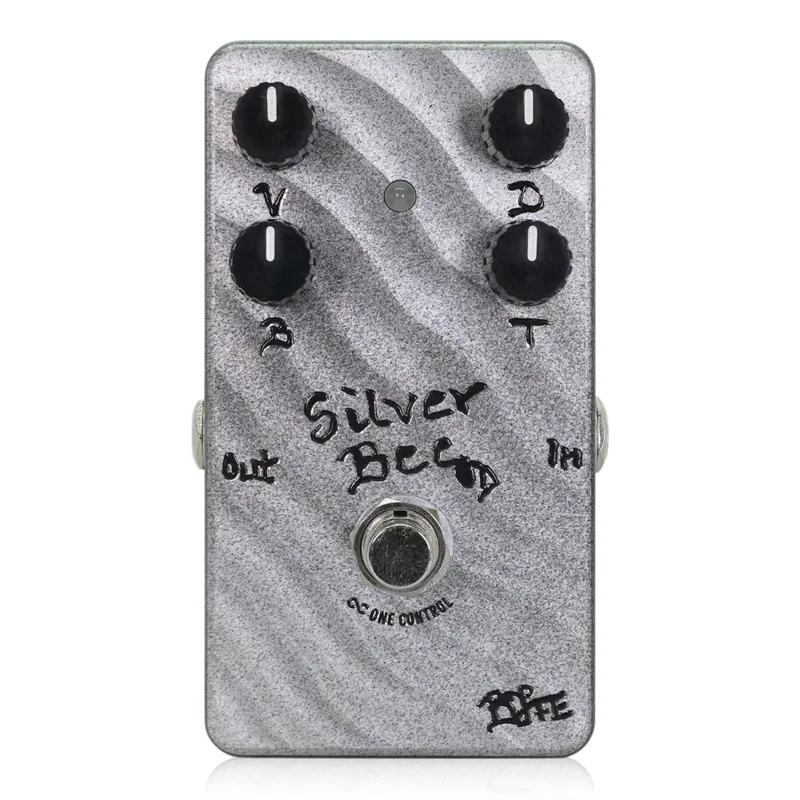
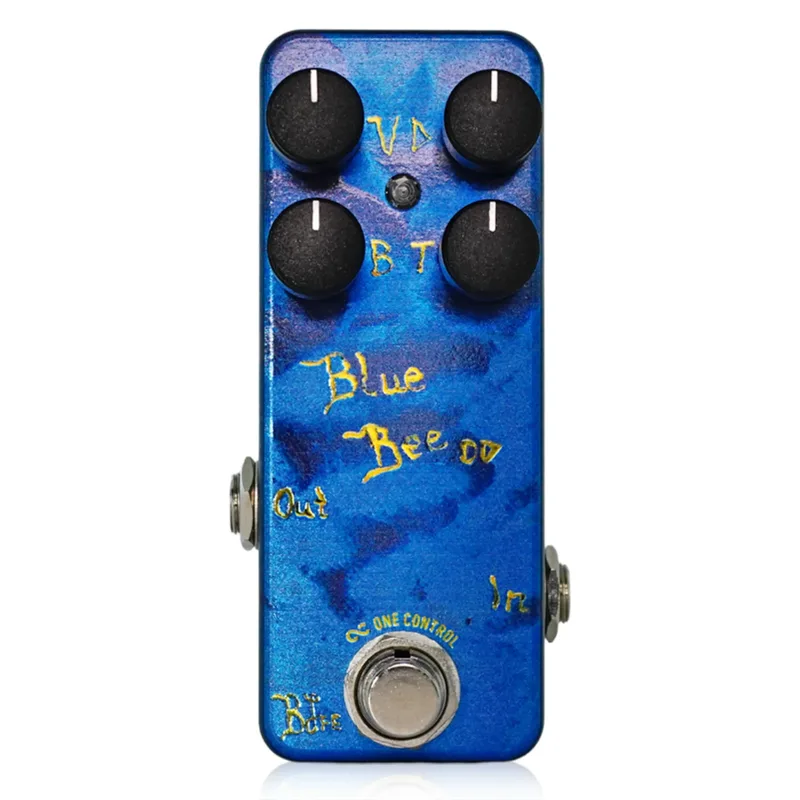
BearFoot FX also built the Honey Beest, a related overdrive in the same family6. One Control now produces the Honey Bee line, including the Honey Bee OD 4K in the BJFE in Your Hand series [2, 6]. One Control's Bjorn Juhl-designed offshoots include the Silver Bee OD, a low-gain overdrive "drawing from his very sought-after Honey Bee OD design"7, and the Blue Bee OD 4K Mini, described as "a custom model based on the Honey Bee OD" and "one of the most famous BJFE overdrives"8.
Pedals based on the Honey Bee
The Honey Bee's influence shows up in both production pedals and DIY boards951:
- One Control Blue Bee OD 4K Mini: a custom model based on the Honey Bee OD8
- One Control Silver Bee OD: a low-gain overdrive drawing from the Honey Bee OD design7
- GuitarPCB Killer Bee: a DIY project "based on the Honey Bee but with some modern features"9
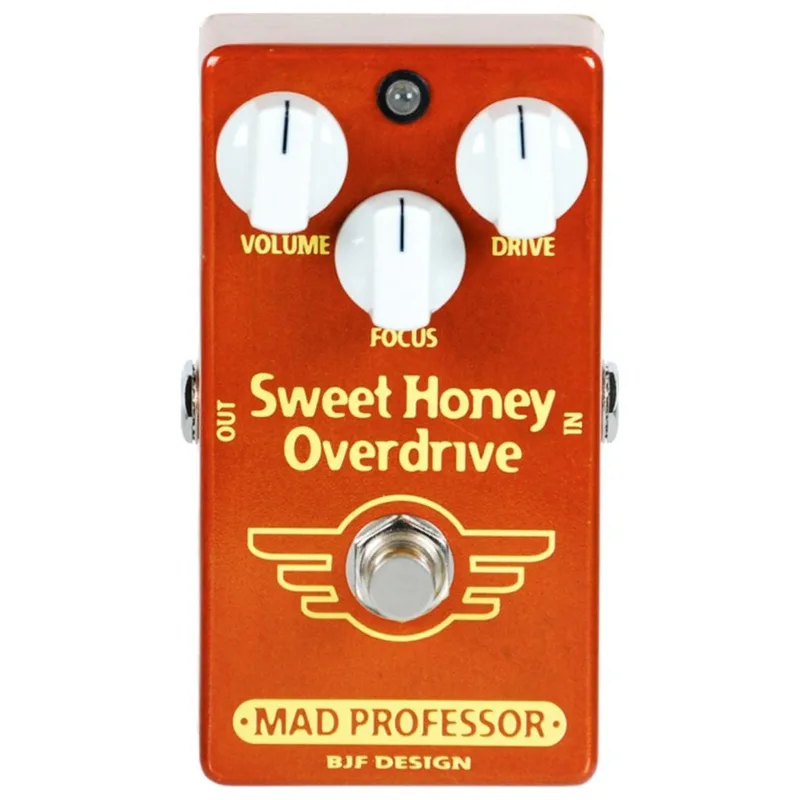
- Mosky Honey Box: based on the Mad Professor Sweet Honey Overdrive, a separate design that shares the honey naming but not the Honey Bee circuit10
- PedalPCB Honeysuckle Overdrive: a DIY PCB compared to the CKK Scream Honey, a derivative in the Honey Bee family tree rather than a trace of the original11
The Mad Professor Sweet Honey question comes up often because of the shared honey name and the Nature-style control, but the documented lineage connects the Mosky Honey Box to the Sweet Honey, not to the Honey Bee10.
The Super Apricot OD is a different case. Both pedals were designed by Bjorn Juhl and share a point of inspiration, but One Control states that "the circuits are entirely unique. SUPER APRICOT OD is designed as an 'Amp in a Box' while Honey Bee OD is a true overdrive effect"3.
DIY kits and layouts
The Honey Bee has one of the more widely copied circuits among DIY overdrive builders. The Free Stomp Boxes trace of 2009 was the source schematic for most DIY adaptations of the circuit since then5. From that trace, a range of independent overdrive PCB projects has followed, including boards sold as DIY pedal PCBs such as the Hatchet Overdrive and the ADHD Overdrive5.
If you are building a Honey Bee from an older schematic, be aware that Aion FX found the final 2009 FSB schematic was a hybrid of two differing units, and that the JFET source bias resistor is 2.2k, not the 5.6k shown in an erroneous draft trace5.
For builders who want a packaged route rather than a community trace, third-party PCB sellers offer overdrive circuit board projects that adapt the circuit independently, such as the GuitarPCB BD Over Drive Circuit, a DIY overdrive circuit PCB project12. These boards are separate from the original BJFe design, which was first released on December 4, 2002 and drawn by Bjorn Juhl1.
Pedals on this page
Questions
What does the Nature knob do on a Honey Bee overdrive?
Nature is a frequency range control that fine tunes the overall color of the tone. Counter-clockwise, the lows and low mids are more predominant; clockwise, a softer output is obtained. BearFoot describes it more simply as an EQ adjustment. In Revision 3 the full clockwise position was changed from a mild treble cut to a mild treble boost.
Is the Honey Bee based on a Supro amp?
The original Honey Bee OD was inspired by the sound of an old Supro amp, but it is a true overdrive effect rather than an amp-in-a-box copy. One Control makes the same distinction when comparing it to the Super Apricot OD, which is designed as an amp in a box while the Honey Bee is an overdrive circuit.
What is the difference between the BearFoot and One Control Honey Bee?
BearFoot FX revived the pedal after the BJFE originals and its standard version adds a Treble control plus extended Drive range. One Control's version carries all the circuit revisions and adds a 6dB gain increase, and its Vintage/Modern switch lets you choose between the sound of the original Honey Bee and the current version, since the One Control unit has both Nature wiring options built in.
Is the Mad Professor Sweet Honey a Honey Bee clone?
The Mad Professor Sweet Honey is a separate design, not a documented Honey Bee derivative. The documented relationship runs the other way in the DIY world: the Mosky Honey Box is described by its maker as based on the Mad Professor Sweet Honey Overdrive, a design that shares the honey naming but not the Honey Bee circuit.
Is the Honey Bee related to the Super Apricot OD?
Both pedals were designed by Bjorn Juhl and share a point of inspiration, but One Control states the circuits are entirely unique. The Super Apricot OD is designed as an amp in a box, while the Honey Bee OD is a true overdrive effect.
Is there an official Honey Bee DIY kit?
Yes. Moody Sounds released an official Honey Bee Overdrive kit designed by BJFe in 2020. Before that, most DIY adaptations of the circuit since 2009 were built from the Free Stomp Boxes trace of the original, which Aion FX later showed was a hybrid of two differing units.
Sources (12)
- One Control Honey Bee Overdrive, Delicious Audio, 2022-01-23
- Honey Bee Overdrive by BearFoot FX, RockBoard PedalPedia, 2026
- SUPER APRICOT OD (OC-SAODn), One Control USA
- Overdrive vs. Distortion vs. Fuzz, Dunlop Lifestyle, 2017-03-14
- Tracing Journal: Revisiting the Original Honey Bee FSB Trace, Aion FX, 2023-11-23
- Honey Beest by BearFoot FX, RockBoard (rockboard.de PedalPedia), 2026
- Silver Bee OD Limited BJFE Style Wave (OC-SVBODn-BJW), One Control USA
- Blue Bee OD 4K Mini (OC-BLBOD4K-M), One Control USA
- Killer Bee New v4, GuitarPCB
- HONEY BOX_M-SERIES_Products_mosky pedal, moskyaudio
- Honeysuckle Overdrive, PedalPCB.com
- BD_Over-Drive-Circuit.pdf, GuitarPCB.com, 2023