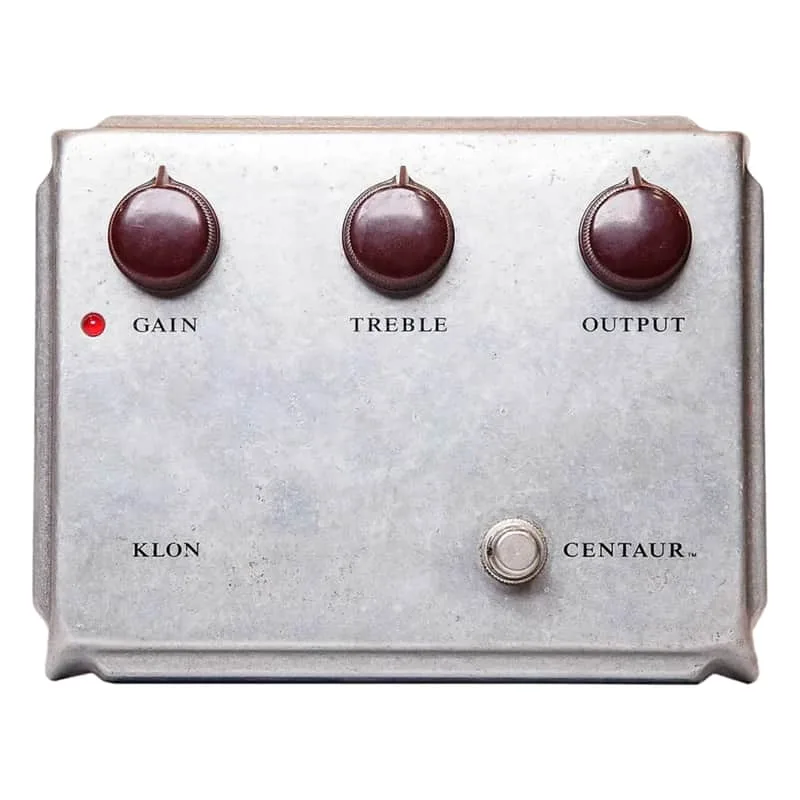
The Kicker is a DIY overdrive PCB project from GuitarPCB, sold under the NostalgiTone name, that recreates the Klon Centaur circuit. GuitarPCB's build document says it "captures the magic of the legendary Klon Centaur, delivering a rich harmonic boost, transparent overdrive"1, and the product page repeats the claim that it "captures the magic of the legendary Klon Centaur"2. Unlike a finished store-bought pedal, it arrives as a bare circuit board: you source the parts, solder them, and house the result yourself.
What you get, according to the maker, is the thing players chase the original Klon circuit for: a boost that adds depth and clarity without coloring your core tone. The build document describes "a transparent boost, rich harmonics, and dynamic touch sensitivity" that "adds depth and clarity without coloring your core tone"3.
A Klon Centaur-based boost
The Klon Centaur is one of the most copied overdrive circuits in guitar history, and the Kicker is GuitarPCB's take on it. The build document is direct about the lineage321:
"The Kicker stays true to the legendary Klon[e] circuit"
The product page frames the same thing in marketing terms, saying the pedal "captures the magic of the legendary Klon Centaur"2.
GuitarPCB has built a small family of Klon-derived projects around this core:
| Project | What it is | Circuit basis |
|---|---|---|
| The Kicker | Single-circuit DIY PCB | Klon Centaur2 |
| Mule Kicker Pro | Build document project | Klon[e] circuit3 |
| Blues Kicker | Dual-combo build | Klon-style circuit plus Blues Breaker circuit4 |
| John Mayer Tribute Dual Combo | Two-section PCB set | Kicker Klon(e) section plus Blues Breaker circuit5 |
The dual-combo projects are worth knowing about because they show how the Klon circuit is typically paired. The Blues Kicker build document says its Kicker section "recreates the articulate boost and midrange clarity of the legendary Klon-style circuit"4, and the John Mayer Tribute set describes the same section as delivering "the articulate boost and midrange clarity of the legendary Klon-style circuit"5. The companion section in both is a Marshall Bluesbreaker circuit, giving a two-in-one overdrive with a Klon-style voice on one side.
How the circuit works: dual RC4558 and a voltage doubler
The parts list in the build document names three ICs4:
- IC1: RC4558 dual op amp
- IC2: RC4558 dual op amp
- IC3: ICL7660S charge pump
That trio tells you most of what the circuit is doing.
The RC4558 is a dual op amp, so each package holds two amplification stages. Two of them give the circuit four op amp sections to work with, which is how a Klon-style design splits its jobs: input buffering, gain staging, tone shaping and output drive. The op amp choice matters to builders, since the RC4558 is the type associated with the original circuit's character4.
The ICL7660S is a charge pump, a small IC that converts one supply voltage into another. In boost and overdrive pedals, makers use this kind of internal voltage multiplying circuitry to raise the operating voltage above what a 9V input provides. MI Audio describes the same approach in its own products:
"we have added internal voltage multiplying circuitry" that boosts "the operating voltage from a 9V input to an 18V supply"
For a player, the practical effect is headroom: the circuit can push harder before the boost itself starts to break up, which is part of why Klon-style circuits are described as transparent rather than fuzzy or compressed.
The ICL7660S is listed as IC3 in the build document's parts list4. Builders following the document should match the IC designations exactly, since the charge pump sits in the power section rather than the audio path.
The controls: Drive, Tone and Volume
The Kicker keeps the Klon circuit's three-knob format. The build document's parts list gives the pot values4:
| Control | Pot | What it does |
|---|---|---|
| Drive | B100K dual pot | Sets the amount of gain; a dual pot adjusts two circuit points with one knob |
| Tone | B10K | Tilts the EQ, from darker to brighter |
| Volume | B10K | Sets the overall output level |
The Drive control is the notable one for builders: it is specified as a dual pot, meaning two B100K potentiometers ganged on one shaft4. That is a parts-sourcing detail that matters, because a dual pot is not interchangeable with a standard single pot, and the Drive knob in a Klon-style circuit adjusts more than one gain-setting element at once.
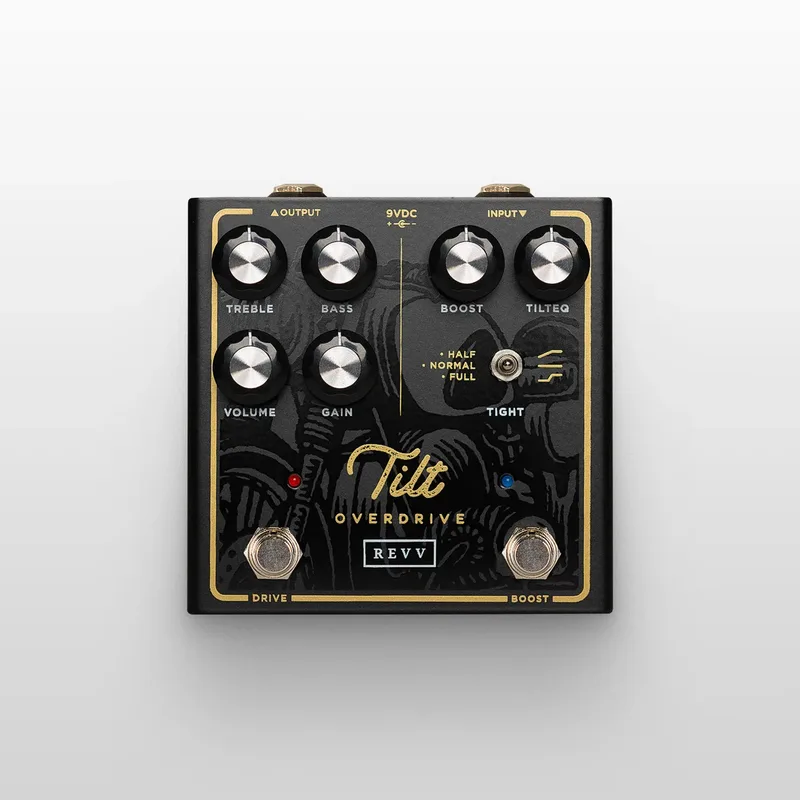
The three-knob layout is shared by other Klon-style and overdrive projects across the market. GUP Tech's Dude Screamer, for example, uses Volume, Drive and Tone knobs in the same arrangement7, and Revv's Tilt Overdrive shapes its drive circuit with Treble, Bass, Volume and Gain knobs8. The Kicker's control set is the classic minimal trio: gain, tone, level.
How the Kicker differs from the alternatives
The Klon circuit has been reproduced in almost every form a product can take, and the Kicker sits in the DIY corner of that landscape. Comparing it with its neighbors shows what each approach offers.
| Product | Maker | Form | Circuit basis |
|---|---|---|---|
| The Kicker | GuitarPCB | DIY PCB project | Klon Centaur2 |
| Klon Centaur Replica | General Guitar Gadgets | DIY kit/PCB | "A replica of the Klon Centaur"9 |
| Trio Rider | Sonicake | Production pedal | "Modified Klon Centaur-style Overdrive"10 |
| K Drive | HeadRush | Modeling unit stompbox | "Based on a Klon Centaur"11 |
| Kemper Drive | Kemper | Profiler effect | Klon Centaur Gold12 |
| Utility Boost (buffer option) | BLAMMO! Electronics | Boost with buffer option | "The buffer option is based on the popular Klon Centaur circuit"13 |
The distinctions are practical ones. General Guitar Gadgets sells its replica as a full kit and PCB project, the same DIY territory as the Kicker, describing it plainly as "a replica of the Klon Centaur"9. Sonicake's Trio Rider is a finished pedal you can plug into, built around a modified version of the circuit10. HeadRush's K Drive is a digital stompbox model "Based on a Klon Centaur"11, and Kemper's Drive effect for the Profiler is based on the Klon Centaur Gold12, so both put the circuit inside modeling platforms rather than analog hardware. BLAMMO! Electronics takes yet another angle: its Utility Boost borrows only the buffer stage, with "the buffer option based on the popular Klon Centaur circuit"13.
For a player deciding between them, the trade is control versus convenience:
- A PCB project like the Kicker costs less in parts and lets you choose your own enclosure, switches and components, but you do the assembly.
- A production pedal like the Trio Rider works out of the box.
- A model gives you the circuit's behavior inside a multi-effect unit, with no analog signal path at all.
Using it in front of an amp
GuitarPCB positions the Kicker as more than a volume lift:
"perfect for tightening low end or pushing your amp with warmth and definition"
That is the classic boost-into-a-driven-amp technique: the pedal's gain and tone shaping firm up the low frequencies before the amp's own gain stage, so the distorted sound is tighter and more articulate.
The technique is not specific to Klon-style circuits, but the Kicker's description matches how players use boosts this way. Revv Amplification notes of its own Tilt Overdrive that "the Boost especially has been widely adopted by metal players for tightening high gain amps"8. The same logic applies to the Kicker's front-of-amp role: a midrange-forward, articulate boost into an amp that is already breaking up changes the character of the distortion as much as the volume.
Pedals on this page

Questions
Is the Kicker Boost a Klon clone?
Yes, in the circuit sense. GuitarPCB's build document says The Kicker stays true to the legendary Klone circuit, and the product page describes it as capturing the magic of the legendary Klon Centaur. It is a DIY PCB project rather than a finished pedal, so you solder and house it yourself321.
What op amp does the Kicker Boost use?
The Kicker uses two RC4558 op amps, listed as IC1 and IC2 in the build document. The RC4558 is a dual op amp, so the two packages give the circuit multiple gain stages, the same op amp family associated with the original Klon Centaur design4.
Why does the Kicker Boost use an ICL7660S?
The Kicker Boost's build document lists IC3 as an ICL7660S. Makers of similar boost circuits describe internal voltage multiplying circuitry as boosting the operating voltage from a 9V input to an 18V supply. This kind of internal voltage conversion is associated with increased headroom in boost circuits416.
Is the Kicker Boost transparent?
GuitarPCB describes it that way. The build document promises a transparent boost, rich harmonics, and dynamic touch sensitivity that adds depth and clarity without coloring your core tone. As with any Klon-style circuit, the Tone control and Drive setting shape how much of that character you hear3.
Does the Drive control on the Kicker Boost use a dual pot?
Yes. The build document's parts list specifies a B100K dual pot for the Drive control, while Tone and Volume each use a single B10K pot. A dual pot is two potentiometers on one shaft, letting one knob adjust two parts of the gain circuit at once14.
Can the Kicker Boost tighten low end in front of an amp?
GuitarPCB says the Kicker is perfect for tightening low end or pushing your amp with warmth and definition. Running a boost into an overdriven amp to firm up the low end is a common metal technique; Revv notes its own boost circuit has been widely adopted by metal players for tightening high gain amps458.
Is the Kicker Boost a Klon clone?
Yes, in the circuit sense. GuitarPCB's build document says The Kicker stays true to the legendary Klone circuit, and the product page describes it as capturing the magic of the legendary Klon Centaur. It is a DIY PCB project rather than a finished pedal, so you solder and house it yourself.
What op amp does the Kicker Boost use?
The Kicker uses two RC4558 op amps, listed as IC1 and IC2 in the build document. The RC4558 is a dual op amp, so the two packages give the circuit multiple gain stages, the same op amp family associated with the original Klon Centaur design.
Why does the Kicker Boost use an ICL7660S?
The ICL7660S (IC3) is a charge pump that converts the 9V supply to a higher internal operating voltage. Makers of similar boost circuits describe this internal voltage multiplying circuitry as boosting the operating voltage from a 9V input to an 18V supply, which increases headroom so the boost stays clean and open at high settings.
Is the Kicker Boost transparent?
GuitarPCB describes it that way. The build document promises a transparent boost, rich harmonics, and dynamic touch sensitivity that adds depth and clarity without coloring your core tone. As with any Klon-style circuit, the Tone control and Drive setting shape how much of that character you hear.
Does the Drive control on the Kicker Boost use a dual pot?
Yes. The build document's parts list specifies a B100K dual pot for the Drive control, while Tone and Volume each use a single B10K pot. A dual pot is two potentiometers on one shaft, letting one knob adjust two parts of the gain circuit at once.
Can the Kicker Boost tighten low end in front of an amp?
GuitarPCB says the Kicker is perfect for tightening low end or pushing your amp with warmth and definition. Running a boost into an overdriven amp to firm up the low end is a common metal technique; Revv notes its own boost circuit has been widely adopted by metal players for tightening high gain amps.
Sources (13)
- 2025 NostalgiTone Singles Kicker, GuitarPCB, 2025-04
- NostalgiTone The Kicker, GuitarPCB
- Mule Kicker Pro Combo, GuitarPCB, 2025-04
- Blues-Kicker-Build-Document.pdf, GuitarPCB, 2025-07
- NostalgiTone John Mayer Tribute Dual Combo PCB SET, GuitarPCB
- Super Blues Pro, MI Audio
- Dude Screamer Overdrive Pedal, GUP Tech (guptech.ca)
- REVV - Tilt Boost - 2025 - Revv Amplification, Revv Amplification, 2025
- Klon™ Centaur™ Clone Kit: Build a Klon Overdrive for $61, generalguitargadgets.com, 2014-09-11
- Trio Rider, Sonicake
- K Drive, HeadRush (revalver.headrushfx.com), 2026
- KEMPER Distortion Effects, Kemper GmbH
- Utility Boost, BLAMMO! Electronics