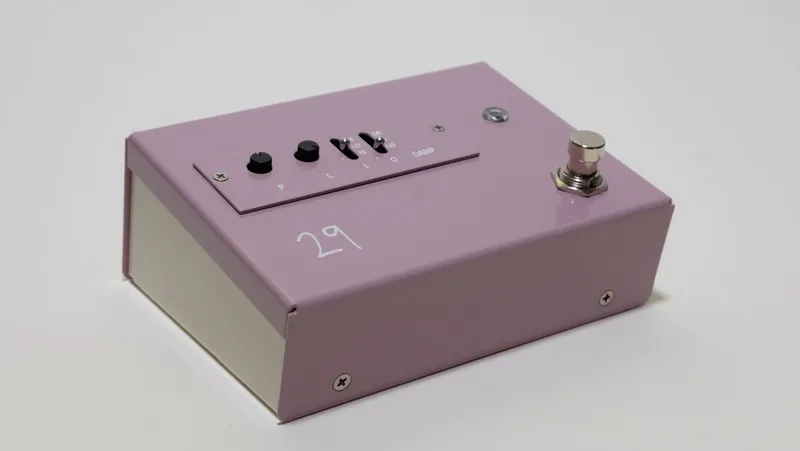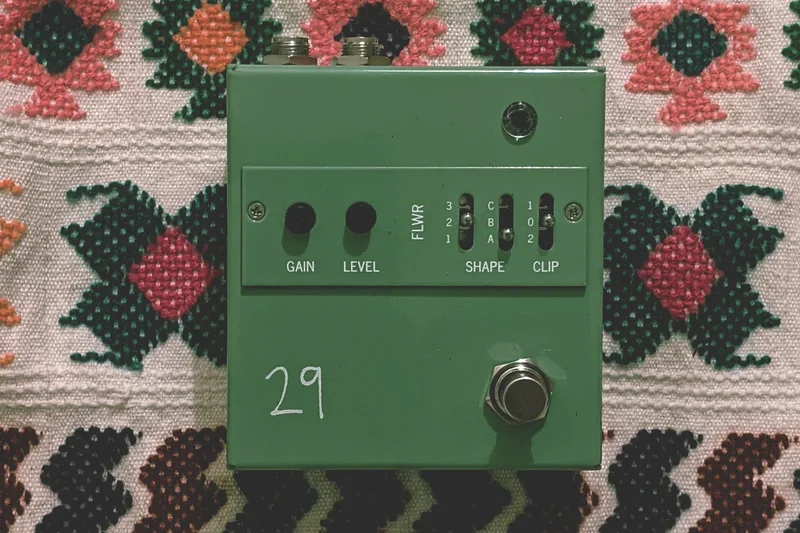


The FLWR from 29 Pedals is a compact gain-staging pedal the maker describes as "an overdrive, distortion and sometimes fuzz!" It starts very clean and, at maximum settings, reaches fuzz territory. The design goal, per the maker, is to help you find your own breakup point so playing stays dynamic and full range while still breaking up nicely when pushed1. Guitar Pedal X's Stefan Karlsson, reviewing it at launch, credited 29 Pedals' Jesse Honig with a compact gain-staging overdrive that also delivers distortion and fuzz flavors2.
The FLWR is currently sold out. The maker's support page states "FLWR totally sold out!" and the Rev D variant is listed as sold out or unavailable31.
Controls and gain staging
The FLWR runs two gain stages. The SHAPE controls manage the first stage, and GAIN controls the second1. The maker describes GAIN as non-linear: at minimum gain and maximum level the pedal sits close to unity gain and relatively clean with a little low-pass filtering, and as you add gain the response warms up, taming highs at higher gain without losing clarity at lower gain. The maker's suggested starting point is setting 3B0, and it advises trimming the level back as you add gain to find your sweet spot4.
| Control | What it does |
|---|---|
| SHAPE (3 x 3-way toggles) | Shapes the first gain stage; 27 variations across the switches2 |
| GAIN | Second gain stage; non-linear, warms up as gain is added1 |
| CLIP | Selects clipping diode array 1 or 2 to engage them1 |
| Clip switch positions | 1st Pair / 0 No Clipping / 2nd Pair2 |
Guitar Pedal X noted that much of the EQ and output shaping is handled by the three toggle switches on the first gain stage2. The default clipping module carries 6 x 1N4148 diodes as Pair 1, and 4 x Schottky diodes plus 2 x LED as Pair 22.
Swappable clipping
The FLWR's most distinctive feature is its modular clipping. The maker explains: "The clipping diode array is modular, pop off the back cover and you can swap out for a different array. PCBs are available" so players can build their own modules1. The CLIP control then selects which of the two installed arrays is engaged1. For players who like to voice their drive, this makes the FLWR a platform rather than a fixed circuit: the stock diode pairs give two distinct clipping characters, and the switch's middle position takes the diodes out of the circuit entirely2.
Power and practicalities
The pedal uses the same WHATEVER power supply featured on 29 Pedals' EUNA and OAMP. Per the maker, it accepts 7.5 to 35 volts of AC or DC in either polarity with absolutely no change in tone or power to the circuit1. That tolerance is unusually wide for a drive pedal and means supply polarity and voltage matching are effectively non-issues. The enclosure matches the depth and height of EUNA and OAMP, so it lines up on a board with the rest of the range1. A QR code on the pedal links to the maker's deeper dive and suggested settings page5.
Price and availability
Pricing has moved over the pedal's life. At launch in October 2022, Guitar Pedal X listed it at $269.99 in the US and £285 in the UK via Andertons2. The maker's product page as of October 2026 shows a regular price of £227.58 GBP1. Both the standard pedal and the Rev D variant are currently sold out13.
What reviewers said
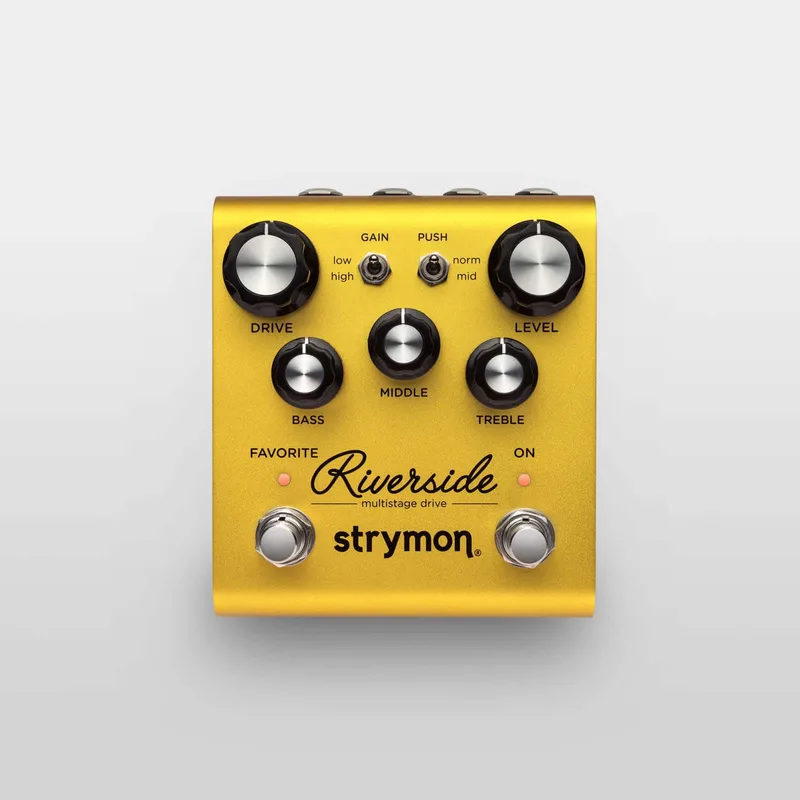
Guitar Pedal X's Karlsson reviewed the FLWR at launch and returned to it in a later comparison. His verdict there: "I really liked the Flower, it has some lovely textures, but I went back to the Strymon Riverside on its greater degree of range, versatility and on-the-fly step-up ability overall"6. In other words, he found the FLWR's textures appealing but ultimately favored a pedal with a wider range of adjustability for his own use.
Videos
29 Pedals
Sasha Ivantic
collector//emitter
Questions
What power supply does the FLWR use?
The FLWR uses the same WHATEVER power supply featured on 29 Pedals' EUNA and OAMP. According to the maker, the pedal accepts 7.5 to 35 volts of AC or DC in either polarity with, in the maker's words, absolutely no change in tone or power to the circuit. That wide tolerance means most standard pedal supplies will run it, and polarity is not a concern.
Can you change the clipping diodes in the FLWR?
Yes. The clipping diode array is modular: you pop off the back cover and swap in a different array, and 29 Pedals makes PCBs available so you can build your own module. The CLIP control selects array 1 or 2 to engage whichever pair is installed, and the default module carries two different diode pairs.
How many gain stages does the FLWR have?
The FLWR has two gain stages. The SHAPE controls manage the first gain stage, shaped by three 3-way toggle switches that give 27 variations. The GAIN knob controls the second gain stage with a non-linear response that warms up as gain is added, taming highs at higher settings without losing clarity at lower ones.
Is the FLWR still available?
As of October 2026 the FLWR is sold out. The maker's support page states the pedal is totally sold out, and the Rev D variant is likewise listed as sold out or unavailable on the product page. There is no indication in the maker's materials of when or whether stock will return.
Sources (6)
- 29 Pedals FLWR, 29 Pedals (Believable Audio)
- Guitar Pedal X, Guitar Pedal X, 2022-10-24
- OAMP Quickstart, 29 Pedals (Believable Audio)
- FLWR Deeper dive and suggested settings, 29 Pedals (Believable Audio)
- FLWR Quickstart, Believable Audio
- Guitar Pedal X, Guitar Pedal X, 2024-12-04