

The A/DA Flanger is an analog flanger pedal designed by engineer Dave Tarnowski and first sold by A/DA (Analog/Digital Associates) in the late 1970s. Premier Guitar has called the original "the most legendary pedal flanger ever built," and it colored countless heavy-rock, funk and reggae tracks1. A flanger varies the speed of a duplicate of your signal, and the A/DA's sweep reaches up to infinity delay time, which is what true tape flanging sounds like12.
Guitar World's Chris Gill describes its range as much broader than most competing flangers: deep, dramatic jet-like flanging, rich and thick chorus and vibrato, brilliant metallic textures, laser gun zaps, rotating speaker-style sounds and even pitch-bending auto-whammy effects2. The pedal is no longer in production: A/DA stopped building it in recent years when its supply of bucket brigade chips ran out, and prices on the used market have soared since2.
What the A/DA Flanger does
Flanging works by delaying a copy of your signal and sweeping that delay time, which creates the characteristic whooshing, jet-like effect. The A/DA's distinguishing trick is that its sweep extends to infinity delay time, the behavior you get by pressing a finger on the flange of a tape reel, which most pedal flangers cannot reach2.
The reissue also covers ground beyond straight flanging. Premier Guitar's reviewer found some of its most effective sounds to be the Leslie- and UniVibe-like voices, along with rotary-style, auto-wah-like and true flanging settings1. A/DA marketed the original as "studio quiet," backed by a built-in noise gate with a Threshold control knob23.
The controls
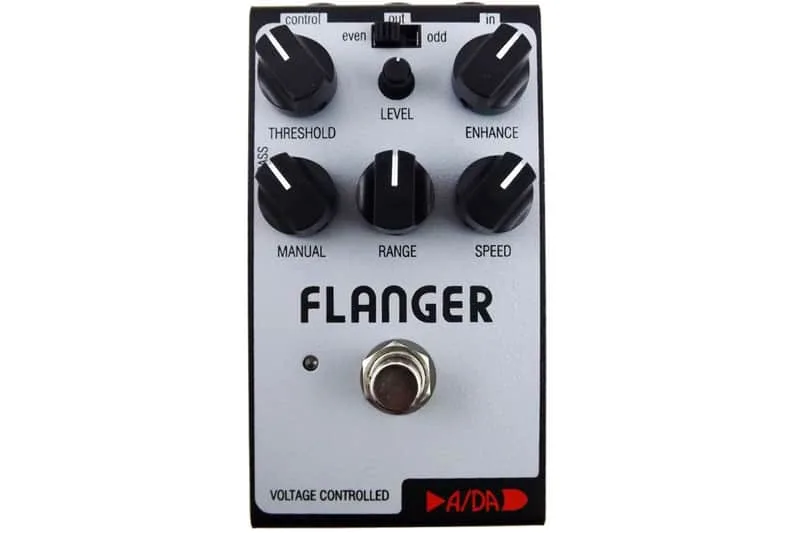
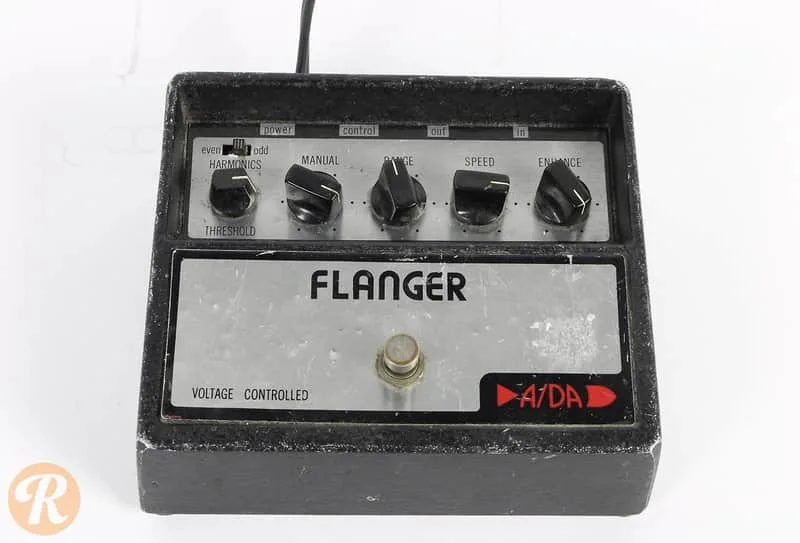
The control set stayed consistent from the original through the reissues: Sweep Range, Speed, Enhance, Manual delay range, an Even/Odd harmonics switch, and Threshold4. The controls sit in a recessed panel that protects them from being kicked out of setting, inside a cast aluminum case with period-correct graphics1.
| Control | What it does |
|---|---|
| Manual | Sets the delay time; disabled when Range is fully clockwise3 |
| Range (width) | Sets the sweep width of the effect23 |
| Speed | Sets the rate of the sweep2 |
| Enhance (resonance) | Regenerates signal back into the front of the circuit for a more intense effect2 |
| Threshold | Gates the flanging effect, eliminating noise23 |
| Even/Odd harmonics switch | Selects a slightly different timbre3 |
The original also had an input for an optional control voltage pedal that manually adjusted the delay time, the same function as the Manual knob2. The reissue keeps this: an input that lets you plug in an expression pedal and put control of the Manual function at your feet1.
Power across the versions
Power is where vintage and reissue units differ most, and it matters if you own an original35.
Some mid-year versions of the original use a 15V internal regulator and need more than 12V, or they will hum. Feeding one from an underpowered supply is a common cause of noise complaints on vintage units3.
- Early versions: 12VDC external wall-wart power transformer with a positive tip plug3
- Later revisions: hardwired AC cord3
- Mid-1990s reissue: MN3010 BBD circuit with a built-in AC power cord; no longer in production3
- Current reissue: built by hand in California, with true hardwire bypass and through-hole construction6
History: Dave Tarnowski, the BBD chips and the reissues
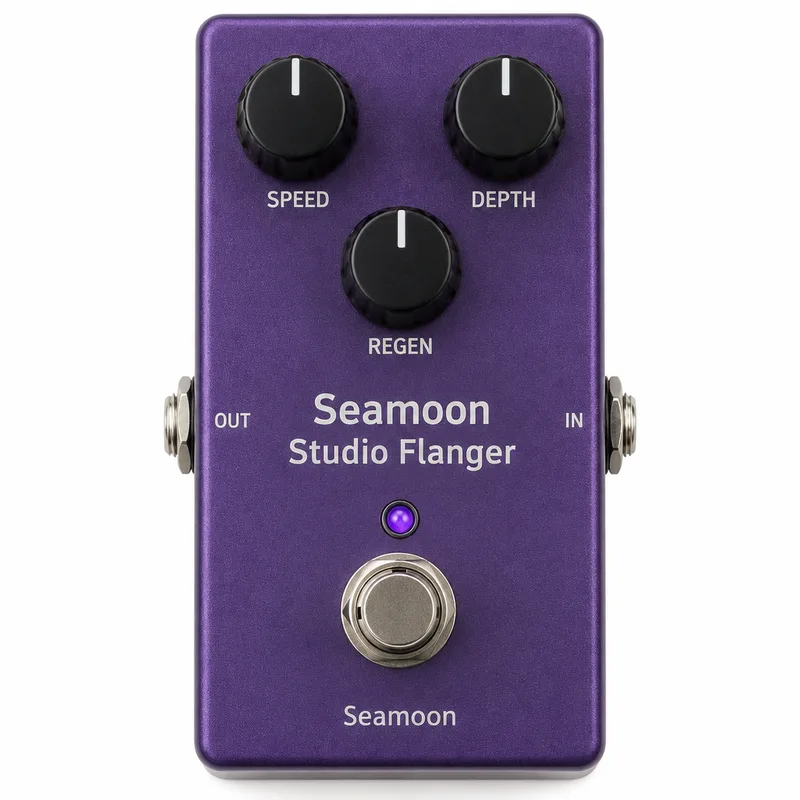
A/DA arose from the ashes of Berkeley, California's Seamoon Ltd., where Tarnowski devised the Seamoon Studio Flanger, a precursor of the A/DA Flanger23. The Flanger was the first product of his new company, launched in January 19782. It was expensive for its day, originally selling for a price equivalent to the cost of a decent entry-level guitar2.
The circuit changed early. The first version used the Reticon SAD1024A bucket brigade device, and in May 1978 the circuit was revised to use the Panasonic MN3010 chip3. The current reissue uses Panasonic bucket-brigade transistors, which Tarnowski considers essential to recreating the original unit's sound1.
- 1981: discontinued after about 50,000 units, as A/DA moved to rackmount effects23
- Mid-1990s: a limited reissue run using the MN3010 BBD and a built-in AC power cord23
- 2009: Tarnowski resurrected the brand and the Flanger as a replica of the original2
- 2010: the A/DA Reissue Flanger launched, hand-built in California, listing at $34964
- 2016: the compact, pedalboard-friendly A/DA PBF Flanger, with the same features as the full-size unit2
- Recent years: production ended when the supply of bucket brigade chips ran out2
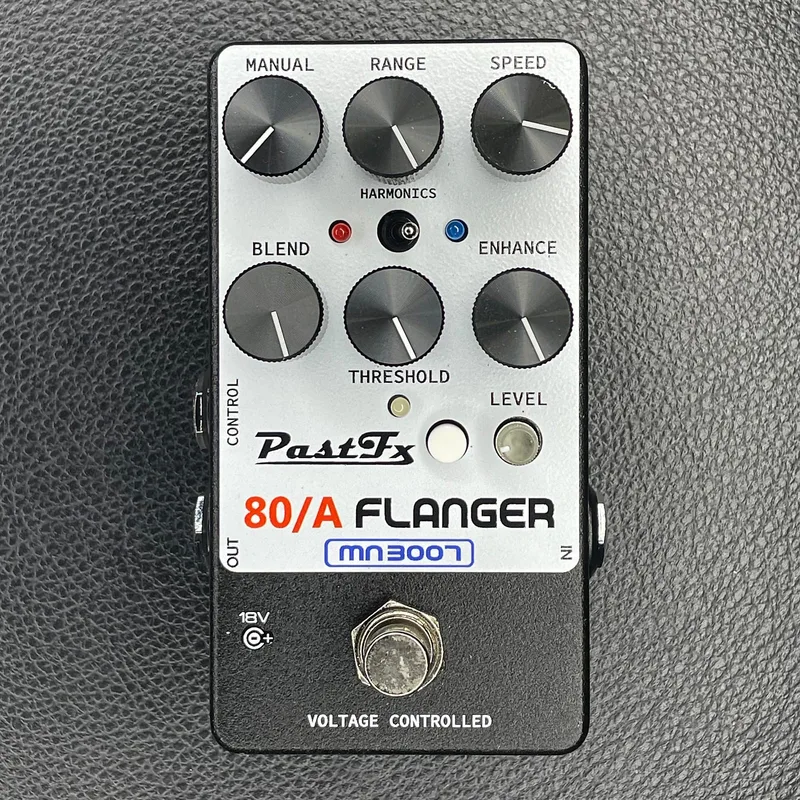
The A/DA circuit lives on in other makers' pedals. The PastFX 80/A Flanger is a vintage-correct reimagining using a Matsushita/Panasonic 512-stage bucket brigade device, with an expression pedal jack for external Manual control7, and Lectric-FX's Flintlock Flanger is a recreation of the circuit adapted to the more common MN3007 BBD chip8.
What reviewers said
Premier Guitar's 2026 review of the reissue tested it with a Rickenbacker 330, a Danelectro Standard Reissue and a Les Paul Studio through Fender amps, and concluded1:
"And in terms of function, musicality, and quality, this reissue remains a gold standard."1
Tom Hughes, writing Premier Guitar's Stompbox Classics history of the pedal, is a longtime owner3:
"It's still my all-time favorite flanger. I can get sounds on the A/DA that I can't get with other flangers, including an absolutely amazing 'steel drum' guitar."3
Hughes also found it super quiet with plenty of headroom and thick, juicy tones3. On the used market, he noted the sale price had been fairly stable across six or seven years of auction records before a recent spike on eBay3.
Who uses it
Juan Alderete used the A/DA Flanger during his entire time in The Mars Volta, telling Stompbox Book: "I used this the entire time I was in Mars Volta."9
Videos
Prymaxe
Joe Perkins
Brad Rodriguez
Questions
Is the A/DA Flanger reissue true bypass?
Yes. Premier Guitar's review of the current reissue describes hardwired true-bypass switching, and the 2010 reissue announcement also specified true hardwire bypass. When the pedal is off, your signal passes through without buffering.
What BBD chip is in the A/DA Flanger?
The first version used the Reticon SAD1024A bucket brigade device. In May 1978 the circuit was revised to use the Panasonic MN3010 chip, which also appeared in the mid-1990s reissue. The modern reissue uses Panasonic bucket-brigade transistors, which designer David Tarnowski considers essential to the original sound.
Why does my vintage A/DA Flanger hum?
Some mid-year versions use a 15V internal regulator and need more than 12V, or they will hum. Early A/DA pedals ran on a 12VDC external wall-wart with a positive tip plug, and later revisions moved to a hardwired AC cord, so the power requirement depends on which version you own.
How many A/DA Flangers were made?
A/DA made about 50,000 units before the pedal was discontinued in 1981, when the company moved to rackmount effects. Limited reissue runs followed in the 1990s and again from 2009.
Can you use an expression pedal with the A/DA Flanger?
Yes. The original had an input for an optional control voltage pedal that manually adjusted the delay time, the same function as the Manual knob. The reissue keeps an expression pedal input that puts control of the Manual function at your feet.
Is the A/DA Flanger still made?
No. A/DA resumed production in 2009 but stopped in recent years when the supply of essential bucket brigade chips ran out. Originals, reissues and the compact PBF version have all risen in price on the used market since.
Sources (9)
- A/DA Flanger Reissue Pedal Review, Premier Guitar, 2010-11-16
- “It actually goes up to infinity, which is what true tape flanging sounds like”: Beloved by Pat Travers and Adrian Belew, the A/DA Flanger was one of the greatest guitar effects of the '70s, Guitar World, 2024-09-17
- Stompbox Classics: A/DA Flanger, Premier Guitar, 2008-05-12
- Gear Watch: A/DA Reissue Flanger, No Treble, 2010-10-01
- A/DA makes its legendary Flanger stompbox pedalboard friendly | MusicRadar, MusicRadar, 2015-11-27
- A/DA Returns with Flanger Reissue, Premier Guitar, 2010-09-23
- 80/A Flanger, PastFx, 2026
- Flintlock Flanger V.1.4, lectric-fx.com
- Juan Alderete, Stompbox Book (stompboxbook.com), 2019-09-22