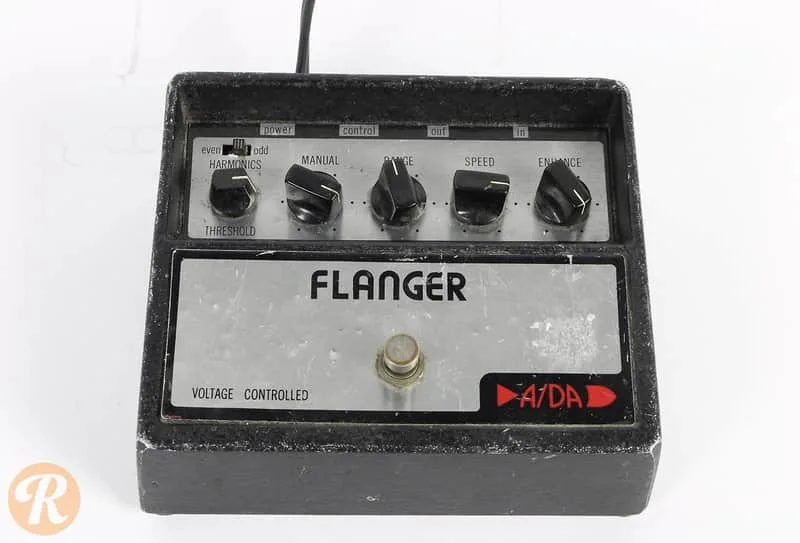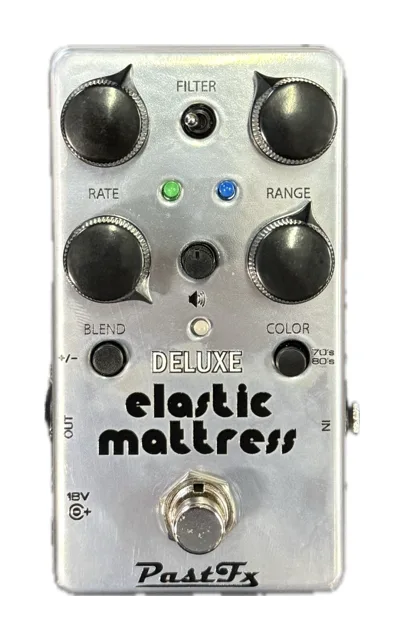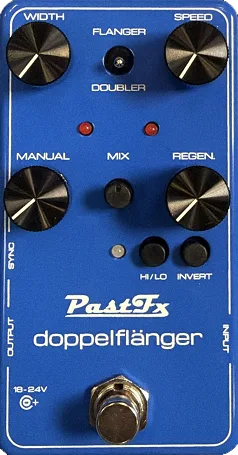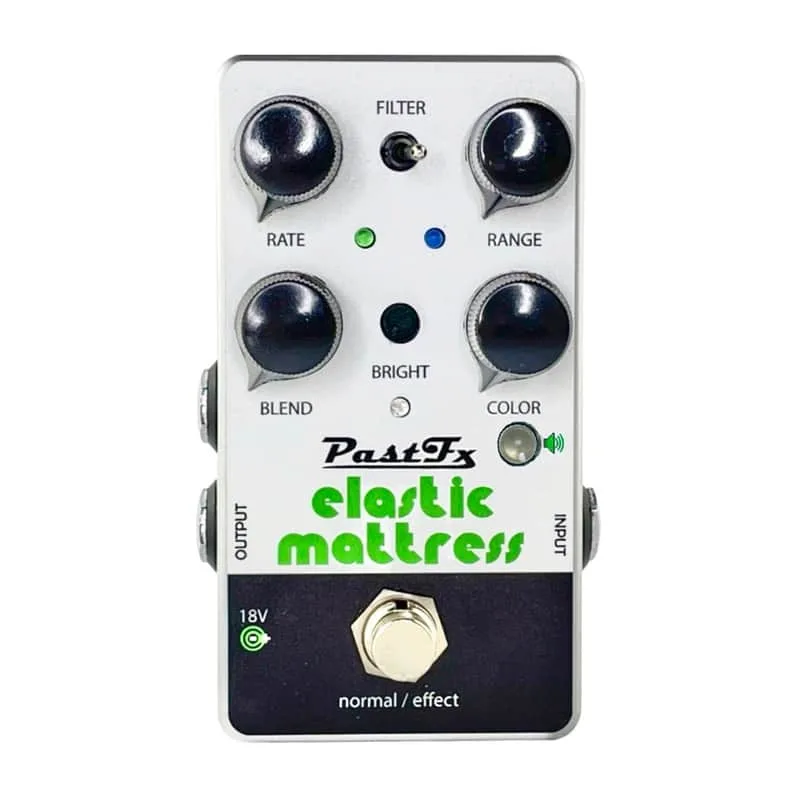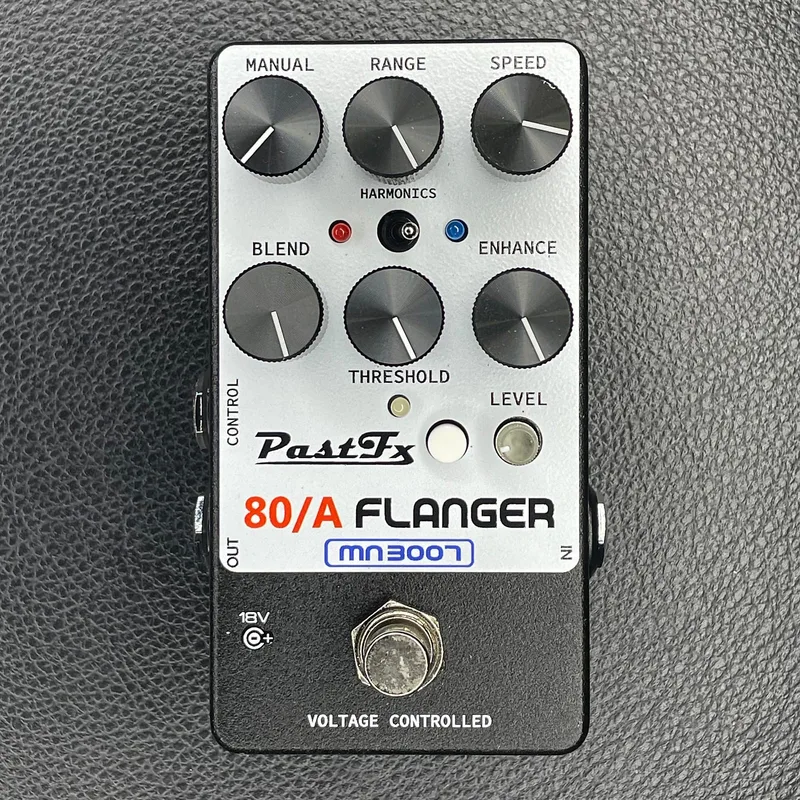


The PastFX 80/A Flanger is an analog flanger pedal built as a vintage-correct reimagining and expansion of the late-70s, early-80s A/DA Flanger, a discontinued analog pedal PastFX describes as "venerable" and famously used by numerous musicians1. Where the original was a large unit, the 80/A packs the circuit into a small, pedalboard-friendly enclosure measuring 112 x 60 x 31mm (4.4" x 2.36" x 1.22", enclosure only)1.
The pedal exists in two versions. The original 80/A uses an obsolete high-voltage Matsushita/Panasonic 512-stage bucket brigade device (BBD), the MN3010, and is available only in limited numbers because of how few vintage chips PastFX could source12. A more economical MN3007 version uses a slightly less obsolete NOS Panasonic MN3007, a 1024-stage chip3.
An analog flanger after a late-70s classic
The 80/A is based on what PastFx describes as "a venerable late 70's, early 80's discontinued analog flanger pedal," the original A/DA Flanger1. Premier Guitar called the original "an elegant piece of analog engineering in 1977"5. The MN3007 version of the 80/A uses a Matsushita / Panasonic 1024-stage bucket brigade device, fitted with NOS Panasonic MN3007 BBD chips3.
A/DA reissued its famous Flanger in the mid-nineties, in a version that used the MN3010 BBD and had a built-in AC power cord; that reissue is no longer in production6. A further reissue runs on 18V, as MusicRadar noted when covering A/DA making the pedal pedalboard-friendly7. Players comparing the modern options can also look at the A/DA Flanger and A/DA Reissue Flanger pages.
PastFX describes the 80/A's range as running "from subtle modulation, to soaring jet woosh, to metallic clang and out-of-this-world warble, and everything in between"1. The design credits "Scruffie" for invaluable assistance and counsel on this and several other PastFx designs3.
Controls and the expression jack
The 80/A carries six knobs plus a Control jack. The control set comes from PastFX's product pages3.
| Control | What it does |
|---|---|
| Manual | Controls the fixed delay time of the effect. Stops functioning when a stereo cable is inserted into the Control jack. |
| Range | Chooses whether the Speed control (automatic) or Manual control (fixed) sets the delay time. Fully clockwise is 100% speed control; fully counterclockwise is fixed (matrix style); 12 o'clock blends both. |
| Speed | Sets the automatic rate of the LFO, shown visually by a blue/red LED. |
| Enhance | Also known as color/feedback/regen, controls the amount of signal regenerated back into the front end of the circuit. |
| Blend | A new control that restricts how much modulated (wet) signal mixes with the dry signal. Fully clockwise is the stock setting; reducing the blend does not reduce the feedback. |
| Level | Output volume adjustment for the overall effect. |
The Control jack is an expression pedal jack that allows the Manual control to be driven externally using a 10K to 100K potentiometer, wired Ring to pot pin 1, Sleeve to pot pin 2, and Tip to pot pin 33. The A/DA reissue takes a similar approach, with an input that lets you plug in an expression pedal and put control of the Manual function at your feet5.
Power: 18V, 35mA
The 80/A runs on 18V DC and draws 35 mA1. PastFx notes that the Dunlop ECB004 18VDC switchmode supply is an economical option that may work, but that in a complex pedalboard setup switchmode supply noise may occur3.
PastFX specifies an 18V DC center negative power supply with a Boss style negative tip, drawing 35 mA, and advises using only a high quality 18VDC regulated supply1. On the MN3007 version's page, PastFX notes that the Dunlop ECB004 18VDC, an economical switchmode supply, may work, but that switchmode supply noise can occur in a complex pedalboard setup3.
MN3010 and MN3007 versions side by side
| 80/A (MN3010) | 80/A MN3007 | |
|---|---|---|
| BBD chip | Matsushita/Panasonic 512-stage (MN3010)12 | NOS Panasonic MN3007, 1024-stage3 |
| Price | $349 (Nov 2024)4 | $210 (Nov 2024)4 |
| Availability | Limited number, due to the small amount of vintage BBDs sourced1 | More economical version3 |
| Headroom | High-voltage BBD1 | Does not use a low-voltage BBD chip, giving higher headroom when engaged3 |
Both versions share the same enclosure size, control set, true bypass operation, and 18V power requirements13.
What reviewers said
Guitar Pedal X's Stefan Karlsson has reviewed the 80/A repeatedly and consistently ranks it at the top of PastFX's flanger line. In October 2025 he called it "my favourite Flanger"8, and in April 2026 he said it is "typically that one's my favourite Past FX Flanger", adding that it is super versatile9. Back in December 2023, reviewing the year's modulation and utility pedals, he wrote of the chip at its core: "that MN3010 512 Stage BBD Chip really is magical!"10
For context on the circuit's reputation, Premier Guitar's review of the A/DA reissue called the original design "one of the most versatile Flangers ever", thanks in part to its Harmonics switch5.
Videos
Leon Todd
Middle Aged Gear Junkie
Middle Aged Gear Junkie
Questions
Can the PastFX 80/A Flanger run on a battery?
No. Both the MN3010 and MN3007 versions of the 80/A Flanger have no battery option available, according to PastFX. The pedal requires an external 18V DC power supply at all times, so it needs a spot on a powered pedalboard rather than running standalone.
Does the 80/A Flanger take an expression pedal?
Yes. A Control jack on the pedal accepts an expression pedal with a 10K to 100K potentiometer, letting you control the Manual function externally. Wiring is Ring to pot pin 1, Sleeve to pot pin 2, and Tip to pot pin 3. Note that when a stereo cable is inserted into the Control jack, the Manual knob itself stops functioning.
What is the difference between the 80/A MN3007 and MN3010 versions?
The original 80/A uses a Matsushita/Panasonic 512-stage MN3010 bucket brigade device, the same chip family as the 1978 A/DA Flanger revision, and costs $349. The MN3007 version is a more economical build using a slightly less obsolete NOS Panasonic MN3007, a 1024-stage chip, at $210. PastFX says the MN3007 version does not use a low-voltage BBD chip, giving higher headroom when engaged.
Is the PastFX 80/A Flanger true bypass?
Yes. PastFX lists true bypass operation for both the MN3010 and MN3007 versions of the 80/A Flanger, so the pedal's circuit is fully out of the signal path when disengaged.
What power supply does the 80/A Flanger need?
It needs an 18V DC center negative (Boss style negative tip) regulated power supply, drawing 35 mA. PastFX advises using only a high quality 18VDC regulated supply. It notes the Dunlop ECB004 18VDC switchmode supply may work, but switchmode noise can occur in complex pedalboard setups. A standard 9V supply will not power it.
Sources (10)
- 80/A Flanger, PastFx, 2026
- SubDecay Starlight Pedal Review, Premier Guitar, 2012-09-05
- 80/A MN3007 Flanger, PastFx, 2026
- Guitar Pedal X, Guitar Pedal X, 2024-11-14
- A/DA Flanger Reissue Pedal Review, Premier Guitar, 2010-11-16
- Stompbox Classics: A/DA Flanger, Premier Guitar, 2008-05-12
- A/DA makes its legendary Flanger stompbox pedalboard friendly, MusicRadar, 2015-11-27
- Guitar Pedal X, Guitar Pedal X, 2025-10-16
- Guitar Pedal X, Guitar Pedal X, 2026-04-07
- Guitar Pedal X, Guitar Pedal X, 2023-12-19