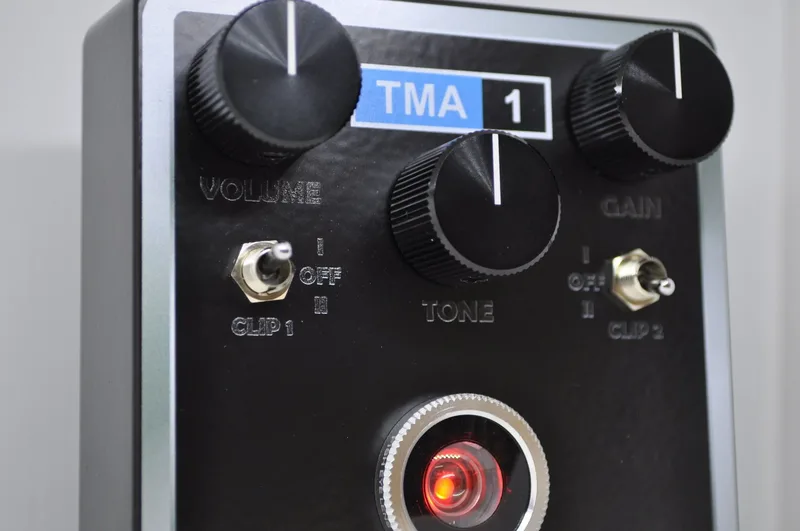


The Acorn Amplifiers TMA-1 is a four-stage transistor fuzz pedal launched in October 2021, when pre-orders opened at USD 199 with the first units expected to ship that December1. Where a classic Fuzz Face circuit uses two transistors, the TMA-1 stacks four stages of transistor gain, and its distinguishing feature is selectable diode clipping: germanium diodes, silicon diodes, or a bypass of the clipping diodes can be switched in two separate stages of the circuit2. Delicious Audio called it Acorn's "most involved foray into the world of fuzz" to that date3.
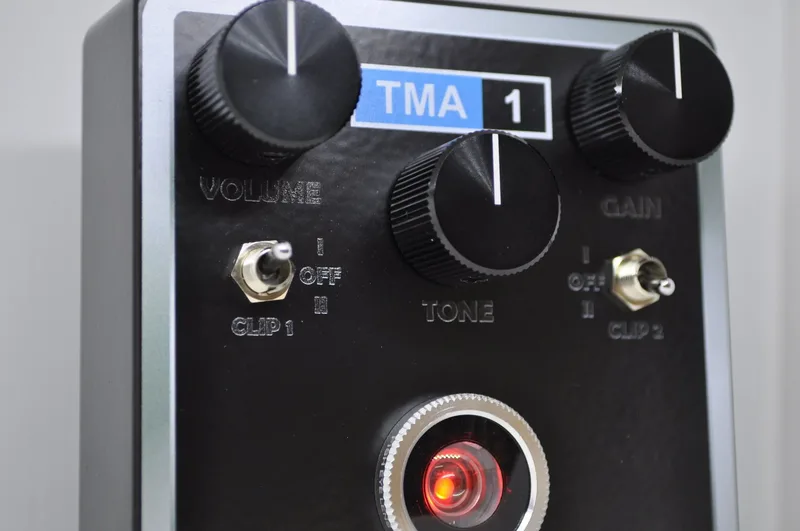
The pedal's look is a big part of its identity. gearnews noted it "bears an uncanny resemblance to HAL 9000 from 2001: A Space Odyssey"1, and a giant glass lens indicator glows red on the face of the pedal when the fuzz is engaged3.
How the circuit works
The TMA-1 is a four-stage transistor fuzz, meaning the signal passes through four transistor gain stages in series before reaching your amp2. On top of that raw transistor gain, the circuit offers diode clipping, the same approach used in many overdrive and distortion pedals where diodes shave off the peaks of the waveform to create saturation.
What makes the TMA-1 unusual is where those choices sit. Germanium diodes, silicon diodes, and a bypass of the clipping diodes are switchable in two separate stages of the fuzz circuit2. Delicious Audio described the same arrangement, with the clipping options applying to the second and third stages3. Because the two stages are set independently, you can, for example, run germanium clipping in one stage and silicon in the other, or take the diodes out of one stage and let the transistors clip on their own.
For a player, the practical difference is this: germanium and silicon diodes clip at different thresholds and with different characters, and bypassing them entirely changes the fuzz from diode-shaped saturation to transistor breakup. gearnews summed it up as "the choice of flicking between classic germanium and silicon diodes, and makes for a nice flexible fuzz"1.
Controls
The control set is simple: three knobs and two toggles.
| Control | What it does |
|---|---|
| Volume | Sets the output level1 |
| Tone | Shapes the frequency balance of the fuzz4 |
| Gain | Sets the amount of fuzz4 |
| Toggle 1 | Selects germanium, silicon or off for one clipping stage4 |
| Toggle 2 | Selects germanium, silicon or off for the second clipping stage4 |
Delicious Audio found that the clipping options, "when added to the sculpting options granted by the Tone knob, make the Acorn TMA-1 a very flexible and multi-faceted fuzz"3.
Power, bypass and build
The TMA-1 is true bypass, so with the pedal off your signal passes straight through without loading it down2. It runs on standard 9V tip-negative pedal power2, the same center-negative supply that powers most pedals on a typical board, and Guitar.com noted that despite its features it is "still a regular-sized pedal that takes standard 9V power"4. It weighs 360 grams3.
Each pedal is hand-made in the Acorn Amplifiers workshop in Atlanta, Georgia, using high-quality components, and the units are hand-wired with Switchcraft jacks1.
The TMA-1 needs a 9V tip-negative supply, the standard arrangement for most modern pedals. Check your power supply's polarity markings before plugging in, since a reverse-polarity supply can damage the pedal.
Where it came from
Acorn Amplifiers launched the TMA-1 Fuzz as a pre-order release, with a pre-order RRP of USD 199 and the first units expected to ship in December 20211. Preorders began shipping in early December that year4. The pedal's space-themed design takes its cue from HAL 9000 in 2001: A Space Odyssey, and a giant glass lens indicator glows red on the face of the pedal when the fuzz is engaged12.
A note on the name
The TMA-1 name comes from the monolith in 2001: A Space Odyssey, and the pedal leans fully into that theme: it bears an uncanny resemblance to HAL 9000, with a giant glass lens indicator that glows red when the fuzz is engaged312. The name is a reference a player will either enjoy or find a bit much, but it is tied to the design rather than to the circuit itself.
Videos
AcornAmplifiers
Demos In The Dark
JayLeonardJ
News
Questions
Is the Acorn TMA-1 true bypass?
Yes. Acorn Amplifiers lists the TMA-1 as true bypass, and gearnews reported the same when covering the pre-order launch. The units are hand-wired and use Switchcraft jacks, so your clean signal passes through untouched when the pedal is off.
What power supply does the Acorn TMA-1 need?
It runs on a standard 9V tip-negative pedal power supply, the same center-negative arrangement most pedalboards already use. No battery or special supply is mentioned by the maker, so a normal 9V daisy chain or isolated output with the correct polarity will power it.
Where is the Acorn TMA-1 made?
Each pedal is hand-made and hand-wired in the Acorn Amplifiers workshop in Atlanta, Georgia, using what gearnews described as high-quality components, including Switchcraft jacks. Acorn is a small US builder rather than a mass-market manufacturer.
What do the germanium and silicon settings do on the TMA-1?
Two toggle switches each select the clipping diodes in two separate stages of the fuzz circuit: germanium, silicon, or diodes bypassed entirely. Germanium and silicon diodes clip at different thresholds and characters, and bypassing them lets the transistors themselves do the work, giving three distinct fuzz flavors per stage.
Sources (4)
- Acorn Amplifiers is now taking pre-orders for its new TMA-1 fuzz pedal, gearnews.com, 2021-10-13
- TMA-1 Fuzz, Acorn Amplifiers
- New Pedal: Acorn Amplifiers TMA-1 Fuzz, Delicious Audio, 2021-10-15
- Open the pedalboard doors, HAL: Acorn Amps releases the TMA-1 Fuzz, Guitar.com, 2021-10-13