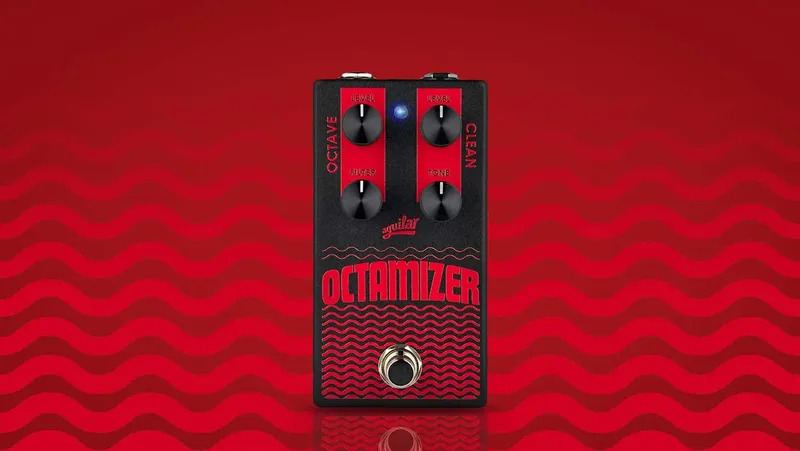


The Aguilar Octamizer II is an analog octave-down pedal for bass from Aguilar. It splits your signal into two paths, a clean instrument sound and an effected sound one octave below the original, and gives each its own level knob so you can blend them to taste. A single footswitch toggles the effect on and off1.
Bass Gear Magazine reviewed it in February 2024 and found it delivers the character players expect from classic analog octave pedals1:
"Aguilar nails the warm, synth-like quality that we all know and love from classic analogue octave pedals. It's thick, smothering, and oh-so funky1."
The reviewer described it as a robust, great-sounding octave pedal that does well at fattening up bass tones1.
The controls: clean and octave levels, tilt EQ and octave filter
The pedal has four knobs, two for each signal path, plus the footswitch. The two level knobs set how much of the clean sound and how much of the octave-down sound you hear, which is the core of the pedal: you can keep your original tone fully present and layer the octave underneath, or lean hard into the effected sound1.
| Control | What it does |
|---|---|
| Clean level | Sets the level of the clean instrument sound1 |
| Octave level | Sets the level of the effected sound, one octave below the original1 |
| Clean EQ | Wide band tilt EQ, +/- 20dB1 |
| Octave filter | Multi-pole low-pass filter, 3 pole LPF 80Hz to 800Hz1 |
The clean EQ is a tilting topology: turning it one way boosts bass while cutting treble, and the other way does the reverse. Because it acts on the clean side of the blend, it lets you shape how your original tone sits against the octave, for example darkening the clean signal so the two paths blend more seamlessly1.
The octave filter is a multi-pole, low-pass type, sweeping from 80Hz to 800Hz. It shapes the effected signal only, so you can keep the octave voice deep and rounded or open it up higher1.
Tracking and how it compares
Tracking is where analog octave pedals live or die, and the Octamizer II uses a proprietary detector circuit for it. Bass Gear Magazine's reviewer found that "the tracking feels fast and responsive, due to the proprietary detector circuit"1.
The same reviewer was clear about the limits of the format itself: analog octave circuits cannot do polyphony, and they will start to struggle tracking lower notes on the bass neck compared with a top-tier digital pedal. That is a property of the analog design rather than a criticism of the Octamizer specifically, and the reviewer offered no criticism of the Octamizer's own tracking limits1. In practice it means playing single notes, especially higher up the neck, gets the best results, while chords and very low notes are where an analog circuit runs out of room. For more on the category, see octave and pitch pedals.
The Octamizer DLX
Videos
Aguilar Amplification
Aguilar Amplification
The Bass Channel
Questions
Does the Aguilar Octamizer II take a 9V battery?
Yes. Power comes from an internal 9V battery, or from an external power supply connected to the standard 2.1mm 9V DC input socket. The external supply is not included with the pedal. Current draw is 6mA, so a battery lasts a long time.
Can the Octamizer II track chords?
No. Like other analog octave circuits, it tracks one note at a time. Bass Gear Magazine notes that analog octave pedals cannot do polyphony and will start to struggle tracking lower notes on the bass neck compared with a top-tier digital pedal, though the reviewer had no criticism of the Octamizer's own tracking limits.
How is the Octamizer II different from the Octamizer DLX?
The Octamizer DLX, announced in January 2026, is an expanded evolution of the Octamizer pedal with new voices, better tracking, and three footswitches. The Octamizer II is the simpler original format: one footswitch, clean and octave level knobs, a tilt EQ and an octave filter.
Sources (1)
- Bassic Review, Bass Gear Magazine, 2024-02-12