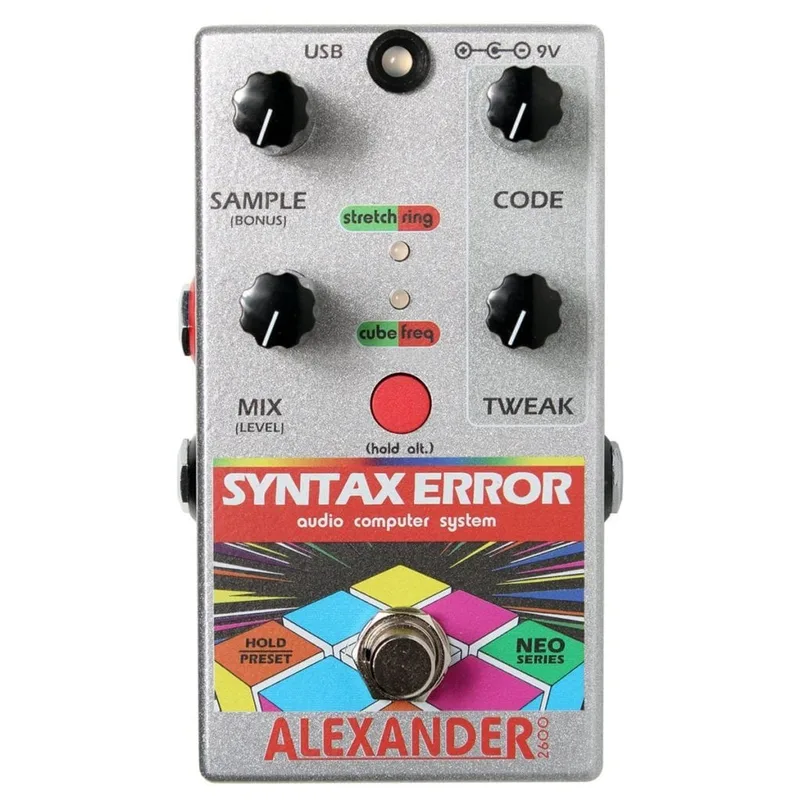


The Alexander Pedals Syntax Error is a digital, multi-mode audio mangling pedal that takes your tone back to the dialup era, when video games were measured by their bits and telephones were wired to your wall1. It is a bitcrusher and modulation effect inspired by the 8-bit sounds of early videogames, delivering grainy, lo-bit tones and a set of functions for warping your sound in creative and unexpected ways12. Alexander Pedals calls the current version, the Syntax Error XP, a "dialup modem simulator"3, and describes it as a comprehensive audio transformation platform for guitar, bass, keys, or whatever you want to plug in3.
The pedal has gone through three versions. The original Syntax Error arrived in 2017 as part of Alexander's Neo Series of compact effects4. The Syntax Error 2 followed in October 2021 at $299, twice as wide as the original and built on a new FXCore DSP56. The Syntax Error XP is the Leap Series version: a smaller enclosure with the same digital chaos, now with stereo inputs and outputs7.
The sound modes
The original Syntax Error offered several modes, including Stretch, Cube, Ring and Freq, plus a Code mode4. Each works differently:
| Mode | What it does |
|---|---|
| Stretch | Varispeed time-stretch; samples your playing and mangles it, with the Speed control messing with the internal sampling clock rate so you can even sound reversed74 |
| Cube | Digital distortion via math, the (abs(INPUT^3))^3 trick, paired with a resonant low-pass filter43 |
| Ring | Ring modulation with Sample and Hold, plus modulation4 |
| Freq | Shifts incoming frequencies by a fixed amount, allowing pitch-shifting effects4 |
| Code | The Code knob controls different parameters per mode, such as distortion gain in Code mode or sample clock direction in Stretch mode4 |
The Syntax Error 2 expanded this to six modes: STRETCH, AIR, RING, CLUBE, FREQ and WAVE, each tunable and customizable86. The XP carries eight sound modes, each with its own set of tweakable parameters3, and the maker describes five of them in detail:
| XP mode | What it does |
|---|---|
| STRETCH | Records your signal and plays it back at variable speed and direction for dialup tones, twisted echoes, and laser bird chaos3 |
| AIR | Simulates early low-memory rack reverbs with added sample-crush dirt, pitch shifting, and grainy diffusion textures3 |
| RING | Ring modulator ranging from tremolo to gonging robot sounds, with a sample & hold that randomizes the carrier3 |
| CUBE | Digital distortion via math, paired with a resonant filter, from subtle grit to genuinely gruesome tones3 |
| FREQ | A frequency shifter (not a pitch shifter) applying a fixed Hz offset, producing phaser-like tones, cascading echoes, or out-of-tune madness depending on feedback settings3 |
Delicious Audio's reviewer also noted a Glitch Shift mode on the XP that pitch-shifts with artifacts7.
The original pedal's controls were mode-dependent. The Tweak knob controlled the sample buffer length in Stretch mode, the low-pass filter cutoff in Cube mode, or the depth of the sample-and-hold filter modulation in Ring mode, while Mix set how much of your signal was affected4.
Control, presets and expression
Beyond its knobs, the Syntax Error line has always been deep on control options. The original offered four onboard presets plus 12 MIDI-accessible presets, running from distortion to bit crushing to time-stretched delay and modem-like bleeps and glitches2, and accepted expression data via an external pedal or CV, plus MIDI control4.
The XP goes further:
- 32 user presets arranged in 4 banks of 8, all accessible on the pedal without external controls3
- MultiJack for an expression pedal, footswitch, or MIDI input3
- EXP Morph, which controls all knobs from an expression pedal, the ramp footswitch, or MIDI37
- An automatic ramping function for expression control without an external pedal3
- An assignable LFO for parameter automation3
- A CTL footswitch for tap tempo and ramp triggering3
The Syntax Error 2 added its own twists: EXP Morph for moving between knob settings on the fly, and a four-step mini-sequencer that can control any one of the pedal's knobs, triggered from the CTL footswitch8. Every knob and setting on the Syntax Error 2 is controllable using MIDI, via the MultiJack with Neo Link, directly to any Disaster Area Gen3 controller, or through the USB MIDI port to a computer or mobile device8.
Power and connections
The XP requires DC 9V only, at 250mA or greater, from an isolated DC power supply3. That current draw rules out a battery and means a shared daisy chain is not what the maker specifies. The original Syntax Error drew 80mA at 9V DC, center negative1.
The XP runs a stereo signal path with phase correction, a low-noise direct-coupled audio path, and improved headroom and frequency response over the earlier Neo Series pedals, using an FXCore DSP with more than eight times the processing power of the previous generation3. The input jack is selectable for standard mono or TRS stereo input without opening the pedal, and the output jacks work as mono, two-cable stereo, or TRS stereo3. The Syntax Error 2 offers the same flexibility, with mono or stereo TRS input and output usable as either TRS or dual TS, plus selectable stereo routing (Mono, Stereo Summing, or Stereo) in its global configuration menu86. Its input impedance is 1M ohms and output impedance 560 ohms8.
The XP measures 4.7" x 2.6" x 1.5" (H x W x D, not including knobs)3, and is made in North Carolina7.
Where it came from
The original Syntax Error got a lot of attention at Summer NAMM before its release, which Gearnews reported was due at the end of August 2017 at an RRP of $199.95 plus shipping and taxes24. The Syntax Error 2 was first reported at Summer NAMM 2021 and released that October at $29965. Matthew from Alexander Pedals said in a Reddit thread that the Syntax Error 2 was the first product he designed using the FXCore DSP6.
What reviewers said
Gearnews' 2017 review of the original was blunt about its character: "Okay, this pedal is not for the faint-hearted! ... but be aware this ain't no fuzz box!"4. The reviewer noted that as a buffered bypass unit it should play nicely on cramped pedalboards4.
"It's not a tool. It's a collaborator with impulse control issues."
The same XP review found the pedal evokes dirty game cartridges, dial-up handshakes and early digital failing7, and described the RAMP function as turning the whole thing into an LFO, cycling between two sounds indefinitely7. It was not all positive: the reviewer reported that Stretch mode's buffer length sometimes randomizes on preset recall, so a three-second delay becomes 300 milliseconds without warning7. On forums, users call it a "WTF is that" pedal, with sweet spots the reviewer described as fractions of a degree wide; the verdict was that it is not plug-and-play, and it is a pedal for sonic anarchists7. Delicious Audio's 2024 roundup of glitch, stutter and granular pedals included the Syntax Error 2, noting its full stereo path, mini-sequencer, and LCD screen to help you make sense of the tones it can deliver9.
For players exploring this territory, the Syntax Error sits alongside filter pedals, synth pedals and octave and pitch pedals as a way to reshape a signal rather than simply gain or time-based effects.
Videos
ProGuitarShopDemos
Knobs
ProGuitarShopDemos
Questions
Is the Syntax Error XP true bypass?
No. The Syntax Error XP uses buffered bypass, as does the Syntax Error 2, which Alexander describes as a hybrid analog and digital buffered bypass. The original Syntax Error was also a buffered bypass unit, which means it should behave well on crowded pedalboards.
Does the Syntax Error XP work in stereo?
Yes. The XP has stereo audio input and output with phase correction. The input jack is selectable for standard mono or TRS stereo without opening the pedal, and the output jacks work as mono, two-cable stereo, or TRS stereo. The Syntax Error 2 also runs in stereo.
Can I control the Syntax Error XP with MIDI?
Yes. The XP's MultiJack accepts an expression pedal, a footswitch, or MIDI input, and its USB port handles firmware updates and USB MIDI. The CTL footswitch gives tap tempo and ramp triggering. The original Syntax Error also offered MIDI control with 12 MIDI-accessible presets.
What is the difference between the Syntax Error and the Syntax Error XP?
The XP is the Leap Series version: a smaller enclosure with the same digital chaos, plus stereo inputs and outputs, eight sound modes instead of the original's smaller set, and 32 user presets in 4 banks of 8. The Syntax Error 2, released in October 2021, is twice as wide as the original and adds an LCD screen and a mini-sequencer.
Does the Syntax Error XP work on bass and keys?
Yes. Alexander Pedals describes the pedal as an audio transformation platform for creating an arcade soundtrack using guitar, bass, keys, or whatever you plug in. The Syntax Error 2 was described the same way, aimed at guitar, bass, keys and other instruments.
Is the Syntax Error XP still available?
As of October 2026 the Syntax Error XP is listed as sold out on the Alexander Pedals product page, at a list price of $249.99. The Syntax Error 2 is also listed as sold out. The original Syntax Error dates from 2017.
Sources (9)
- Syntax Error by Alexander Pedals, RockBoard PedalPedia, 2026
- Alexander Pedals Syntax Error, Delicious Audio, 2020-04-07
- Alexander Pedals Syntax Error XP Dialup Modem Simulator, Alexander Pedals
- Alexander Pedals Syntax Error: A crazy glitch pedal from the 80s dial-up era, gearnews.com, 2017-07-24
- Best New Pedals Of 2021, Delicious Audio, 2021-11-02
- Alexander Pedals Syntax Error 2, Delicious Audio, 2023-04-20
- Alexander Pedals Error XP Multi-FX Pedal, Delicious Audio, 2026-02-26
- Syntax Error 2, Alexander Pedals
- The Best Glitch, Stutter And Granular Pedals In 2024, Delicious Audio, 2024-05-27