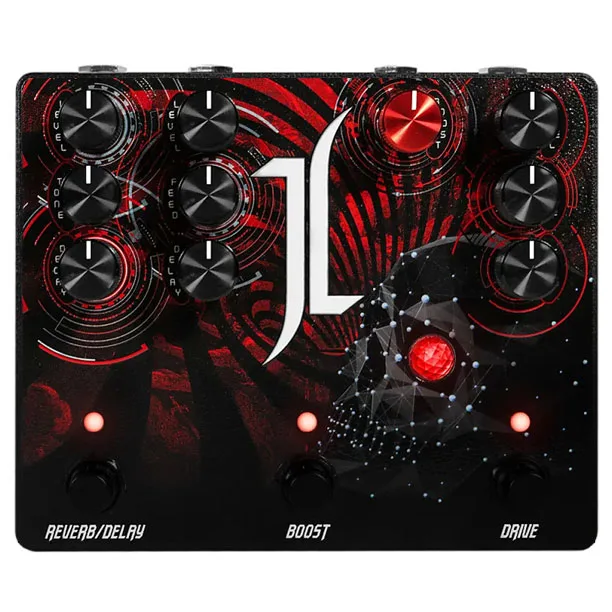


The All-Pedal Devils Triad is a multi-effect stompbox created for metal players, built in collaboration with Jeff Loomis of the bands Nevermore and Arch Enemy. Its circuit combines footswitchable overdrive, boost, and a reverb/delay section within a single box roughly the size of two compact pedals1. It was designed to be Loomis' "all-in-one pedal for live and in-studio purposes"1.
What it does to your signal
The overdrive and boost work together rather than as two independent effects. Delicious Audio describes the pedal as being able to deliver several types of distortion, from smooth crunch to very high-gain tones, through the interaction of the Boost and the op-amp Drive circuit1. For players who currently run a separate boost into an overdrive on a board, the Triad puts that pairing in one enclosure.
The reverb/delay section is digital but retains the analog dry signal, so the unaffected part of your tone never leaves the analog path1. The reverb is described as a digital plate reverb emulator in an analog signal path1. Players comparing this with other multi-effects pedals or standalone delay and reverb units should note that the wet effects are digital while the drive side is fully analog.
Controls
Overdrive section
| Control | What it does |
|---|---|
| Gain | Increases signal to the clipping LEDs to increase distortion |
| Level | Off to 20 dB |
| Tone | 10 dB boost at 4 kHz to 15 dB cut at 4 kHz |
The Drive circuit is an analog op-amp with soft clipping, and the Boost is also an analog op-amp circuit1.
Reverb and delay
| Control | What it does |
|---|---|
| Reverb Level | Reverb level |
| Reverb Tone | Reverb tone |
| Decay | Sets the level of wet signal feedback |
| Delay Volume | Delay volume |
| Delay Feedback | Delay feedback |
| Delay Speed | Time between repeats, roughly 50 ms minimum to roughly 500 ms maximum |
The reverb has its own level, tone, and decay controls, while the delay has its own volume, feedback, and speed settings1. A single footswitch turns the reverb and delay both on or off together1.
Input impedance
Delicious Audio lists measured input impedance figures for each section: 260K at 1 kHz for the overdrive, 325K at 1 kHz for the boost, and 250K at 1 kHz for the delay1.
The reverb and delay share one footswitch: they switch on and off together, though each keeps its own set of knobs.
Videos
All-Pedal
Ola Englund
Jeff Loomis
News
Questions
Is the All-Pedal Devil's Triad analog or digital?
The overdrive and boost sections are analog op-amp circuits. The reverb/delay section is digital, but it retains the analog dry signal, so your unaffected guitar tone stays analog even when the time-based effects are engaged. The reverb itself is described as a digital plate reverb emulator sitting in an analog signal path.
Who designed the All-Pedal Devil's Triad?
The Devil's Triad was built in collaboration with Jeff Loomis, the guitarist known for his work with the bands Nevermore and Arch Enemy. It is a signature pedal designed to be Loomis' all-in-one pedal for live and in-studio purposes.
How long can the delay time go on the Devil's Triad?
The delay's time between repeats runs from roughly 50 milliseconds at the minimum to roughly 500 milliseconds at the maximum, according to the product page published when the pedal launched.
Does one footswitch control the reverb and delay together?
Yes. The reverb and delay share a single footswitch that turns them both on or off at the same time. Each effect keeps its own separate controls, so you can shape them independently even though they switch together.
What kind of clipping does the overdrive use?
The overdrive section is an analog op-amp circuit with soft clipping. The Gain knob increases the signal fed to the clipping LEDs to raise the amount of distortion.
Sources (1)
- All-Pedal Devils Triad (Jeff Loomis Signature), Delicious Audio, 2022-09-22