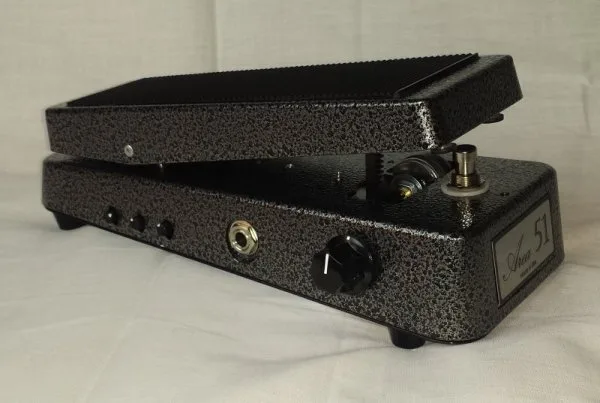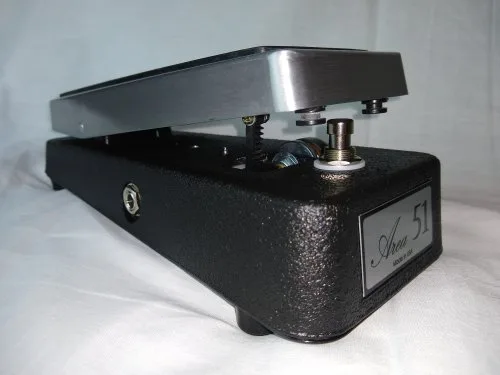


The Area 51 Clone McCoy Wah is a wah pedal from Area 51 Tube Audio Designs built as a take on the Clyde McCoy wah. The maker describes it as "a Clyde McCoy that's built better than the original," and its centerpiece is a special hand-wound and tuned inductor, the component that shapes a wah's voice1. The maker pitches its sound at the early Italian-made wahs: "If you have been looking for that elusive hollow, vocal growl of the early Italian made wahs - here it is!"1
The Clyde McCoy name
The pedal takes its name from one of the earliest wah designs. Guitar.com traces the first commercially available wah to a collaboration between Vox and a noted jazz trumpeter, Clyde McCoy, who approached the company for something that mimicked the tone of a muted brass instrument and could be used with a keyboard2. Guitar World's Nick Wells describes McCoy as "a trumpet player, well known for his use of the mute to create wah'd effects"3. Area 51's Clone aims to reproduce that early circuit with modern construction1.
Controls and options
The Clone McCoy keeps its control set close to the vintage original, with the adjustments moved onto the board rather than the pedal's top surface1:
| Control | What it does |
|---|---|
| Rocking treadle | The classic wah sweep, rocking forward and back to move the filter1 |
| Input level/impedance trimmer (latest versions) | On-board trimmer, ships set to the stock 68K setting for a true-to-vintage setup1 |
The trimmer is the modern addition. Turned to maximum, it lowers the input impedance so the wah cleans up with the guitar's volume control, the way a vintage Fuzz Face does1. That makes it a natural partner for players who run the wah in front of dirt pedals and want it to respond to their volume knob.
Beyond the trimmer, the maker offers two ways to extend the pedal:
- Output Buffer option: available for $30 extra, for players who want the pedal to drive longer cable runs1
- Area 51 Wah Output Buffer Kit: the same buffer sold separately as a kit1
- Area 51 Rev 10a All Options Wah: the maker's fuller-featured design, which adds an input level/impedance control and a selectable bypass and buffering system1
The Output Buffer option changes the pedal from pure true bypass to a buffered design. Players who want the stock true bypass behavior should order without it1.
Power
The Clone McCoy Wah runs on a 9V battery or any 2.1mm standard pedal power supply, and the maker rates it for up to 14 volts1. The 2.1mm connector is the standard type used by most pedalboard supplies, so it fits a normal power setup alongside other pedals.
Videos
millstap
millstap
millstap
Questions
Is the Area 51 Clone McCoy Wah true bypass?
Yes. Area 51 Tube Audio Designs specifies the Clone McCoy Wah as true bypass for zero tone loss in bypass. Players who want buffering instead can add the maker's Output Buffer option, which is available for $30 extra, or look at the maker's other wah designs that include a selectable bypass and buffering system.
What voltage can the Area 51 McCoy wah run on?
The pedal runs on a 9V battery or any standard 2.1mm pedal power supply, and the maker says it can handle up to 14 volts. That headroom means a higher-output supply will not harm it, though a standard 9V supply is all it needs.
What does the Output Buffer option cost?
The Output Buffer option is available for $30 extra, according to the maker's product page. It is aimed at players who want the pedal to drive longer cable runs or other pedals while keeping the wah's vintage-style circuit.
What does the input impedance trimmer do?
The latest versions carry an input level/impedance trimmer on the board, set at the stock 68K setting for a true-to-vintage setup. Turned up to its maximum, it lowers the input impedance so the wah cleans up with the guitar's volume control, in the way a vintage Fuzz Face does.
Sources (3)
- Area 51 Clone McCoy Wah, Area 51 Tube Audio Designs, 2020
- Xotic Wah XW-1 review, Guitar.com, 2016-09-05
- Dunlop Cry Baby Bass Wah: the most recognizable effects pedal ever made?, Guitar World, 2023-04-05