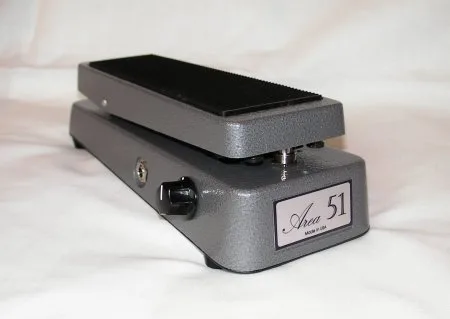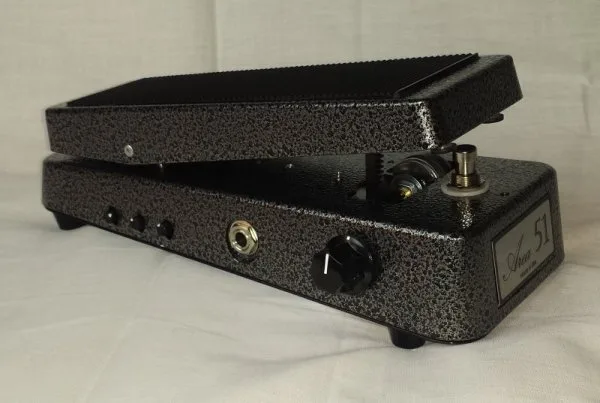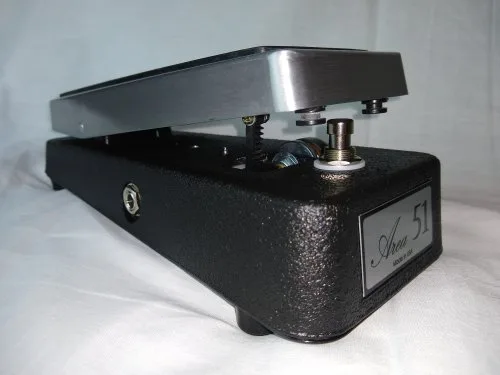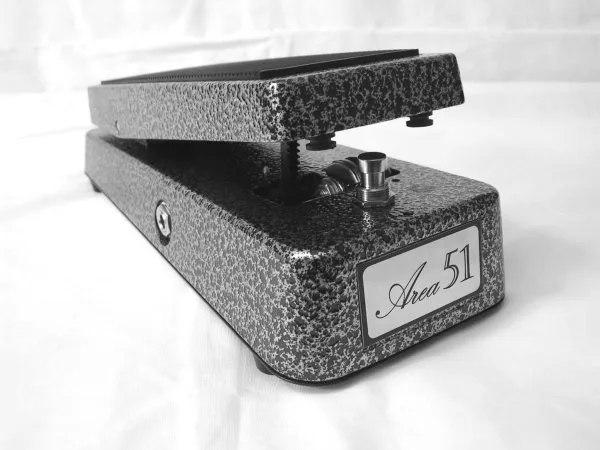


The Area 51 Wah Standard is a hand-built wah pedal from Area 51 Tube Audio Designs, listed at $229.95 USD as of 20201. It carries what the maker calls the "Area 51 Voicing": a slightly lower range than a vintage type wah, smoother treble, and a sharper Q, and the maker says it pairs well with humbuckers, P90s and Fender style single coils1. Its most distinctive practical feature is a selectable bypass and buffering system, letting you choose how the pedal sits in your signal chain1.
What it sounds like
The Standard model's voicing sits slightly lower in range than a vintage type wah, with smoother treble and a sharper Q1. For comparison, Dunlop describes its own GCB95 Cry Baby Standard as an aggressive modern sound2, and the Castledine Standard Wah, another independent build, is described as a vocal wah with a well balanced sweep, smooth treble and resonant bass3. The Area 51 Standard's lower range and smoother top place it on the warmer side of that spread, and the maker's claim that it suits humbuckers, P90s and Fender style single coils suggests it is voiced to work across pickup types rather than favoring one1.
The controls
The pedal's controls are aimed at dialing it into a specific rig rather than reshaping the voicing itself1.
| Control | What it does |
|---|---|
| Input level/impedance | Set about 1/3 of the way up for a vintage Clyde or Thomas Organ type response; half way for the Area 51 setting; all the way up lowers input impedance for cleanup with the guitar volume knob1 |
| Buffer level trimmer | Dials in the output level of the buffer circuit to match a fuzz face type pedal1 |
The input level/impedance control is the one to reach for first: it changes how the wah responds to your playing and how it cleans up with the guitar's volume control, from a vintage style sweep at the low end to a more open feel with the control all the way up1.
Bypass and buffering
The Standard offers six bypass configurations: true bypass, vintage bypass, or buffered bypass, each available with the output buffer on or off1. True bypass with the output buffer on is the configuration the maker lists first1. The buffer's level trimmer matters most when a fuzz pedal follows the wah, since a fuzz face type circuit is sensitive to the level hitting its input1.
Players who run a wah into a fuzz regularly may want to look at the maker's dedicated Fuzzwah version, one of four fixed wahs Area 51 now builds alongside the Standard, the Clone and the All Options model1.
The four Area 51 wah versions
The maker builds the Standard to order from a fixed design, and as the maker puts it, "This allows me to build pedals in advance and have stock available at any given time"1.
| Version | Positioning |
|---|---|
| Standard | The maker's own Area 51 voicing, covered on this page1 |
| Clone | The maker's vintage style build1 |
| All Options | Adds the input level/impedance control and selectable bypass and buffering system1 |
| Fuzzwah | Built for use with fuzz pedals1 |
The Area 51 Rev 10a All Options Wah and the Clone McCoy Wah are related versions covered on their own pages1.
The hand-wound inductor
The inductor, the component that shapes a wah's resonant peak, is made by hand at the maker's shop. Area 51's builder describes the process in his own words1:
"I make them right here at my shop - by hand on a winder that I designed for the purpose that uses an antique sewing maching motor and programmable relay to set the amount of turns."
Hand winding in house is part of how the Standard arrives at its own voicing rather than an off-the-shelf inductor's response1.
Videos
Prymaxe
gearmanndude
Questions
What is the difference between the Area 51 Standard, Clone, All Options and Fuzzwah?
Area 51 Tube Audio Designs builds its wah in four fixed versions: Standard, Clone, All Options, and Fuzzwah. The Standard carries the maker's own Area 51 voicing, with a slightly lower range, smoother treble and sharper Q than a vintage type wah. The Clone is the maker's take on a vintage circuit, the All Options model adds an input level/impedance control and a selectable bypass and buffering system, and the Fuzzwah is built around pairing with fuzz pedals.
Is the Area 51 Wah Standard true bypass?
Yes, and it goes further than a simple true bypass switch. The pedal offers selectable bypass: true bypass, vintage bypass, or buffered bypass, each with the output buffer on or off, for six configurations in total. True bypass with the output buffer on is the maker's headline setting, and the buffer's level can be trimmed to match other pedals.
Does the Area 51 wah work with a Fuzz Face?
The maker designed it with fuzz pedals in mind. The buffer circuit has a volume control trimmer so the output level can be dialed in to match a fuzz face type pedal, and the input level/impedance control can be set to suit how the wah drives whatever follows it. Players who run wah into fuzz have the Fuzzwah version as a dedicated alternative.
How is the Area 51 wah inductor made?
The inductor is made by hand at the maker's shop. Area 51's builder winds them on a winder he designed for the purpose, which uses an antique sewing machine motor and a programmable relay. Hand winding the inductor in house is part of how the Standard gets its voicing.
What pickups suit the Area 51 Wah Standard?
The maker says the Standard's voicing, with its slightly lower range and smoother treble, pairs well with humbuckers, P90s and Fender style single coils. That covers most common pickup types, so the pedal is voiced to work across a range of guitars rather than favoring one.
Sources (3)
- Area 51 Wah, Area 51 Tube Audio Designs, 2020
- RANGE OF EXPRESSION: FIND YOUR CRY BABY® WAH, Dunlop (lifestyle.jimdunlop.com), 2021-10-08
- Castledine Electronics Wah Wah Pedals, Castledine Electronics (www.wah-wah.co.uk), 2021