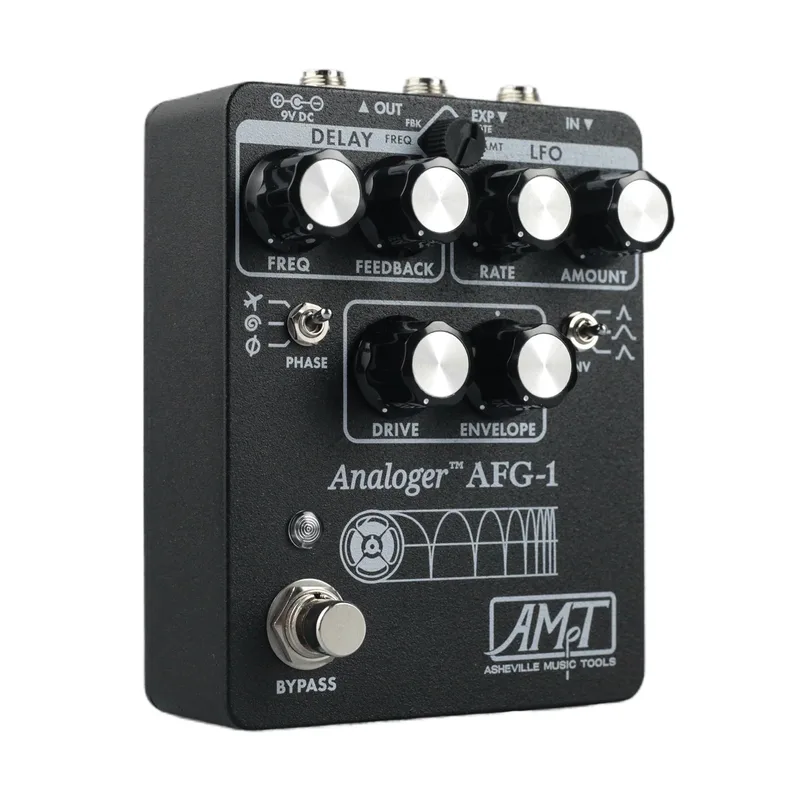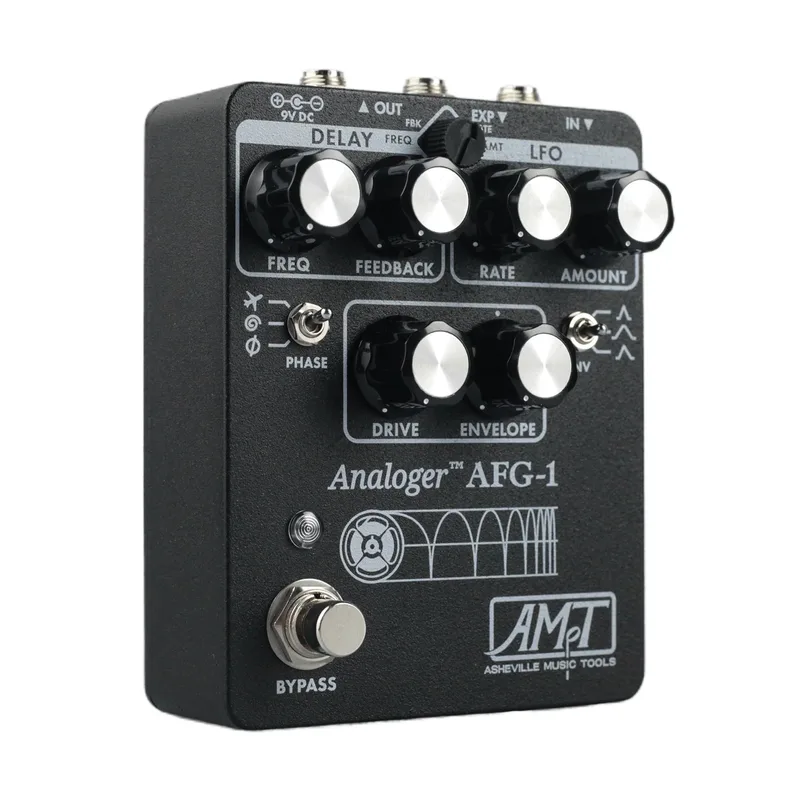


The Asheville Music Tools Analoger AFG-1 is a 100% analog dynamic flanger pedal, the first of the maker's Analoger Series. What sets it apart from most flanger pedals is how the effect is driven: alongside an on-board LFO, it uses a bi-directional, multi-response envelope follower, so the sweep of the effect is articulated by your playing dynamics rather than only by a repeating cycle1.
At its core is a high headroom, 256-stage reissue MN3009 bucket brigade device (BBD), the analog delay chip that produces the comb-filter sweeps a flanger is known for. Asheville Music Tools describes the result as "lush swirls, vocal comb filter sweeps, and metallic flourishes," controllable from the on-board LFO or from the envelope follower12.
The AFG-1 is listed as Sold Out on the maker's product page as of late October 20261. When Pedal of the Day covered it in May 2024, it could be found at Heyday Music in downtown Asheville2.
A dynamic flanger with an envelope follower
Most flangers give you an LFO, a low-frequency oscillator that sweeps the delay time back and forth at a rate and depth you set. The AFG-1 has that, but adds a second way to move the sweep: a bi-directional, multi-response envelope follower that reads the level of your playing and translates it into control of the effect. The maker's own words for it14:
"articulated by your playing dynamics with our bi-directional, multi response envelope follower"
In practice, that means the flanger can open up when you dig in and settle when you play lightly, or respond in the opposite direction, since the follower is bi-directional and offers multiple response characters. For a player used to rate, depth and feedback controls, this is closer to how an envelope filter or a synth's modulation routing works, and that is deliberate: the pedal's control-voltage topology is synthesizer-inspired, which Pedal of the Day said "provides an extended range of functionality and precision not available in most flangers"2.
The palette of sounds is wide. Pedal of the Day described "lush swirls, vocal comb filter sweeps, and metallic flourishes"2, and Guitar Pedal X's Stefan Karlsson, reviewing it in June 2026, named his favorite presets as Classic Flanger, Talk Box / Formant, Barracuda and Res-O-Flange3. Those preset names hint at the range: conventional flanging, formant-like vocal effects, and more unusual settings.
Guitar Pedal X's review judged the pedal broadly:
"For the Flanger it is the Envelope / 'Whoosh' Filter / Attenuator which makes it so unique."
Karlsson found that this section tempers the typical excesses of flangers and smooths the output envelope control, and his overall verdict was that the AFG-1 draws a wide range of tone out of its 256-stage MN3009 chip, calling it one of the most versatile and wide-ranging flangers on the market3.
Design and circuit lineage
The AFG-1's design draws from synthesizer-style architectures and elements of beloved vintage rack effects4. The designer, Hawker, built the circuit around a 256-Stage MN3009 chip2, and its synthesizer-inspired control voltage topology provides an extended range of functionality and precision not available in most flangers2.
- Synthesizer-style architectures, which is where the control-voltage approach and the envelope follower come from4
- Elements of vintage rack effects, whose influence shows in the range of modulation behavior and the precision of the controls4
The audio path is built around the 256-stage MN3009 BBD, a reissue of the classic Panasonic bucket brigade chip23. Around that core, the pedal uses tightly tuned, discrete, high-order filters and a compandor with emphasis/de-emphasis to keep the noise floor low, a technique carried over from vintage analog delay and modulation designs where the signal is boosted before the BBD and attenuated after it2. Pedal of the Day counted over 380 components in the build2.
The whole ensemble runs on a protected and highly regulated internal 15V power supply, generated from the 9V DC input, which the maker says allows carefree operation in any stage or studio situation12.
Power and connections
The AFG-1 takes a standard 9V DC center-negative 2.1mm x 5.5mm barrel plug and generates its own internal +15V rail1. The current figures are worth knowing before you put it on a power supply:
| Power spec | Value |
|---|---|
| Supply voltage | 9V DC, center negative, 2.1mm x 5.5mm barrel1 |
| Maximum draw | Under 150mA1 |
| Typical draw | 75 to 120mA1 |
| Start-up surge | Up to 300mA1 |
| Internal rail | +15V1 |
That start-up surge of up to 300mA means the AFG-1 can briefly ask for twice its maximum rated draw when first powered. Isolated power supplies with per-output current limits should be sized with that in mind1.
Connections are a 1/4" TS input, a 1/4" TRS expression jack and a 1/4" RS output3. The expression jack opens the pedal up to external control, which fits the synthesizer-style design: the same control-voltage architecture that the envelope follower feeds can also be driven from an expression pedal. Input impedance is over 1MΩ, and output impedance is 1KΩ maximum, rising to 5KΩ maximum when the pedal is in buffered bypass1.
Where it sits among analog flangers
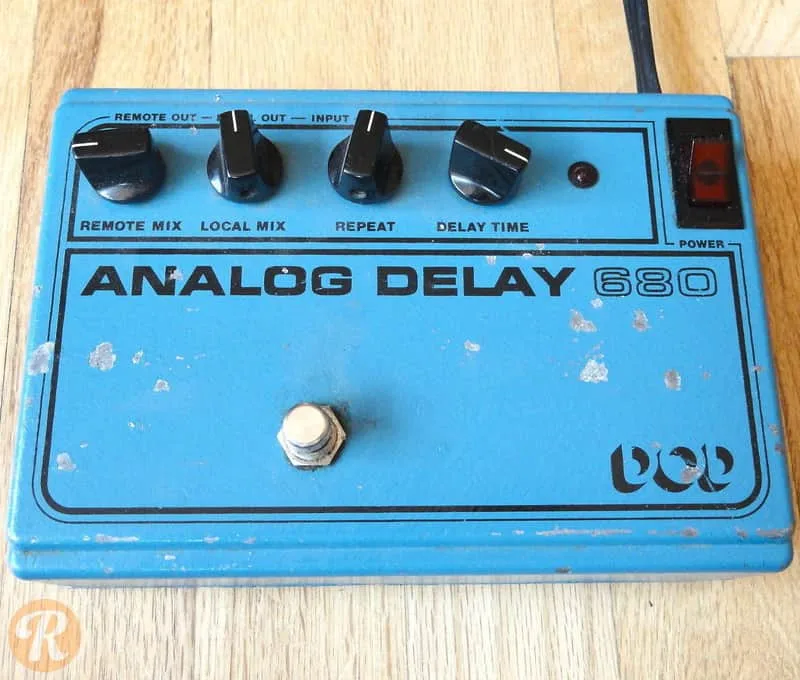
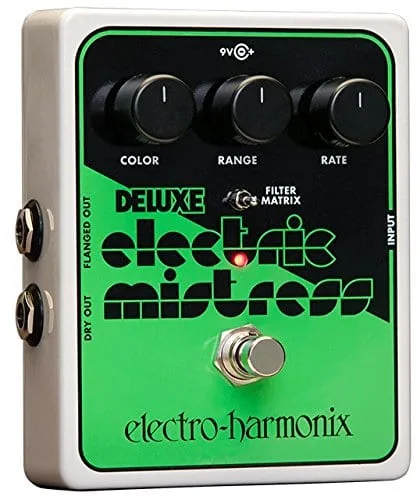
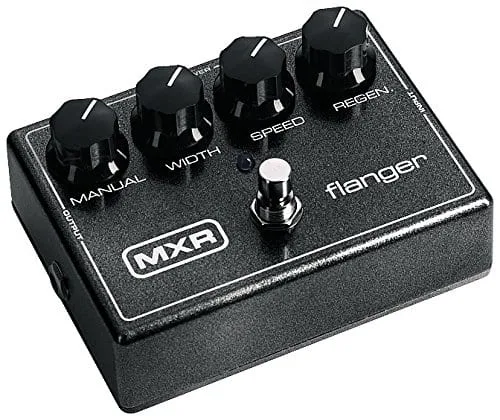
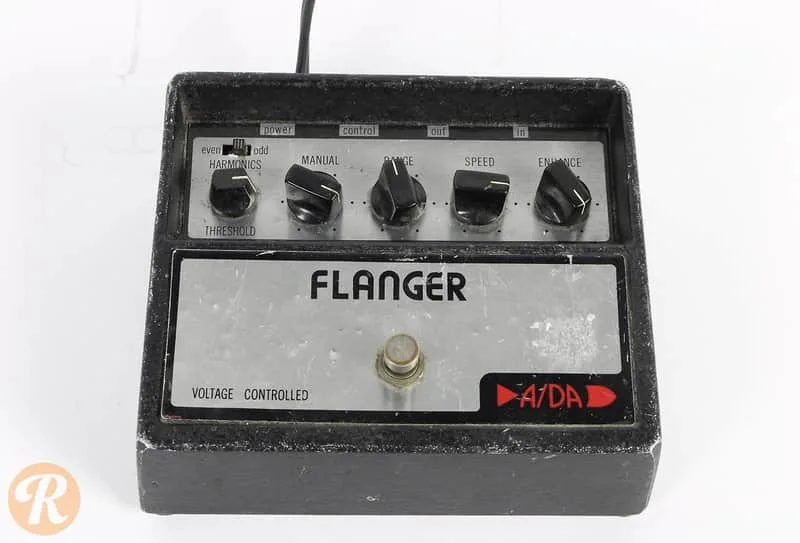
The AFG-1's combination of a BBD audio path and dynamic, envelope-driven control puts it in a small group of flangers. Players comparing analog circuits might also look at the Electro-Harmonix Deluxe Electric Mistress, the MXR Flanger or the A/DA Flanger, all of which take different approaches to analog flanging. Where most of those are LFO-driven, the AFG-1's envelope follower and control-voltage topology are its distinguishing features, the things both the maker and Guitar Pedal X point to as what makes it different13.
Videos
Mark Johnston
collector//emitter
ambienttrash
Questions
Is the Asheville Music Tools AFG-1 fully analog?
Yes. Asheville Music Tools describes the Analoger Series AFG-1 as a 100% analog dynamic flanger, with an analog signal and control path throughout. The core of the circuit is a high headroom, 256-stage reissue MN3009 bucket brigade device, and the pedal is built with over 380 components.
How much current does the AFG-1 draw?
It runs on 9V DC at under 150mA, with a typical draw of 75 to 120mA and a start-up surge of up to 300mA. The pedal generates an internal +15V rail from that 9V supply. That start-up surge is worth accounting for when sizing a power supply.
Is the AFG-1 sold out?
As of late October 2026, the maker's product page lists the AFG-1 as Sold Out. When Pedal of the Day reviewed it in May 2024, the pedal was available at Heyday Music in downtown Asheville. Check the maker's page for current availability.
What does the envelope follower do on a flanger?
Instead of only cycling with an internal LFO, the AFG-1's bi-directional, multi-response envelope follower lets your playing dynamics shape the flanger sweep. Pick harder and the effect articulates one way; play softly and it responds differently. Guitar Pedal X's reviewer found this envelope control is what makes the pedal unique.
Who designed the Analoger AFG-1?
The designer is Hawker, who built the modulator from the ground up for Asheville Music Tools. According to the maker and press coverage, the design draws on synthesizer-style architectures and elements of vintage rack effects, resulting in a control-voltage topology not found in most flangers.
Sources (4)
- AFG-1 Dynamic Analog Flanger, Asheville Music Tools
- Asheville Music Tools AFG-1 Analog Dynamic Flanger, Pedal of the Day, 2024-05-17
- Guitar Pedal X, Guitar Pedal X, 2026-06-23
- Analoger AFG-1 by Asheville Music Tools, RockBoard PedalPedia, 2026