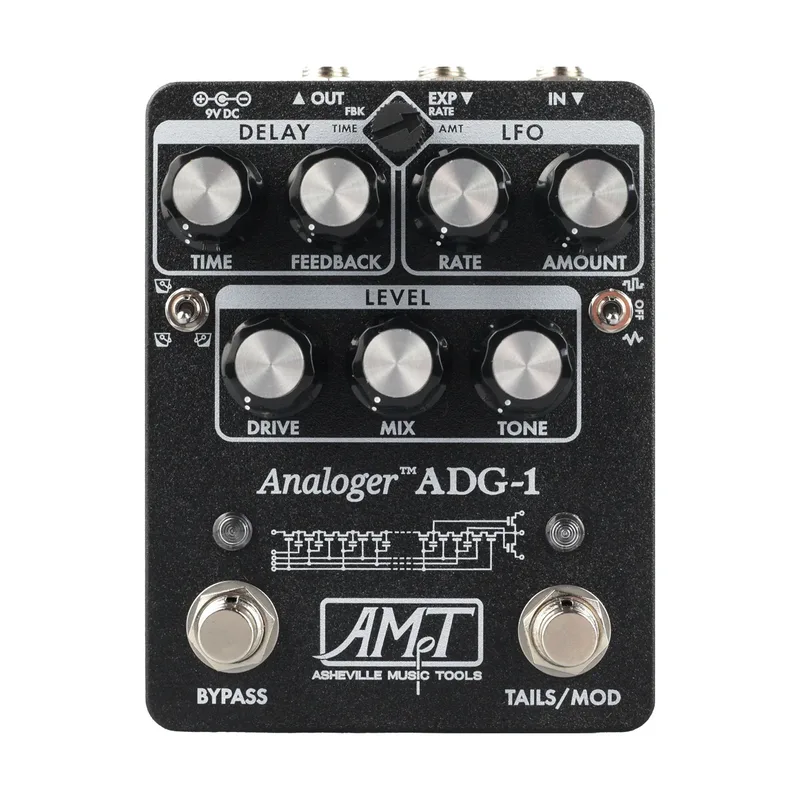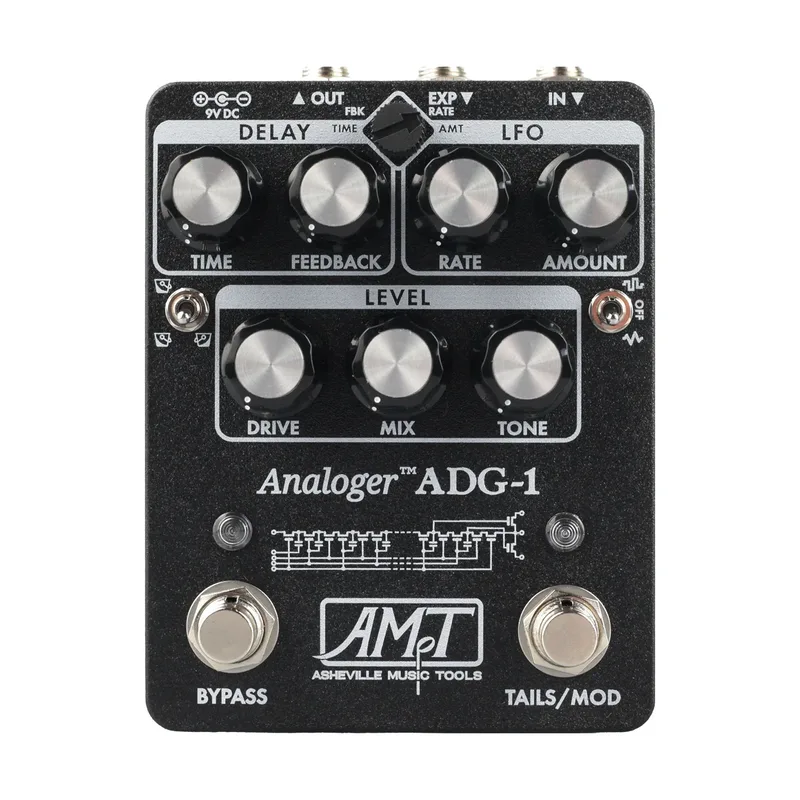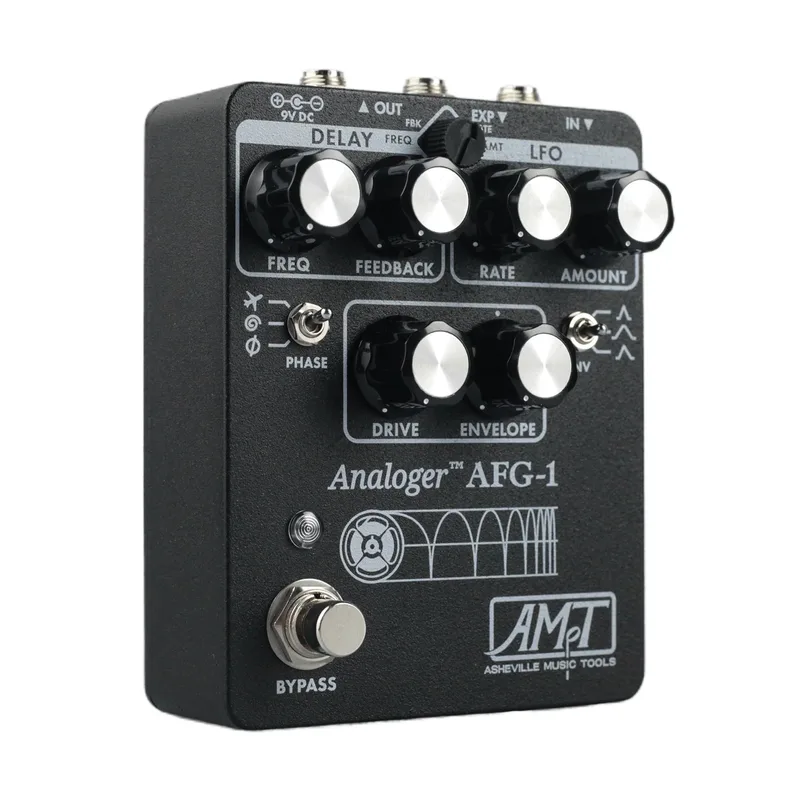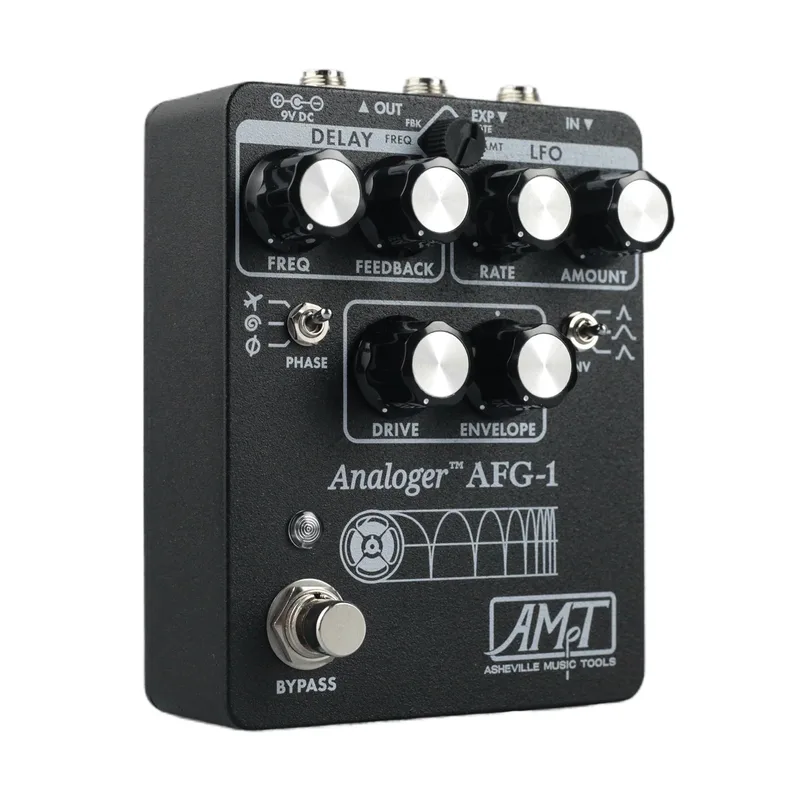


The Asheville Music Tools AFG-1 is a 100% analog flanger pedal in the maker's Analoger Series, built around a 256-stage MN3009 bucket brigade device1. What sets it apart from most flangers is that the sweep can be driven two ways: by an on-board LFO, like any conventional flanger, or by a bi-directional, multi-response envelope follower that articulates the effect from your playing dynamics1. Asheville Music Tools describes its output as "lush swirls, vocal comb filter sweeps, and metallic flourishes"1.
Designer Hawker built the modulator from the ground up1. It carries a list price of $397.001, with a UK RRP of £3792. Note that the maker's product page lists it as sold out as of late October 20261.
What it does: an analog BBD flanger that follows your playing
Flanging works by delaying the signal a fraction of a millisecond and mixing it back with the original, which cancels some frequencies and boosts others. The AFG-1's delay time is adjustable from about 0.52ms to 13.5ms with the FREQ knob, expanding to 0.33ms to 85ms when driven by the expression pedal, control voltages, the LFO or the envelope controls1. That wider range reaches into territory most pedal-format flangers do not, which the maker notes is rarely found in pedal flangers1.
The dynamic part is the envelope follower. Instead of a steady LFO sweep, the flanging responds to how hard or softly you play, with attack and release times you can set. Asheville Music Tools calls this "Whooshless" dynamic flanging: the effect rides your dynamics rather than cycling on its own1. Pedal of the Day's 2024 review described the result as combining vintage audio processing techniques with modern control, built with over 380 components3.
The controls
| Control | What it does |
|---|---|
| FREQ | Delay time, about 0.52ms to 13.5ms; expanded to 0.33ms to 85ms with expression, CV, LFO or envelope1 |
| Rate | LFO rate, sine wave from <0.01Hz to 8.3Hz, about 16Hz with CV control1 |
| Amount | LFO depth from off to about 85% of the time sweep, from light shimmers to deep jet engine roars1 |
| Envelope | Envelope follower level for dynamic flanging1 |
| ENV | Positive and negative FREQ modulation attenuator, center off; over 100% modulation possible1 |
| Drive | Up to 36dB of boost with increasing saturation and a band pass character as gain rises1 |
| Feedback | Off to self-oscillation and beyond using the EXP input coupled with knob position2 |
| Bypass footswitch | Effect on/off; internal switch selects true or buffered bypass1 |
The Drive knob is a tweak of the drive circuit from Asheville Music Tools' ADG-1 analog delay pedal, giving the AFG-1 up to 36dB of boost ahead of the flanging1. Noise reduction is 2:1 broadband with 10dB of HF emphasis1.
The envelope detector offers three attack/release settings1:
- Fast/Fast: about 40ms attack, 60ms release
- Slow/Slow: 600ms attack, 800ms release
- Medium/Slow: 60ms attack, 700ms release
Phase switch and envelope modes
The Phase toggle sets the phase of both the feedback and the wet signal, and it changes the character of the effect more than most flanger switches do1:
- Airplane: traditional flanger mode, classic flanger sounds1
- Swirl: warm, subtle and textural1
- Phase: a deep hollow or vocal tone; Pedal of the Day likened it to a talk box13
The switch itself is three position: positive wet and feedback, out of phase feedback, or out of phase feedback and wet signal. A fourth "secret" mode, in phase feedback with out of phase wet, exists on the PCB as a modification1. Guitar Pedal X's review noted the Airplane, Swirl and Phase options alongside three envelope waveforms as part of what makes the pedal so wide ranging2.
Power and connections
The AFG-1 takes a standard 9V DC center negative supply through a 2.1mm x 5.5mm barrel, and internally generates a +15V rail that feeds the MN3009 for high headroom12. Pedal of the Day described the internal 15V supply as protected and highly regulated for stage use3.
Current draw is under 150mA, typically 75 to 120mA, but start up can pull up to 300mA1. That surge means a marginal or shared daisy-chain output may not reliably power the pedal.
The expression jack is a TRS input usable with a CV or expression pedal, with a CV range of 0 to 5V; the ring supplies a current limited 5V output and the control input is on the tip1. An expression pedal also pushes the LFO rate faster than the panel's 8Hz ceiling1. The pedal sits in a genuine Hammond die-cast aluminum enclosure, D 4.95" (12.5 cm), W 3.75" (9.4 cm), H 2.25" (5.8 cm), weighing 14oz (425g), in Whetstone Rock Bronze or black1.
History: the MN3009 chip and the ADG-1 drive circuit
The AFG-1 is an analog dynamic flanger built around a 256-stage MN3009 bucket brigade device4. Its core is a high headroom, 256-stage Xvive reissue MN30091. Hawker, who designs Asheville Music Tools' circuits, built the modulator from the ground up, drawing on synthesizer-style architectures and elements of vintage rack effects35.
The Drive knob traces back to the ADG-1, the maker's analog bucket brigade delay, whose drive circuit the AFG-1 adapts1. In the maker's own explanation of the ADG-1, an analog delay passes sound from one capacitor or "bucket" to another, thousands of times, before it goes out6.
What reviewers said
Guitar Pedal X reviewed the AFG-1 and was hugely impressed, finding that it scores very highly in pretty much every category and describing it as one of the most versatile and wide-ranging flangers currently on the market overall2. As the reviewer put it:
"Overall the AFG-1 scores very highly in pretty much every category."
Stefan Karlsson, Guitar Pedal X2
Karlsson judged it "one of the most versatile and wide-ranging flangers currently on the market," squeezing every ounce of tone out of its 256-stage MN3009 chip, and listed favorite presets including Classic Flanger, Talk Box / Formant, Barracuda and Res-O-Flange2.
Videos
Mark Johnston
collector//emitter
ambienttrash
News
Questions
Is the AFG-1 true bypass?
It is user selectable. An internal slide switch chooses between true bypass, which takes the pedal entirely out of the signal path, and a buffered bypass that uses a JFET buffer. Output impedance is 1K ohm maximum, or 5K maximum in buffered bypass.
Can you use an expression pedal with the AFG-1?
Yes. It has a 1/4 inch TRS jack usable with a CV or expression pedal, with a CV range of 0 to 5V. The ring supplies a current limited 5V output and the control input is on the tip. An expression pedal expands the delay time range and can push the LFO rate faster.
What BBD chip does the AFG-1 use?
A 256-stage MN3009 bucket brigade device, in Xvive reissue form, running on an internal 15V power supply for high headroom. The MN3009 is the same short-delay chip family used in classic analog flangers.
How much current does the AFG-1 draw?
It runs on 9V DC at under 150mA, with 75 to 120mA typical and up to 300mA at start up. Because of that start-up surge, give it a power supply with headroom rather than a shared low-current output.
Is the AFG-1 sold out?
Asheville Music Tools lists the AFG-1 as sold out on its product page as of late October 2026. Its list price was $397.00. Availability may return, so the maker's site is the place to watch.
Does the AFG-1 self-oscillate?
Yes. Guitar Pedal X's review describes the feedback control as running from off to self-oscillation and beyond when the expression input is coupled with the knob position, so it can be pushed into runaway regeneration.
Sources (6)
- AFG-1 Dynamic Analog Flanger, Asheville Music Tools
- Guitar Pedal X, Guitar Pedal X, 2026-06-23
- Asheville Music Tools AFG-1 Analog Dynamic Flanger, Pedal of the Day, 2024-05-17
- New Pedal: Asheville Music Tools AFG-1 Flanger, Delicious Audio, 2023-06-13
- Analoger AFG-1 by Asheville Music Tools, RockBoard PedalPedia, 2026
- ADG-1 Preorder Updates, Asheville Music Tools