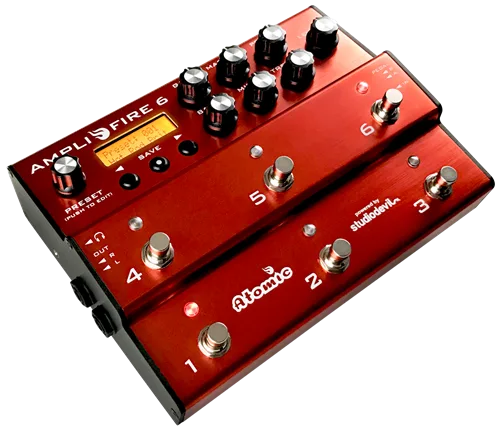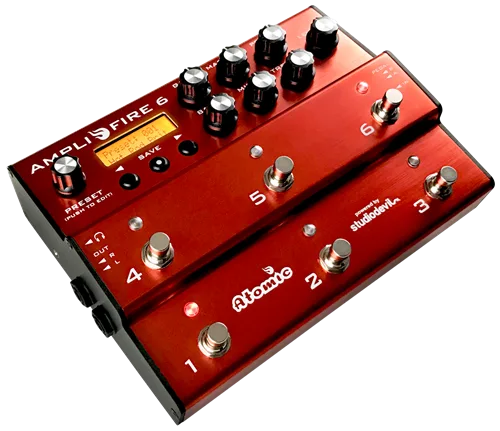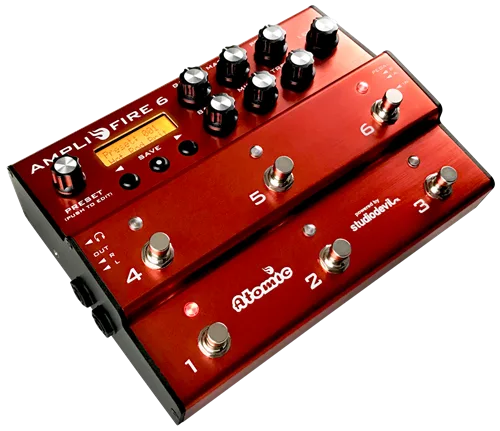


The Atomic Amps AmpliFire is an amp modeling and multi-effects pedal: one floor unit that replaces a guitar amp and a pedalboard of effects. Atomic Amps describes it as "an exceptional amp tone and multi-effects pedal," built on what the company calls "all new, state-of-the-art amp modeling based on Studio Devil's highly acclaimed and patented technology"1. In the maker's words, with that modeling and the ability to load third-party speaker impulses, "it can faithfully recreate the experience of playing through the greatest guitar amps of all-time"1.
The effects selection covers the ground most players build boards for: drive, modulation, delay, reverb, EQ, gate and more1. Firmware is field upgradeable, so the pedal's software can be updated rather than replaced1.
Amp modeling and effects in one pedal
The AmpliFire sits in the multi-effects pedals category, but its center of gravity is amp modeling. The signal path starts with amp models built on Studio Devil's patented technology, then adds a "robust effects selection including drive, modulation, delay, reverb, eq, gate and more"1. That covers the drive family players usually stack in front of an amp, from overdrive and distortion through time-based effects like delay and reverb.
Cabinet simulation is handled through impulse responses, and the pedal accepts third-party speaker impulses rather than locking you to a fixed set of built-in cabs1. Because the outputs are stereo and the cabinet impulses are stereo too, a single preset can feed two channels of a PA or interface with a full amp-and-cabinet sound1.
The pedal earned enough of a reputation that later multi-effects units were measured against it. Writing on Guitar Pedal X in 2024, Stefan Karlsson noted that Boss's 500 Series pedals "seem to have been in part at least influenced by Atomic's AmpliFIRE Multi-FX and Amp Modeller Unit"2.
The controls and footswitches
Atomic Amps gives the AmpliFire "dedicated, physical amp control knobs for intuitive tone adjustments"1. That is a deliberate design choice: instead of paging through menus to change a gain or tone setting, the amp controls sit on the surface as knobs, the way they would on a real amplifier.
Footswitch control comes from "3 configurable and rugged footswitches"1. Three switches is enough for preset recall and bypass duty on a small board, but it is the main thing that separates the original from its siblings: the AmpliFire 6 carries 6 fully assignable silent footswitches3, and the AmpliFIRE 12 carries 124.
| Model | Footswitches | Notes |
|---|---|---|
| AmpliFire | 3 configurable, rugged1 | Original pedal |
| AmpliFire 6 | 6 fully assignable, silent3 | Adds MIDI in/out/through3 |
| AmpliFIRE 12 | 12 fully assignable, silent4 | Larger LCD screen5 |
Inputs, outputs and MIDI
The I/O is built for both live and studio use. On the input side there is a 1/4" Hi Z input with proprietary processing1. On the output side, the pedal has separate stereo 1/4" and XLR outputs1, so it can drive an amp or powered speakers and a mixing desk at the same time without adapters.
Preset storage and remote control are tied together: the AmpliFire holds 128 presets, and as Atomic Amps puts it, "yep, you can plug a midi controller into AmpliFire for extended control"1. A MIDI floor controller can therefore recall presets from a distance, which matters on a stage where the pedal itself lives in a rack or off to the side of the board.
Studio Devil technology and the AmpliFIRE 12
The amp modeling inside the AmpliFire comes from Studio Devil. Atomic Amps describes the pedal's modeling as "based on Studio Devil's highly acclaimed and patented technology"1, and MusicRadar's NAMM 2017 coverage of the range likewise credits the AmpliFIRE 12 with "world-class, patented amp modelling technology from Studio Devil"5.
The AmpliFIRE 12's I/O goes further than the original: proprietary guitar input circuitry, 2 sets of balanced outputs with separate stereo 1/4" and XLR jacks, an aux input, a stereo effects loop, 2 dedicated expression pedal jacks, MIDI in/out/through, and a 1/4" headphone jack4. The AmpliFire 6 shares much of that, including MIDI in/out/through, 2 dedicated expression pedal jacks and a high quality headphone amp3. Both expanded models keep the 128 MIDI controllable presets of the original34.
Videos
Premier Guitar
Andertons Music Co
Andertons Music Co
Questions
Can the Atomic AmpliFire load third-party impulse responses?
Yes. Atomic Amps lists the ability to load third-party speaker impulses as a core feature of the AmpliFire, alongside its patented amp modeling technology. Impulses can be loaded in stereo, and the pedal has separate stereo quarter-inch and XLR outputs for running those cabinet sounds to a mixer or interface.
How many presets does the AmpliFire hold?
The AmpliFire holds 128 presets, and all of them are MIDI controllable. Atomic Amps notes you can plug a MIDI controller into the pedal for extended control, so presets can be recalled from a floor controller or switching system rather than only from the pedal's own footswitches.
Does the Atomic AmpliFire have XLR outputs?
Yes. The pedal has separate stereo quarter-inch and XLR outputs, so it can feed a recording interface or PA mixer with balanced connections while still driving a guitar amp or powered speakers through the quarter-inch jacks. Stereo cabinet impulses are supported.
Can I control the AmpliFire with a MIDI controller?
Yes. The AmpliFire has 128 MIDI controllable presets and a MIDI controller input for extended control. The larger AmpliFIRE 12 adds full MIDI in, out and through jacks, and the AmpliFire 6 also carries MIDI in/out/through.
Is the Atomic AmpliFire digital or analog?
It is digital. Atomic Amps describes the AmpliFire as dual-DSP powered hardware running complex and detailed algorithms, with amp modeling based on Studio Devil's patented technology. RockBoard's PedalPedia likewise lists the circuit type of the AmpliFire 6 as digital.
Sources (5)
- AmpliFire Pedal, Atomic Amps
- Guitar Pedal X, Guitar Pedal X, 2024-10-17
- AmpliFire 6, Atomic Amps
- AmpliFire 12, Atomic Amps
- NAMM 2017: Atomic unveils AmpliFIRE 12 and Ampli-Firebox multi-effects pedals, MusicRadar, 2017-01-26