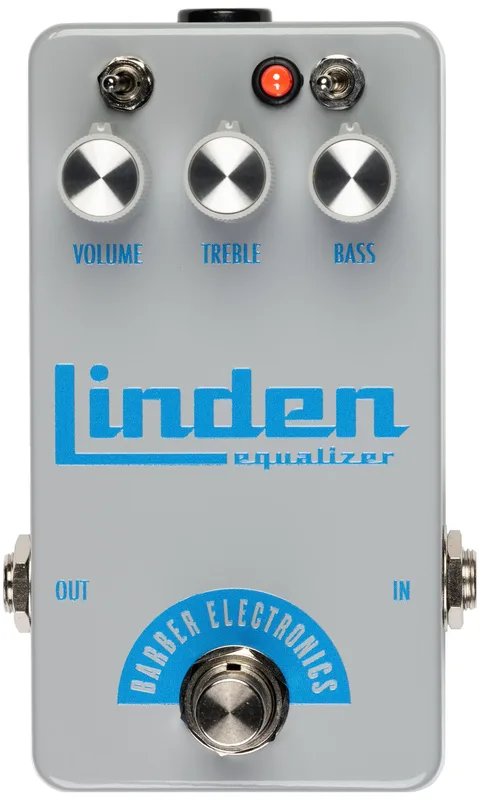

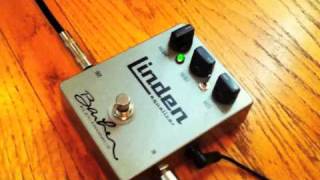
The Barber Linden E.Q. is a compact bass EQ pedal from Barber Electronics, a maker of equalization pedals for guitar and bass rigs. Barber describes it as "an ultra high headroom device" that draws 25 working DC volts from a standard 9 volt supply, which the maker says gives it far superior headroom over a standard 9 volt powered pedal1. The EQ circuit is derived, according to Barber, from the flip top bass amps manufactured in Linden, New Jersey1.
The pedal is built around a simple set of familiar controls: bass, treble and volume knobs, plus two toggle switches that reshape how the EQ responds. Barber's manual says the Linden "brings classic tones to your bass rig, using a simple set of familiar controls"2.
Controls
The Linden's three knobs and two toggles cover a lot of tonal ground for a compact pedal1.
| Control | What it does |
|---|---|
| Volume | Sets the overall output level, located after the EQ circuit, and provides a low impedance unbalanced output2 |
| Treble | Adjusts high frequency content; use it to give the bass sound definition or roll back highs for a round, full sound2 |
| Bass | Sets low frequency content; voiced to allow powerful bass that stays tighter than modern EQ circuits, and can also cut bottom from basses with unruly low end2 |
| Contour toggle (left switch) | Chooses between three EQ responses, described below2 |
| Input toggle (right switch) | Tailors the input filtering, with three settings described below2 |
Contour toggle
The contour switch, on the left, gives three EQ responses2:
- Left: a classic vintage EQ with plenty of growl
- Middle: makes the treble control only active on higher frequencies, so you can cut or boost the "liveliness" of your sound
- Right: reduced mids and cleans up "clanky" artifacts; Barber says this works great for aggressive styles that include slap and pop techniques, and allows more aggressive treble settings without excessive harshness
Input toggle
The input switch, on the right, tailors the input filtering2:
- Left: a natural full response with deep bass
- Middle: "tight mode", which allows you to be aggressive with the bass control without losing a defined sound
- Right: emulates the "bright input" on a vintage bass amp, which Barber says is great for cleaning up the bottom of neck humbuckers and for creating a throaty bass effect
Headroom and power
Barber describes the Linden as an ultra high headroom device that draws 25 working DC volts internally from a standard 9 volt supply, which the maker says results in far superior headroom over a standard 9 volt powered pedal1. The pedal requires a 9 volt DC negative tip power supply and draws 40 mA12.
The Linden does not accept batteries and does not include a power supply, so you will need your own 9 volt DC negative tip adapter12.
Buying direct
The Linden is sold direct from Barber Electronics. David Barber sends buyers a secure PayPal invoice, which can normally be paid with a credit or debit card without a PayPal account1. The list price is $149.951.
Guitar use
Although it is voiced for bass, Barber's manual notes that because of its flexibility the Linden is also a fantastic guitar EQ2. Players looking at other tone-shaping tools on a bass rig may also want to compare it with preamp pedals or compressor pedals.
Videos
JetCityMusic
mysteriousdemos
Questions
Does the Barber Linden E.Q. work for guitar as well as bass?
Yes. Barber Electronics says that because of its flexibility the Linden is also a fantastic guitar EQ, so although it is voiced around a bass rig, guitar players can use the same bass, treble and contour controls to shape their tone.
Can the Barber Linden E.Q. run on a battery?
No. Barber Electronics states that the pedal does not accept batteries. It needs a 9 volt DC negative tip power supply, which is not included with the pedal, and it draws 40 mA.
Sources (2)
- Linden EQ, Barber Electronics
- Linden_compact.doc, Barber Electronics