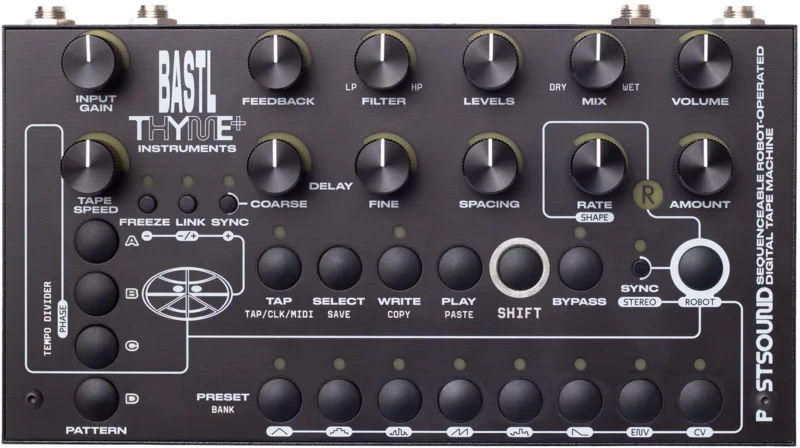


The Bastl Thyme+ is a digital tape delay box from Bastl Instruments, the second generation of the original THYME released in 201712. Bastl describes it as "a digital tape machine that transcends typical delay effects and spans across various multi-effect categories," and says it "adds a lot of unique spice and texture to your audio sources, capable of transforming them into a sound designer's dream"1. Where a typical delay pedal gives you a repeat or two, Thyme+ gives you a tape machine metaphor with multiple playback heads, nine adjustable parameters, and a set of "robots" that move the heads around2.
Though proudly digital, it operates with the metaphor of an analog tape delay machine, offering adjustable tape speed1. Gearnews, covering the announcement in May 2024, called it "a digital tape delay emulation with multiple playback heads and nine adjustable parameters"2. It is built as a desktop unit in a compact metal enclosure with larger knobs and a sleeker faceplate, but it also brings in a footswitch input for instrumentalists1.
A digital tape delay with a sound designer's reach
The core of the machine is its tape metaphor. Delay length stretches from 2.7 seconds up to 108 seconds, so it covers everything from tight slapback to long-form sound design1. Multiple playback heads read the "tape," and nine adjustable parameters shape the result2.
Beyond the basic delay, the feature set reaches into territory most delay pedals do not touch21:
- Randomization2
- Rhythmic quantization of both the delay time and the robots2
- High-pass and low-pass filters2
- A FREEZE button for tape loops12
Gearnews noted that the original THYME "quickly became a favorite of electronic performers thanks to its inspiring workflow and creative possibilities"2. For a guitarist, that means the machine rewards experimentation: quantized robot movement can turn repeats into rhythms, and freeze turns the tape into a looping pad.
The controls: Freeze, Link, tap tempo and presets
Three controls define the workflow. The FREEZE button creates tape loops, holding the contents of the tape so you can play over them1. The LINK button compensates for the change in delay time caused by adjusting the tape speed, so speeding the tape up or slowing it down does not throw off your delay setting1. Tap tempo lets you set the delay time in time with the music rather than by ear1.
| Control | What it does |
|---|---|
| FREEZE button | Creates tape loops1 |
| LINK button | Compensates for the change in delay time caused by adjusting Tape Speed1 |
| Tap tempo | Sets delay time in tempo1 |
Presets are handled with internal memory for 8 presets organized in 8 banks, giving 64 presets in total1. That is a full snapshot system rather than a single saved setting, useful given how many interacting parameters the machine has.
Power and connections
Thyme+ runs on 7 to 12V DC, center positive, through a 5.5mm/2.1mm barrel connector, with power consumption under 300 mA and a 400 mA minimum supply recommended1.
The power requirement is center positive, the opposite of the center-negative standard used by most guitar pedals, and the current draw rules out sharing a small daisy chain. Use the included adapter or a supply that matches the polarity and current.
The box ships with the THYME+ instrument, a 9V power adapter with changeable socket blades for Europe, the United Kingdom, North America and Australia, a MIDI adapter type A (DIN5 to 3.5mm jack), a quickstart guide, a sticker, and rubber feet1. Bastl's support pages for the original Thyme describe the same system: the adapter ships with four blade types for US, EU, UK and Australia, with the adaptor inserted depending on your location3.
Connections go well beyond audio jacks1:
- Audio input: mono and stereo 6.35 mm (quarter inch) jack, 10k input impedance
- Audio output: mono and stereo 6.35 mm (quarter inch) jack
- MIDI IN: 3.5 mm jack, MIDI type A
- Clock in: 3.5mm mono, 100k input impedance, trigger threshold at about 0.5V, rising edge, maximum 5V
- CV in: 0 to 5V, volt per octave for Tape Speed and Delay Time
- Footswitch input: 3.5mm mono, for a passive switch connecting sleeve and tip, for BYPASS
The CV input's ring carries a 5V voltage source for use with an expression pedal, which works as a passive voltage divider1. That gives you hands-free control over tape speed or delay time, both of which track at a volt per octave. The footswitch jack handles bypass for players who want the unit on a pedalboard rather than a desk1.
From the original Thyme to Thyme+
The original THYME was released in 2017, and Bastl calls it iconic1. Gearnews reports that it quickly became a favorite of electronic performers thanks to its inspiring workflow and creative possibilities2.
Bastl positions Thyme+ as "an updated and innovated version of the iconic THYME released in 2017"1. Gearnews reports that shipping will begin in early June2. The changes from the original:
- Improved connectivity, including dedicated input jacks for the left and right channels12
- A better audio codec1
- Firmware tweaks and refinements1
- A compact metal enclosure, larger knobs, and a sleeker faceplate1
For a player choosing between the two on the used market, the practical differences are the hardware and codec updates and the dedicated stereo inputs; the tape machine concept and the robot workflow carry over from the original12.
Videos
Bastl Instruments
True Cuckoo
Red Means Recording
Questions
Is the Bastl Thyme+ analog or digital?
It is digital. Bastl describes it as proudly digital but operating with the metaphor of an analog tape delay machine, with adjustable tape speed and multiple playback heads. It is a digital tape delay emulation rather than an actual tape loop.
Does the Bastl Thyme+ have tap tempo?
Yes. Tap tempo is listed among its features on Bastl's product page, alongside rhythmic quantization of the delay time and the robots, so delay times can be locked to a tempo rather than dialed in by ear alone.
How many presets does the Bastl Thyme+ store?
It has internal memory for 8 presets organized in 8 banks, for 64 presets in total. That is enough to keep full settings snapshots, including the robot and delay time settings, ready to recall.
Can I use an expression pedal with the Bastl Thyme+?
Yes. The CV input jack's ring carries a 5V voltage source intended for use with a passive expression pedal, which acts as a voltage divider. The CV input itself accepts 0 to 5V, with volt per octave tracking for Tape Speed and Delay Time.
Does the Bastl Thyme+ work in stereo?
Yes. It has stereo/mono input and output on 6.35 mm (quarter inch) jacks, with a 10k input impedance, and the new version has dedicated input jacks for the left and right channels.
What power supply does the Bastl Thyme+ need?
It runs on 7 to 12V DC, center positive, on a 5.5mm/2.1mm barrel connector, drawing under 300 mA, and Bastl recommends a 400 mA minimum supply. A 9V adapter with changeable socket blades for Europe, the UK, North America and Australia is included.
Sources (3)
- Bastl Thyme+ Step into the world of digital tape. Jam with Robots by your side!, Bastl Instruments
- Bastl Instruments THYME+: Return of the Delay Robots, gearnews.com, 2024-05-10
- FAQ Thyme, Bastl Instruments