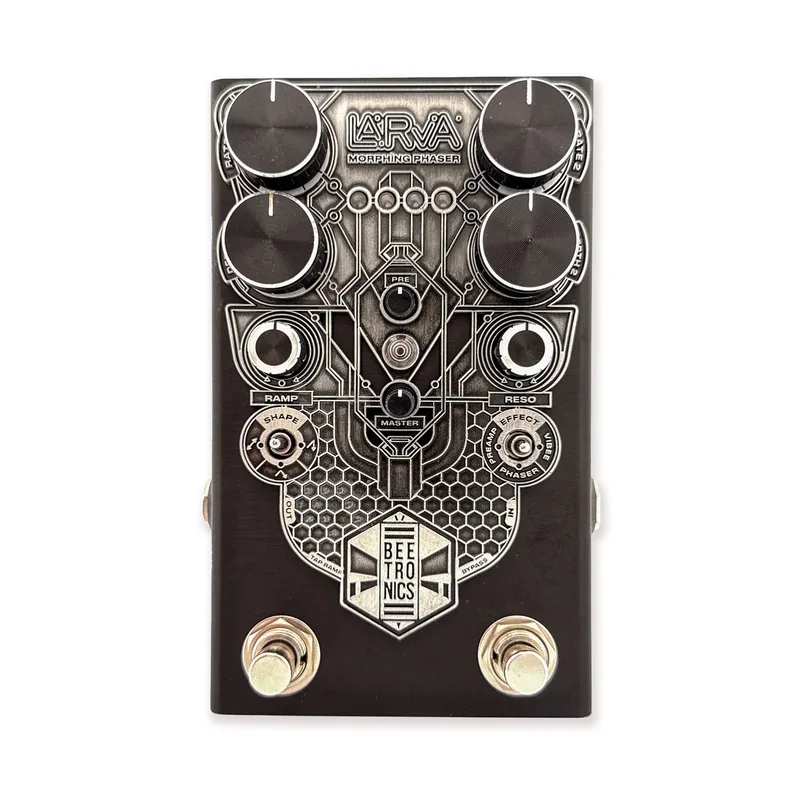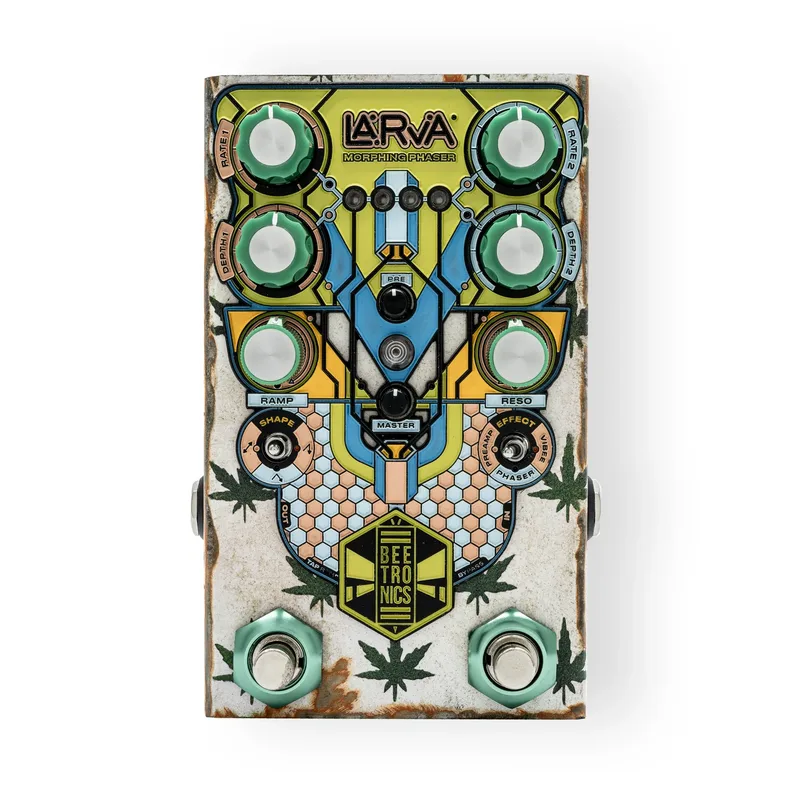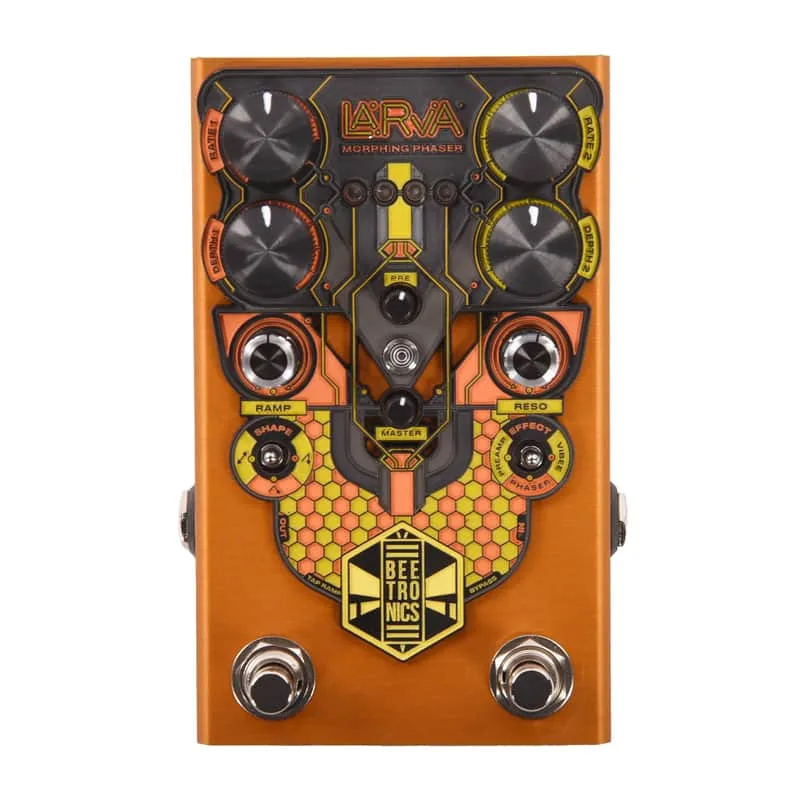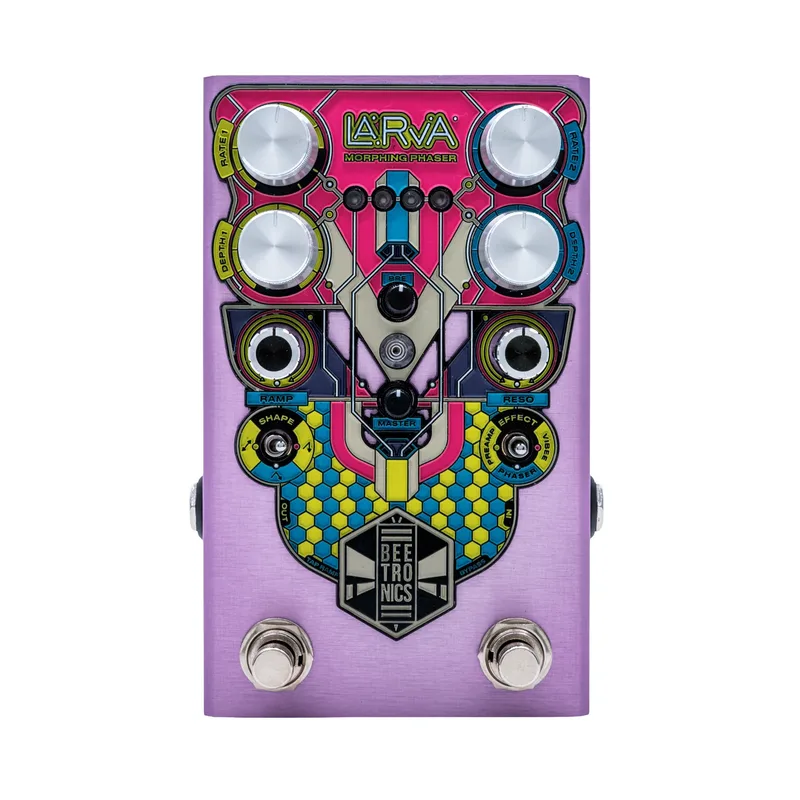


The Beetronics Larva Morphing Phaser is a 6-stage analog phaser pedal with morphing capabilities: it stores two independent phaser settings, each with its own rate and depth, and lets you sweep between them rather than switch abruptly1. Alongside the phaser it carries a Vibee mode and a preamp circuit inspired by the classic Moog Moogerfooger line, which Beetronics credits as the source of its preamp design12. The pedal was announced in November 2024 and became available from the Beetronics webstore, with press coverage noting its tap tempo and presets that glide between sounds3.
Beetronics describes the Larva as a 6-stage analog phaser "delivering unmatched warmth," paired with a simple interface and modern features1. The maker's own framing of the sound is a thick, warm, vintage-style phaser rather than what it calls the cheesy, over-the-top 80s phaser sound1.
The controls and the ramp footswitch
The Larva's core idea is two phasers in one box. You set the rate and depth for Phaser 1 (left) and Phaser 2 (right), and the two settings can be used separately or morphed between15. The effect toggle chooses between the phaser, Vibee, or just the preamp5.
The ramp footswitch is where the morphing lives. Beetronics describes it plainly: hold the ramp footswitch and the pedal sweeps between the two phaser settings as an expression-style movement12. Premier Guitar's reviewer found that the pedal can also stay fixed at one speed until you hit the left footswitch again, giving a deliberate jump between settings6. A further trick from the same review: with the ramp rate set to zero, the middle ramp-shape position allows momentary and instantaneous switches between speeds as you hold or release the switch6.
The pedal also has tap tempo, which Delicious Audio highlighted at launch alongside its presets3. Guitar Pedal X's coverage of the Dual Morphing Phaser variant describes the footswitch layout in full: a Tap/Ramp footswitch (tap for tap tempo, hold for ramping) and a bypass footswitch (double tap to flip between Phaser 1 and 2 playback, hold for secondary or alternative parameters)7.
| Control or switch | What it does |
|---|---|
| Rate 1 / Depth 1 (left) | Set the rate and depth for Phaser 11 |
| Rate 2 / Depth 2 (right) | Set the rate and depth for Phaser 21 |
| Effect toggle | Choose between phaser, Vibee, or preamp only5 |
| Ramp footswitch | Hold to activate the ramp morphing movement between the two settings1 |
| Bypass footswitch | Hold to enter the alternate control mode; ramp LEDs change to white while holding1 |
| Ramp time | Controls how fast or slow the morphing flows8 |
Hidden control: Ramp Speed Offset
The Larva has hidden controls reached by holding the bypass footswitch. Beetronics notes that the ramp LEDs change to white while you hold it, indicating you are in the alternate control mode1. One of those hidden controls is the Ramp Speed Offset: while holding the bypass, adjusting the ramp speed changes the center point of the LFO, and it interacts with the depth control915. In practice this shifts where the modulation sits, so the same knob positions behave differently once the offset is moved.
Limited editions and Custom Shop versions
The Larva has been sold in several finishes beyond the standard pedal. Limited editions include the DARK version and a RED FADE version, both listed as sold out at the maker's webstore85. The RED FADE carried a regular price of £163.00, against £154.00 for the standard finish51.
Alongside the limited editions, Beetronics offers Custom Shop versions of the Larva. The maker's product pages list Custom Shop variants numbered LV992 through LV1004, plus a 420 edition, alongside Limited Edition DARK and Limited Edition RED FADE finishes912. The standard Larva carried a regular price of £154.00, with the Limited Edition RED FADE at £163.00, and both the standard and limited editions have since sold out15.
The standard Larva and its limited editions are shown as sold out at the Beetronics webstore as of October 2026185. The maker offers a 14-day money back guarantee1.
What reviewers said
Guitar World's Trevor Curwen reviewed the Larva and summed up its strengths and quirks in list form: among the pluses, a classic phasing sound; among the minuses, side-mounted jacks, which he notes "may be a no-no for some"4. The same review lists the pedal's connections as a standard input and standard output, power from a 9V DC adaptor (not supplied) drawing 100 mA, and its origin as the USA4.
Published reviewers were positive about the Larva's core sound. Guitar World's review highlighted its "classic phasing sound" as a point in its favor, while noting that its side-mounted jacks may be a no-no for some players4. The maker describes the pedal as a 6-stage analog phaser delivering warmth, with a preamp that can be cranked for grit and what the maker calls a very 70s psychedelic vibe lead tone5.
Related pedals
The Larva's ramping system is one Beetronics had previously explored with its Zombee and SeaBee pedals, combined here with the phaser circuit and preamp2. A separate page covers the Beetronics Larva and the Beetronics Larva Dual Morphing Phaser, the variant with the full tap/ramp and double-tap footswitch layout7.
Videos
Beetronics FX
AndyDemos
R.J. Ronquillo
News
Questions
What is the difference between Vibee and Phaser mode on the Larva?
Vibee is essentially the wet signal from the phaser modulation on its own, while the phaser mode combines both the wet and dry signals. The effect toggle also offers a third option, preamp only, which runs the Moog Moogerfooger-inspired preamp circuit without any modulation.
Is the Beetronics Larva true bypass?
Yes. Beetronics confirms the Larva uses true bypass, so with the effect off your signal passes through without buffering. The bypass footswitch also has secondary functions: holding it accesses hidden controls, and on the Dual Morphing Phaser a double tap flips between the two phaser settings.
Can the Larva take line-level signals from synths?
Yes. Beetronics states the Larva accepts line-level or instrument-level signals, so it works with synths and other line-level sources as well as guitar and bass. Connections are a standard input and a standard output, with side-mounted jacks.
How many stages does the Beetronics Larva have?
The Larva is a 6-stage analog phaser. It holds two independent phaser settings, each with its own rate and depth controls, and you can use them separately or morph between them with the ramp footswitch.
Where is the Beetronics Larva made?
The Larva is made in the USA by Beetronics. The maker offers a 14-day money back guarantee on the pedal. Limited edition finishes and Custom Shop versions have been sold through the Beetronics webstore.
Sources (9)
- LARVA Morphing Phaser • Limited Edition • Crystal Neon, Beetronics
- LARVA Morphing Phaser • Limited Edition • BREAKING BEE, Beetronics (www.beetronicsfx.com)
- New Pedal: Beetronics Larva Morphing Phaser, Delicious Audio, 2024-11-19
- Beetronics Larva Morphing Phaser review, Guitar World, 2025-04-17
- LARVA Morphing Phaser • Limited Edition • RED FADE, Beetronics
- Beetronics FX Larva Guitar Pedal Review, Premier Guitar, 2025-01-18
- Guitar Pedal X, Guitar Pedal X, 2024-12-19
- LARVA Morphing Phaser • Limited Edition • DARK, Beetronics (www.beetronicsfx.com)
- LARVA Morphing Phaser • Custom Shop • 420, Beetronics