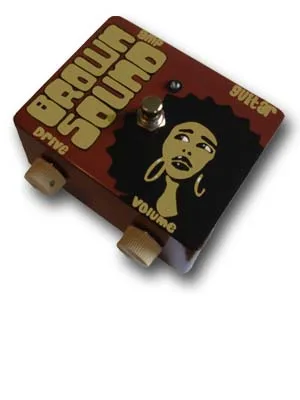

The Bennett Music Labs Brown Sound is a hand-wired distortion pedal built by Bruce Bennett of Bennett Music Labs. It is a two-knob box aimed at players chasing late-sixties tones: the design goal was to capture the essence of Jimi Hendrix's "Foxy Lady" sound and other classic tones of the era, which were based around a touch of fuzz and a ton of power amp distortion1. It sold for $159.00 and is no longer available1.
What it does to your sound
The pedal is voiced around power amp distortion rather than the tight, saturated clipping of a modern high-gain pedal. The reviewer's description of the Drive control gives a picture of the range: at lower settings it produces a grind with some added presence, and turned up it approaches an almost thrashed speaker tone1. That places it closer to the cramped, breaking-up character of a vintage amp than to a fuzz or a modern overdrive pedal.
The controls: Drive and Volume
The control set is deliberately minimal. Both knobs are side mounted rather than on the top face, which keeps the enclosure low and the footprint small1.
| Control | What it does |
|---|---|
| Drive | Rotates from a nice grind with some added presence to an almost thrashed speaker tone1 |
| Volume | Better described as a cut, since it is more or less at unity full up1 |
The Volume knob's behavior is worth noting for pedalboard planning: because it acts as a cut rather than a boost, full up is roughly the same level as the bypassed signal. Players who want a solo lift from the pedal itself will not get one; the level control is there to pull the pedal down to match the rest of the chain, not to push past it1.
Circuit and construction
Inside the enclosure is a simple hand-wired circuit, built with solid Switchcraft jacks, in an attractive and appropriately painted box1. Hand wiring rather than a printed circuit board is a construction choice usually associated with small-batch builders, and it matches the pedal's origin as a one-man operation.
The Brown Sound name also has a wider history in DIY circles. The Brown Sound in a Box project, designed by Ed Guidry, first appeared in 2001 as a modified version of Jack Orman's Mini-Booster, and a second version followed in 2004. That revision changed the JFETs from J201 to 2N5457 for a less gainy and compressed drive sound, and added more high-end filtering to better simulate the resonance of a speaker cabinet2. Bennett's pedal is a separate product, but it shares the same design target: the brown sound of a cranked vintage amp.
The Bennett Music Labs Brown Sound is no longer available, so it is found on the used market rather than from the builder1.
Power and connections
The pedal runs from a Boss style DC-in jack1. Inputs and outputs are solid Switchcraft jacks1. No battery option or current draw figure was published for it.
Videos
bennettmaxfield
Questions
Is the Bennett Music Labs Brown Sound true bypass?
Yes. The pedal uses true-bypass switching with an LED indicator, so when it is off the signal passes through without the circuit coloring it. That suits players who want to keep the rest of the pedalboard clean when the pedal is disengaged.
Is the Brown Sound still being made?
No. The Analog Man product page for the pedal lists it as no longer available, so it is not currently offered. Used units and the related Brown Sound in a Box projects are the practical ways players encounter the circuit today.
Who designed the Bennett Music Labs Brown Sound?
The pedal was designed and built by Bruce Bennett of Bennett Music Labs. The related Brown Sound in a Box project, a modified version of Jack Orman's Mini-Booster, was designed by Ed Guidry and first appeared in 2001.
What is the Brown Sound's circuit like?
It is a simple hand-wired circuit, built point to point rather than on a mass-produced board. The design aim was to capture late-sixties tones built on a touch of fuzz and a lot of power amp distortion, rather than modern high-gain clipping.
What kind of power jack does the Brown Sound use?
It uses a Boss style DC-in jack, the same barrel connector and polarity used by most 9V pedals. That means it runs from standard pedalboard power supplies rather than a battery or a proprietary adapter.
Sources (2)
- Bennett Music Labs BROWN SOUND, Analog Man (analogman.com), 2015
- Plexus Amp Overdrive / BSIAB2, Aion FX, 2022-04-08