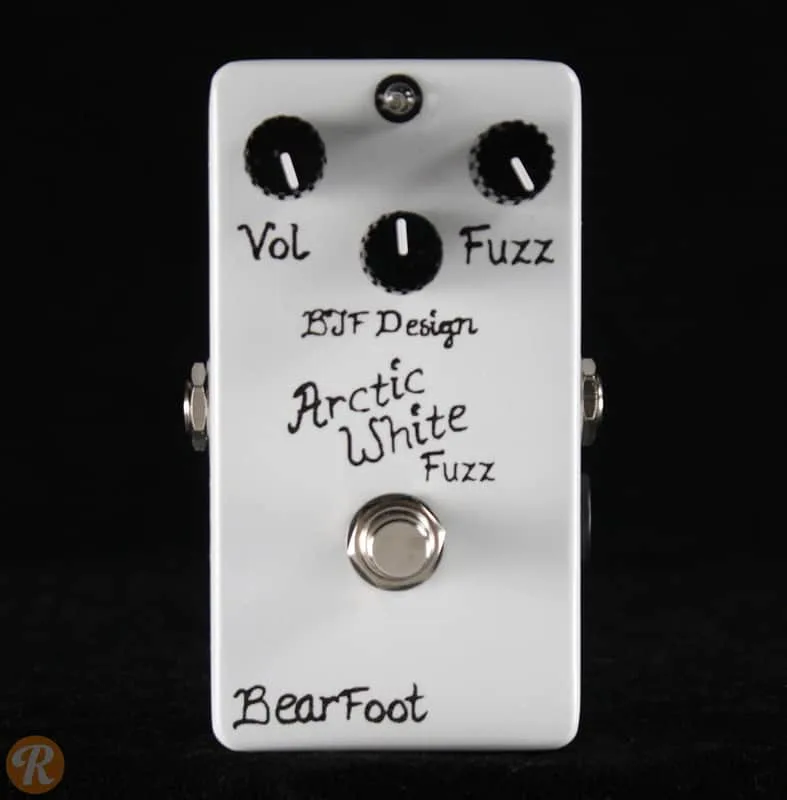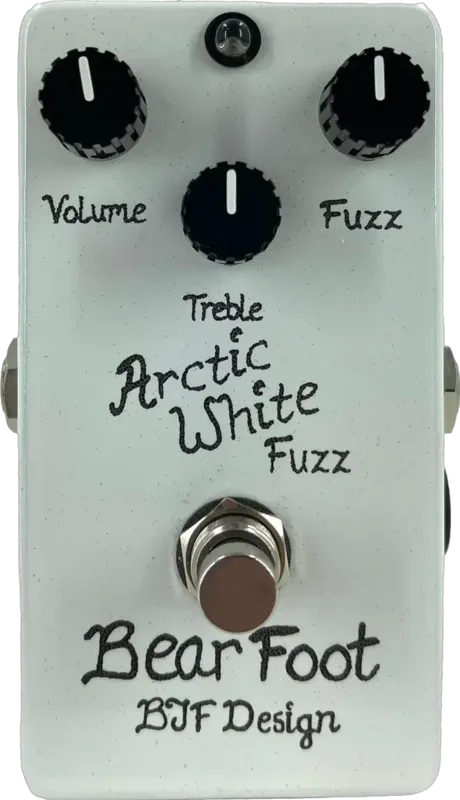


The BJFE/Bearfoot Arctic White Fuzz is a boutique fuzz pedal designed by Björn Juhl, the Swedish designer behind the BJFE and Bearfoot FX lines1. RockBoard's PedalPedia describes it as based on the classic silicon Fuzz Face circuit, with a Treble knob added for enhanced EQ versatility1. DIY builders who traced the schematic agree on the lineage: on Guitar FX Layouts, it is described as "nothing but a redone Fuzz Face, with even Q2 collector biased at 4.5v," rebuilt with a JFET in the second stage2.
The pedal's character, as described by those who have built or reviewed it, is vintage fuzz with its own personality. Guitar FX Layouts' writeup says it "purrrs like a snow leopard at lower levels and attacks with full vintage growl when pushed"2. Pedal of the Day's Mike B found it "able to get as dirty and gritty as you want, but never too over-the-top and out-of-control," and noted it plays well with both clean and dirty amp settings3.
The controls
The pedal carries three knobs. Guitar FX Layouts lists them as Volume Level, Fuzz Level and a Tone control, "with just the right amount of treble control to match the Arctic to your" guitar2. RockBoard's product page frames the third knob as a Treble control added for EQ versatility over the basic Fuzz Face formula1. Pedal of the Day found all three "easily adjustable to suit your tonal needs, with a nice range of sounds available"3.
| Control | What it does |
|---|---|
| Volume | Sets output level; the pedal has a very high output2 |
| Fuzz | Sets the amount of fuzz2 |
| Tone / Treble | Rolls off or opens up brightness to match the pedal to the guitar12 |
One builder's caveat on the tone control: "I have found that the tone pot doesn't have much range. Kind of less bright to really bright"2. The output level is worth knowing when dialing in: builders report the pedal has a ton of output, so a build with low output points to a misplaced component or a solder bridge2.
Power: 8-18V
The DIY community rates the circuit at 8 to 18V2, while RockBoard's product listing for the Bearfoot FX version specifies 9V DC center negative1. There is no charge pump inside: builders interpret the 8-18V rating as meaning an 18V supply can simply be used if you want it, with the original built using capacitors rated at 25V minimum2.
The bias point is around 4.5 volts at the JFET drain, set with a 9K1 drain resistor from the 9V supply. Builders troubleshooting a quiet or wrong-sounding build are told to start by replacing the 9K1 with a lower value resistor to bring the drain back toward that 4.5V target2.
Builder notes and common modifications
A stripboard layout for the pedal was published on Guitar FX Layouts in August 2013, drawn from a schematic provided by Matt, and verified by builder johnk, who reported it sounds great2. The verdict from the builders who finished it: "It's worth the time fiddling with it for the tone you get"2.
The parts list is short, and the specified transistors matter. Builders who used the J113 and BC550C got the intended result2. Substituting an MPF102 for the JFET works electronically, but the volume drops considerably, to roughly 25 percent of a J113 build, and the fuzz is not pleasing2. One builder's measured pin voltages on a bipolar transistor in the circuit came out at C:1.17, B:0.71, E:0.13 volts2.
Two build issues come up repeatedly:
- Hiss when engaged. One builder reported "a significant amount of hiss when engaged" with the guitar turned down or the input removed2. The traced cause is the wire to the fuzz 2 control, which sits under extremely high impedance from the 1M resistance between the input and the circuit, making it extremely microphonic in that position2.
- Fizz on some settings. The 100pF ceramic capacitor in the layout fails to filter out high-frequency noise2.
The fixes builders recommend:
- For the hiss, route the fuzz 2 wire "preferably with shielded wire or maybe some aluminum foil grounded from the enclosure and avoiding running other wires parallel to it"2.
- For the fizz, "just change the 100p ceramic cap to a 270p-330p and it'll sound great"2. Alternatives given are adding another 220pF capacitor in parallel, or any capacitor between 270pF and 370pF2. Builders who made the change report it "won't change the tone when it's good in any audible way but helps with fizz on some settings immensely"2.
One detail for builders copying the original: Björn Juhl always uses a zener diode as part of the LED circuit, but the layout omits it as unnecessary2.
Noise and recording
Despite the hiss some builds show, the pedal's reputation among builders is as an unusually quiet fuzz. Guitar FX Layouts' summary: "its a great recording fuzz as Bjorn wiped out the backround noise found in most fuzzes"2. Pedal of the Day's Mike B heard the family resemblance, writing that it "has an almost Fuzz Face quality to it"3.
"It's got an almost Fuzz Face quality to it"
Videos
Prymaxe
Brett Kingman
intheblues
Questions
Who designed the BJFE/Bearfoot Arctic White Fuzz?
The Arctic White Fuzz was designed by Björn Juhl, the Swedish designer behind BJFE and Bearfoot FX. RockBoard's PedalPedia describes him as a renowned effects pedal designer, and DIY builders on Guitar FX Layouts note that his pedals tend to excel at low to medium gain drive sounds.
What transistors does the Arctic White Fuzz use?
The circuit pairs a J113 JFET with a BC550C bipolar transistor. Builders who used these specified parts reported the layout working and sounding great. Substituting an MPF102 for the JFET works electronically but drops volume to roughly a quarter of the J113 build and the fuzz is not pleasing.
Is the Arctic White Fuzz quiet enough for recording?
Yes, by builder accounts. Commenters on Guitar FX Layouts say Björn Juhl wiped out the background noise found in most fuzzes, making it a great recording fuzz. Some builds still show hiss when engaged, which builders trace to the unshielded high-impedance wire to the fuzz control and fix with shielding.
How do you reduce fizz in an Arctic White Fuzz build?
The common fix is to change the 100pF ceramic capacitor. Builders recommend replacing it with a 270pF to 330pF part, or adding a second 220pF capacitor in parallel, or any capacitor between 270pF and 370pF. The change is not audible in the pedal's good tone but helps with fizz on some settings.
Sources (3)
- Arctic White Fuzz by BearFoot FX, RockBoard PedalPedia, 2026
- Guitar FX Layouts: BJFE / Bearfoot Arctic White Fuzz, Guitar FX Layouts (tagboardeffects.blogspot.com), 2013-08-19
- BearFoot FX Arctic White Fuzz, Pedal of the Day, 2014-09-12