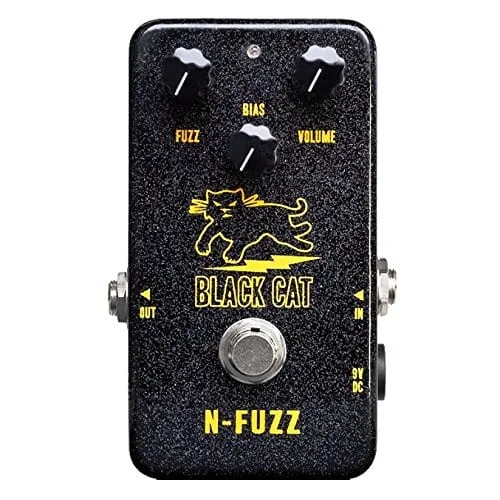


The Black Cat N-Fuzz is a fuzz pedal from Black Cat Pedals, announced in June 2015 as the latest legacy product from the original line created by Fred Bonte1. It is a hand-wired, boutique-quality pedal made in the USA, housed in a durable powder-coat "Holographic Sparkle" finish, and it carried a list price of $165.00 at announcement1.
The 2015 N-Fuzz is based on the Fuzz channel of the Black Cat OD-Fuzz1. Its history goes back further: the original N-Fuzz, designed by Fred Bonte and made in limited numbers between 2001 and 2003, was based on a modified Fuzz Face and sold only in the Asian market23.
The controls: one wide-ranging Bias knob
The defining control of the 2015 N-Fuzz is its Bias knob. Black Cat describes it as "an extra wide ranging Bias control that allows you to dial in a sweeping array of fuzz tones and timbres"1.
That knob is the main difference from the original. On the first N-Fuzz, a toggle switch selected between two fixed bias points, one High output and one Low output2. The redesign replaced that switch with a variable bias control pot. As the announcement put it:
"We replaced the toggle switch with a variable bias control pot. This control makes the new N-Fuzz much more versatile."2
For a player, this means the choice is no longer between two preset fuzz characters. Turning the Bias knob sweeps continuously across the range the old toggle only sampled at two points, which the maker says "allows the N-Fuzz to offer many different tones and timbres of fuzz"1.
| Version | Bias control | What it gives you |
|---|---|---|
| Original N-Fuzz (2001 to 2003) | Toggle switch, two fixed bias points | High output or Low output, nothing in between2 |
| 2015 N-Fuzz | Variable Bias knob | A continuous sweep of fuzz tones and timbres1 |
Circuit and transistors
Like the original, the new N-Fuzz uses N-Channel (NPN) transistors12. For the redesign, Black Cat settled on specific Japanese parts: a Toshiba 2SC1815 for Q1 and a Panasonic 2SC1384 for Q2, alongside premium Japanese transistors and capacitors1.
The move to Japanese components came out of discussions with the Japanese distributor about reintroducing the pedal to the Asian market. As Black Cat explained1:
"we decided to further redesign the N-Fuzz circuit to use Japanese electronic components"1
That redesign also changed what the name means. According to Fred Bonte, the letter N in the original name represented "N-Channel," describing the type of transistors used2. With the Japanese rebuild, the name took on a second meaning:
"This gave a new meaning to the name, which now stands for 'Nippon Fuzz.'"2
Where it came from
The N-Fuzz sits in Black Cat's legacy line. The original was designed by Fred Bonte, made in limited numbers between 2001 and 2003, and available only in the Asian market123. The 2015 version brought the circuit back with the Bias knob and Japanese components1.
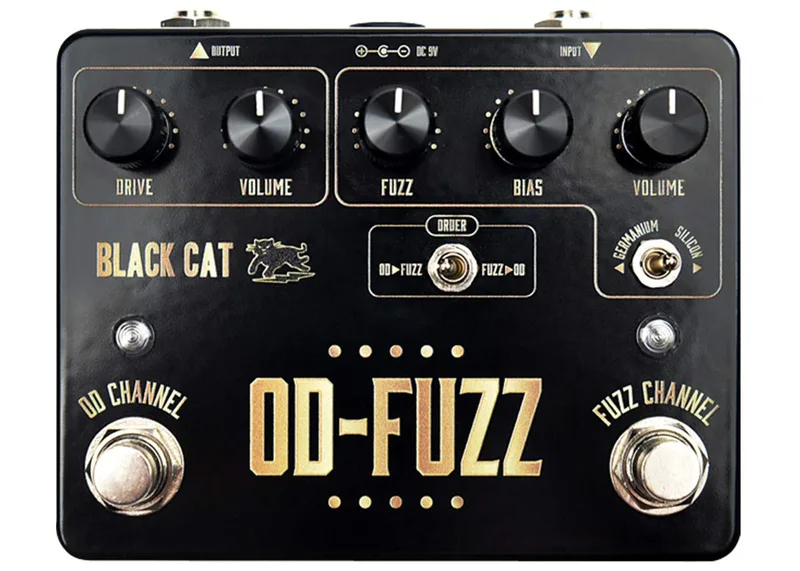
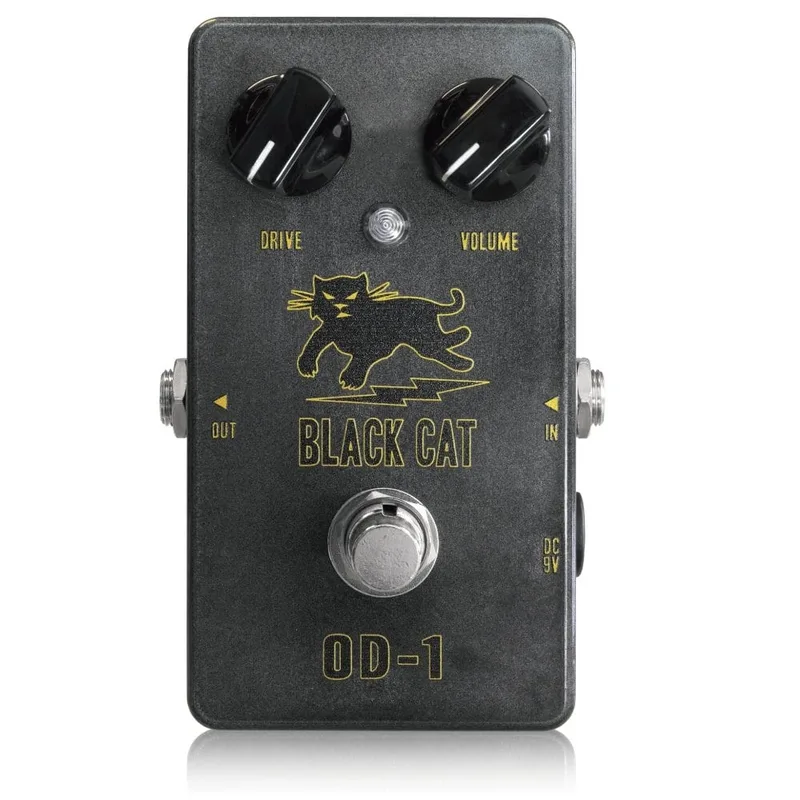
Its parent circuit also has a history. The Black Cat OD-Fuzz pairs the Black Cat OD-1 overdrive with a modified Fuzz Face-style circuit4, and the N-Fuzz takes its Fuzz channel as its own pedal1.
Power and bypass
The N-Fuzz uses a 2.1mm Boss style power jack or an internal 9V battery1. The Boss-style jack matches the center-negative 9V supplies most players already run, and the battery option means it works without a power supply at all.
Bypass is a 3PDT true-bypass switch with Switchcraft jacks, so the guitar signal passes around the circuit when the pedal is off1.
Videos
BlackCatPedals
BlackCatPedals
shnobel
Questions
Does the Black Cat N-Fuzz take a battery?
Yes. The N-Fuzz uses a 2.1mm Boss style power jack or an internal 9V battery, so it runs either way. The Boss-style jack means it works with the standard center-negative power supplies most pedalboards already use.
Is the Black Cat N-Fuzz true bypass?
Yes. The 2015 N-Fuzz is built with a 3PDT true-bypass switch and Switchcraft jacks, so the signal passes around the circuit when the pedal is off.
What transistors are in the Black Cat N-Fuzz?
The 2015 version uses N-Channel (NPN) transistors: a Toshiba 2SC1815 for Q1 and a Panasonic 2SC1384 for Q2, along with premium Japanese capacitors. The original N-Fuzz also used N-Channel transistors.
Is the N-Fuzz based on a Fuzz Face?
The original N-Fuzz circuit was based on a modified Fuzz Face. The 2015 N-Fuzz is based on the Fuzz channel of the Black Cat OD-Fuzz, which itself pairs the Black Cat OD-1 with a modified Fuzz Face-style circuit.
What does the N in N-Fuzz stand for?
On the original pedal, designer Fred Bonte said the N stood for N-Channel, the type of transistors used. After the 2015 redesign with Japanese components, the name took on a new meaning: Nippon Fuzz.
Where is the Black Cat N-Fuzz made?
The 2015 N-Fuzz is hand-wired in the USA by Black Cat Pedals, in a powder-coat Holographic Sparkle finish. The original version, made between 2001 and 2003, was built in limited numbers and sold only in the Asian market.
Sources (4)
- Black Cat Pedals Announces the N-Fuzz, Premier Guitar, 2015-06-16
- Black Cat Pedals Releases the N-Fuzz Based on the Fuzz Channel of the, Guitar Interactive Magazine, 2015-06-17
- New Pedals: Black Cat N-Fuzz, Delicious Audio, 2015-06-25
- NAMM 2017: Black Cat unveils OD-Fuzz Deluxe guitar effects pedal, MusicRadar, 2016-12-13