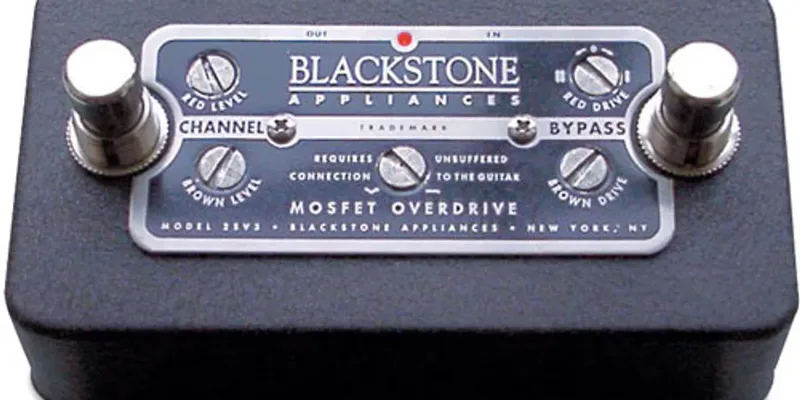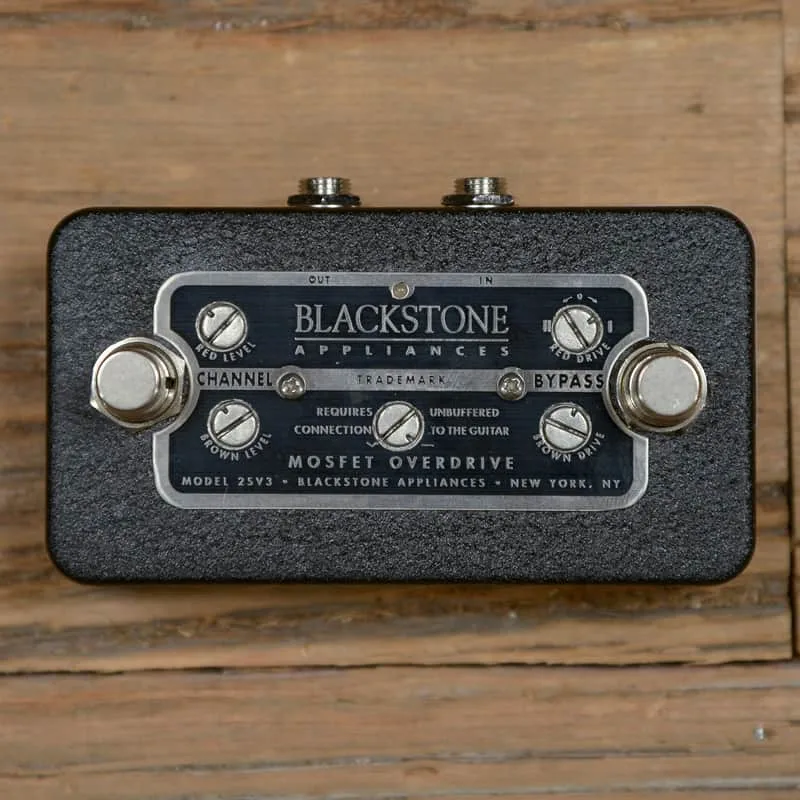


The Blackstone Appliances Mosfet Overdrive is a dual-channel overdrive pedal with two separate, footswitchable channels, each with its own adjustable gain stage, so you can select between them on the fly1. It is designed to go into a clean amp and control all of the distortion on its own, rather than pushing your amp into breakup territory1. Guitar.com's Richard Purvis has called it "something of a stompbox legend," with a list price of $260 as of August 20262.
The pedal reviewed by Premier Guitar in September 2026 was the Mosfet Overdrive 2S version3.
Two overdrive channels built for a clean amp
The Mosfet Overdrive is a dual channel overdrive derived from a single circuit. Rather than doubling up on the parts, channel switching is done by swapping between two sets of volume and drive controls with a shared tone control4. The design shares some passing familiarity with other CD4049-based overdrives like the Tube Sound Fuzz (Red Llama), EHX Hot Tubes, ROG Double D and Mark Hammer's Forty-Niner4.
The concept is unusual among overdrives: instead of using the pedal to push an already-breaking-up amp, the Blackstone is meant to supply all the grit itself into a clean platform1. Blackstone also maintains that the circuit avoids intermodulation and fizzy high-order harmonics in the same manner as vintage amps3.
The circuit interacts with the inductance of your guitar's pickups, translating playing dynamics into changes in waveform distortion, in the way some vintage fuzz pedals do3. Premier Guitar's reviewer found the pedal very dynamic in this respect: at the Brown channel's moderate-drive setting, it cleaned up completely when backing off the guitar volume. On feel, the reviewer noted it is not as saggy as some overdrives and amps, but it "gives" enough to let you feel natural playing it3.
The controls and internal trimpots
Each channel has a Level control on the left and a Drive adjustment on the right3. A center control adjusts the midrange tones, with a flat EQ to the right, or decreased mids for more gain when dialed counterclockwise1.
| Control | What it does |
|---|---|
| Level (each channel) | Sets the output volume for that channel3 |
| Drive (each channel) | Sets the gain for that channel3 |
| Center midrange control | Flat EQ to the right; counterclockwise decreases mids for more gain1 |
| Red Drive, clockwise | Adds midrange girth to single-coils3 |
| Red Drive, counterclockwise | Reduces bass and emphasizes higher frequencies, keeping humbuckers from getting muddy3 |
| Brown Drive, clockwise | Boosts drive from a mild grit to a fat roar3 |
| "Gn2" trimpot (internal) | Adjusts the gain output1 |
| "Trbl" trimpot (internal) | Adjusts the high-end frequencies1 |
Inside the pedal, a jeweler's screwdriver can be used to simultaneously adjust Gain and Treble settings for the second stage of both channels3. Removing the backplate also reveals the 9-volt battery and a small switch that converts the pedal from unbuffered to buffered3.
The bypass is selectable, not fixed: an internal switch chooses between true bypass and buffered modes1. In buffered mode the pedal can sit anywhere in your pedal chain with clear and precise sonic results1.
The Red and Brown channels
Both channels, the Brown and the Red, are the same circuit, except that the Red Channel is divided into two different drive ranges: one to thicken up single-coil pickups, the other to tighten up the bass for humbuckers1. Blackstone recommends clockwise on the Red Drive for single-coils and counterclockwise for humbucker-equipped instruments3.
Channel 1 also has two different drive settings: counterclockwise is more mids focused and clockwise is fatter, with the center position being the point of lowest gain4.
One practical quirk noted in review: the channel LED appears more orange than brown in Brown mode, and at some angles a red tinge can be confusing at first glance. In Red mode the light is bright red with no confusion3.
What reviewers said
Premier Guitar's reviewer found the pedal covers a wide range, from classic rock crunch at tamer settings to, with the Drive maxed out, "balls-to-the-wall distortion, bordering on fuzz with tons of singing sustain"3. Plugging in a Fernandes Tele-style guitar pushed the drive a little harder and sounded more Robben Ford-ish3. Trying the single-coil setting maxed out with humbuckers, the reviewer discovered a great woolly, Big Muff tone3.
"A truly unique dual overdrive pedal, with a ton of options and funky controls"
Pedal of the Day's Mike B called the pedal extremely popular among the players who actually know about it, and said it produces excellent distortion and drive tones while remaining very dynamic in regards to each player's individual techniques1. The same feature names Billy Gibbons among the incredible guitar players who use it1.
On buying advice, Premier Guitar's verdict was to buy it if you want an extremely musical, articulate overdrive pedal, and to skip it if you seek a saggier, amp-style sound3.
Videos
gearmanndude
Joe Perkins
echodeluxe
Questions
Is the Blackstone Mosfet Overdrive true bypass or buffered?
It can be either. Inside the pedal, behind the backplate, a small switch converts it from unbuffered (true bypass) to buffered operation. The buffered mode lets you place the pedal anywhere in your chain with clear, precise results, and the factory settings are recommended as a starting point.
What is the difference between the Red and Brown channels?
Both channels are the same circuit, except the Red Channel is divided into two different drive ranges: one to thicken up single-coil pickups, the other to tighten up the bass for humbuckers. The Brown Channel runs from a mild grit to a fat roar and still cleans up when you lower your guitar volume.
Which Red Channel setting suits humbuckers?
Blackstone recommends turning the Red Drive control counterclockwise for humbucker-equipped instruments. That direction reduces bass and emphasizes higher frequencies, preventing humbuckers from getting muddy. Clockwise is recommended for single-coils, and adds midrange girth.
Does Billy Gibbons use a Blackstone Mosfet Overdrive?
Yes. Pedal of the Day named Billy Gibbons among the incredible guitar players who use the Blackstone Mosfet Overdrive, and the pedal has been described as extremely popular among the players who actually know about it.
Sources (4)
- Blackstone Appliances Mosfet Overdrive, Pedal of the Day, 2016-03-27
- RhPf Electronics Mosphoros review, Guitar.com, 2026-08-19
- Blackstone Appliances Mosfet Overdrive 2S Pedal Review, Premier Guitar, 2010-04-15
- Mysterioso24.pdf, madbeanpedals.com, 2024-08-18